|
|
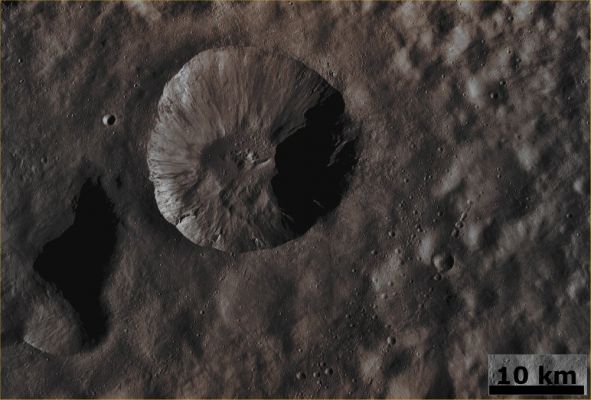
Unnamed Crater in Floronia Quadrant (Absolute Natural Colors; credits for the additional process. and color.: Dr Paolo C. Fienga - Lunexit Team)
|
This Dawn FC (framing camera) image is dominated by an approx. 20 Km-wide, young, fresh Unnamed Impact Crater. Surrounding this Unnamed Crater is its Ejecta Blanket, which is a covering of small particles that were thrown out during the impact that formed it and the Ejecta Blanket is the cause of the smooth Surface visible all around the Crater itself. This Ejecta Blanket buried many older, degraded craters, but some of them can be seen poking through the Blanket. Old and degraded craters are less clear or not visible directly next to the Unnamed Crater dominating the frame and this suggests that its Ejecta Blanket is very thick and fit to bury almost all the other (relatively small) impact craters located next to the bigger one.
There are also several distinctive Chains of small Craters running obliquely across the image on top of the Ejecta Blanket. They were not buried by the Ejecta Blanket and this means that they must be younger than it. These Crater Chains likely formed due to Secondary Impacts, when material thrown out of previous impacts re-impacted Vesta. Similarly, material ejected from the Unnamed approx. 20 Km-wide Crater has fallen back into the Crater itself and created several Pit-like features on its Floor.
This image is in Vesta's Floronia Quadrangle and the center latitude and longitude of the image is 32,5° North and 1,2° East. NASA's Dawn Spacecraft obtained this image with its framing camera on October 24th, 2011. This image was taken through the camera's clear filter. The distance to the Surface of 4-Vesta is 662 Km and the image has a resolution of about 62 meters per pixel. This image was acquired during the HAMO (High Altitude Mapping Orbit) phase of the mission.
|
|