Inizio Registrati Login

Elenco album Ultimi arrivi Ultimi commenti Più viste Più votate Preferiti Cerca

Inizio > SOLAR SYSTEM > 1-Ceres and 4-Vesta
Ritorna alla pagina delle miniature FILE 52/55 Torna all'inizio Guarda foto precedente Guarda foto successiva Salta alla fine
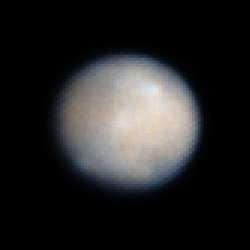
1-Ceres (natural colors, from HST - credits: NASA/ESA et al.)
The Hubble image of Ceres on the reveals bright and dark regions on the asteroid's surface that could be topographic features, such as craters, and/or areas containing different surface material. Large impacts may have caused some of these features and potentially added new material to the landscape. The Texas-sized asteroid holds about 30 to 40% of the mass in the Asteroid Belt.
Ceres' round shape suggests that its interior is layered like those of terrestrial planets such as Earth. The asteroid may have a rocky inner core, an icy mantle, and a thin, dusty outer crust. The asteroid may even have water locked beneath its surface. It is approx. 590 miles (950 Km) across and was the first asteroid discovered in 1801.
The observation was made in visible and ultraviolet light between December 2003 and January 2004 with the HST Advanced Camera for Surveys. The color variations in the image show either a difference in texture or composition on Ceres' surface. 

Astronomers need the close-up views of the Dawn spacecraft to determine the characteristics of these regional differences.

Parole chiave: From Space Images - Hubble Space Telescope - 1-Ceres

1-Ceres (natural colors, from HST - credits: NASA/ESA et al.)

The Hubble image of Ceres on the reveals bright and dark regions on the asteroid's surface that could be topographic features, such as craters, and/or areas containing different surface material. Large impacts may have caused some of these features and potentially added new material to the landscape. The Texas-sized asteroid holds about 30 to 40% of the mass in the Asteroid Belt.
Ceres' round shape suggests that its interior is layered like those of terrestrial planets such as Earth. The asteroid may have a rocky inner core, an icy mantle, and a thin, dusty outer crust. The asteroid may even have water locked beneath its surface. It is approx. 590 miles (950 Km) across and was the first asteroid discovered in 1801.
The observation was made in visible and ultraviolet light between December 2003 and January 2004 with the HST Advanced Camera for Surveys. The color variations in the image show either a difference in texture or composition on Ceres' surface.

Astronomers need the close-up views of the Dawn spacecraft to determine the characteristics of these regional differences.

006-Ceres.jpg 004-Ceres.jpg 021-Vesta-2.jpg 099-DawnTrajectory.jpg 007-Ceres-PIA10235.jpg
Informazioni sul file
Nome del file:006-Ceres.jpg
Nome album:MareKromium / 1-Ceres and 4-Vesta
Valutazione (7 voti):55555(Mostra dettagli)
Parole chiave:From / Space / Images / - / Hubble / Space / Telescope / - / 1-Ceres
Copyright:NASA, ESA and J. Parker (Southwest Research Institute)
Dimensione del file:51 KiB
Data di inserimento:Giu 29, 2007
Dimensioni:250 x 250 pixels
Visualizzato:59 volte
URL:https://www.lunexit.it/gallery/displayimage.php?pid=17300
Preferiti:Aggiungi ai preferiti


Powered by Coppermine Photo Gallery