Inizio Registrati Login

Elenco album Ultimi arrivi Ultimi commenti Più viste Più votate Preferiti Cerca

Inizio > MARS > Mars Reconnaissance Orbiter (MRO)
Ritorna alla pagina delle miniature FILE 1153/2237 Torna all'inizio Guarda foto precedente Guarda foto successiva Salta alla fine
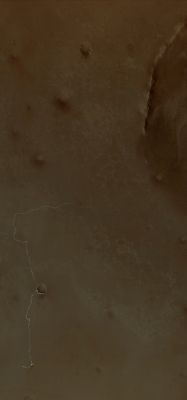
Opportunity's "Martian Traverse" through Sol 2442 (Natural Colors; credits for the additional process. and color.: Dr Paolo C. Fienga - Lunexit Team)
The white line on this map shows where NASA's Mars Rover Opportunity has driven from the place where it landed in January 2004 - inside Eagle Crater, at the lower left end of the track - to where it reached on the 2442nd Martian Day, or Sol, of its work on Mars (such as December 6, 2010). 
The map covers an area about 14 Km (approx. 8,7 miles) wide. 
South is at the top. 

An Eastward drive of 124 meters (405 feet) on Sol 2442 brought Opportunity to within about 550 meters (1800 feet) of Santa Maria Crater. 
Santa Maria, with a diameter about of about 90 meters (295 feet), is nearly as big as Endurance Crater, which Opportunity entered and explored from June to December 2004.
The Sol 2442 drive brought Opportunity's Total Odometry to 25,92 Km (such as 16,11 miles). The long-term destination of the Mission since mid-2008 has been Endeavour Crater, still more than 6 Km (about 3,7 miles) away. The western edge of Endeavour appears in the upper right, including Ridges that are part of the Crater's eroded Rim. This Crater is about 22 Km (approx. 14 miles) in diameter, dwarfing the largest crater that Opportunity has visited so far, Victoria, which is about 800 meters (approx. half a mile) in diameter. Opportunity explored the Rim and interior of Victoria from mid-2006 to mid-2008.

The base map for this traverse map is a mosaic combining images from the High Resolution Imaging Science Experiment camera and the Context Camera, both on NASA's Mars Reconnaissance Orbiter. It is used by Tim Parker of NASA's Jet Propulsion Laboratory, Pasadena, for mapping each of Opportunity's drives based on images taken by the rover after the drive.
Opportunity completed its three-month prime mission in April 2004 and has continued operations in extended missions since then. JPL, a division of the California Institute of Technology in Pasadena, manages the Mars Exploration Rover Project for the NASA Science Mission Directorate, Washington. The University of Arizona, Tucson, operates the High Resolution Imaging Science Experiment. Malin Space Science Systems, San Diego, operates the Context Camera.
Parole chiave: Mars from orbit - Meridiani Planum

Opportunity's "Martian Traverse" through Sol 2442 (Natural Colors; credits for the additional process. and color.: Dr Paolo C. Fienga - Lunexit Team)

The white line on this map shows where NASA's Mars Rover Opportunity has driven from the place where it landed in January 2004 - inside Eagle Crater, at the lower left end of the track - to where it reached on the 2442nd Martian Day, or Sol, of its work on Mars (such as December 6, 2010).
The map covers an area about 14 Km (approx. 8,7 miles) wide.
South is at the top.

An Eastward drive of 124 meters (405 feet) on Sol 2442 brought Opportunity to within about 550 meters (1800 feet) of Santa Maria Crater.
Santa Maria, with a diameter about of about 90 meters (295 feet), is nearly as big as Endurance Crater, which Opportunity entered and explored from June to December 2004.
The Sol 2442 drive brought Opportunity's Total Odometry to 25,92 Km (such as 16,11 miles). The long-term destination of the Mission since mid-2008 has been Endeavour Crater, still more than 6 Km (about 3,7 miles) away. The western edge of Endeavour appears in the upper right, including Ridges that are part of the Crater's eroded Rim. This Crater is about 22 Km (approx. 14 miles) in diameter, dwarfing the largest crater that Opportunity has visited so far, Victoria, which is about 800 meters (approx. half a mile) in diameter. Opportunity explored the Rim and interior of Victoria from mid-2006 to mid-2008.

The base map for this traverse map is a mosaic combining images from the High Resolution Imaging Science Experiment camera and the Context Camera, both on NASA's Mars Reconnaissance Orbiter. It is used by Tim Parker of NASA's Jet Propulsion Laboratory, Pasadena, for mapping each of Opportunity's drives based on images taken by the rover after the drive.
Opportunity completed its three-month prime mission in April 2004 and has continued operations in extended missions since then. JPL, a division of the California Institute of Technology in Pasadena, manages the Mars Exploration Rover Project for the NASA Science Mission Directorate, Washington. The University of Arizona, Tucson, operates the High Resolution Imaging Science Experiment. Malin Space Science Systems, San Diego, operates the Context Camera.

PSP_004412_1715_RED_abrowse-PCF-LXTT.jpg PSP_004026_1765_RED_abrowse-10-MF-PCF-LXTT.jpg PSP_004804_1105_RED_abrowse.jpg PSP_006561_2485_RED_abrowse.jpg North_Polar_Layers-PSP_001332_2620_RED.jpg
Informazioni sul file
Nome del file:Meridiani_Planum-PIA13598-PCF-LXTT.jpg
Nome album:MareKromium / Mars Reconnaissance Orbiter (MRO)
Valutazione (2 voti):55555(Mostra dettagli)
Parole chiave:Mars / from / orbit / - / Meridiani / Planum
Copyright:NASA/JPL-Caltech and Paolo C. Fienga/Lunexit Team per l'additional process. e la colorizzazione
Dimensione del file:549 KiB
Data di inserimento:Dic 13, 2010
Dimensioni:1686 x 3600 pixels
Visualizzato:71 volte
URL:https://www.lunexit.it/gallery/displayimage.php?pid=27977
Preferiti:Aggiungi ai preferiti


Powered by Coppermine Photo Gallery