Inizio Registrati Login

Elenco album Ultimi arrivi Ultimi commenti Più viste Più votate Preferiti Cerca

Inizio > MARS > Mars Reconnaissance Orbiter (MRO)
Ritorna alla pagina delle miniature FILE 2236/2237 Torna all'inizio Guarda foto precedente Guarda foto successiva Salta alla fine
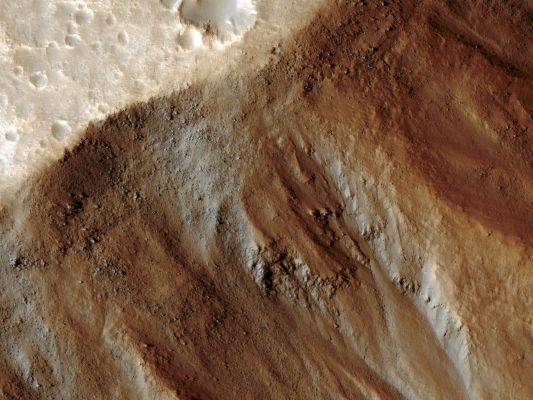
Features of Kasei Valles (EDM - Saturated Natural Colors; credits for the additional process. and color.: Dr Paolo C. Fienga - Lunexit Team)
This observation from NASA's Mars Reconnaissance Orbiter (MRO) shows the very steep side of a Plateau, part of the Northern Limit of the Kasei Valles System, which is one of the largest Outflow Channel Systems on Mars. The difference in elevation here between the mostly flat Channel's Floor (bottom right) and the top of the Plateau (top left) is over 1300 meters (about 0,8 miles), comparable in height to the Grand Canyon Walls. The Kasei Valles System is much wider than the Grand Canyon, though, getting to be in places approx. 500 Km (such as about 300 miles) wide. (The Grand Canyon's maximum width is approx. 30 Km, or about 18 miles).

This EDM shows numerous paths with the appearance of dotted lines, criss-crossing the steep side of the Plateau. The carving agents can be found at the end of some of these paths: rocky blocks such as the ones in this subset, up to 2 meters (2,2 yards) across (4 meters or 4,4 yards across elsewhere in the image). Some of these blocks traveled downhill several hundred meters (yards) as they rolled and bounced leaving behind a trail of indentations or poke marks in the surface's fine-grained, light-toned soils. The raised borders in some of these poke marks indicate they are relatively recent features, unaffected by wind erosion, or that this soil has cohesive properties, such as if it was cemented.

The sound of these blocks falling did not travel very far, though. According to computer simulations sound in Mars travels only 1,5% (per-cent) the distance it would travel on Earth. (No Martian sound has ever been officially recorded) Hence, the same sound which would travel one Km (0,6 miles) on Earth, would travel only 15 meters (16 yards) on Mars. This is due to the lower Martian Atmospheric Pressure, which is approximately 1% of that of the Earth.
Parole chiave: Mars from orbit - Kasei Valles

Features of Kasei Valles (EDM - Saturated Natural Colors; credits for the additional process. and color.: Dr Paolo C. Fienga - Lunexit Team)

This observation from NASA's Mars Reconnaissance Orbiter (MRO) shows the very steep side of a Plateau, part of the Northern Limit of the Kasei Valles System, which is one of the largest Outflow Channel Systems on Mars. The difference in elevation here between the mostly flat Channel's Floor (bottom right) and the top of the Plateau (top left) is over 1300 meters (about 0,8 miles), comparable in height to the Grand Canyon Walls. The Kasei Valles System is much wider than the Grand Canyon, though, getting to be in places approx. 500 Km (such as about 300 miles) wide. (The Grand Canyon's maximum width is approx. 30 Km, or about 18 miles).

This EDM shows numerous paths with the appearance of dotted lines, criss-crossing the steep side of the Plateau. The carving agents can be found at the end of some of these paths: rocky blocks such as the ones in this subset, up to 2 meters (2,2 yards) across (4 meters or 4,4 yards across elsewhere in the image). Some of these blocks traveled downhill several hundred meters (yards) as they rolled and bounced leaving behind a trail of indentations or poke marks in the surface's fine-grained, light-toned soils. The raised borders in some of these poke marks indicate they are relatively recent features, unaffected by wind erosion, or that this soil has cohesive properties, such as if it was cemented.

The sound of these blocks falling did not travel very far, though. According to computer simulations sound in Mars travels only 1,5% (per-cent) the distance it would travel on Earth. (No Martian sound has ever been officially recorded) Hence, the same sound which would travel one Km (0,6 miles) on Earth, would travel only 15 meters (16 yards) on Mars. This is due to the lower Martian Atmospheric Pressure, which is approximately 1% of that of the Earth.

PSP_006714_2255_RED_abrowse.jpg PSP_003520_1010_RED_abrowse-00.jpg PIA11230.jpg PSP_001510_2195_RED_abrowse.jpg PSP_002922_1725_RED_abrowse-01.jpg
Informazioni sul file
Nome del file:Kasei_Valles-PIA13265.jpg
Nome album:MareKromium / Mars Reconnaissance Orbiter (MRO)
Valutazione (4 voti):55555(Mostra dettagli)
Parole chiave:Mars / from / orbit / - / Kasei / Valles
Copyright:NASA/JPL/Univ. of Arizona and Paolo C. Fienga/Lunexit Team per l'additional process. e la colorizzazione
Dimensione del file:1210 KiB
Data di inserimento:Lug 15, 2010
Dimensioni:2560 x 1920 pixels
Visualizzato:54 volte
URL:https://www.lunexit.it/gallery/displayimage.php?pid=27109
Preferiti:Aggiungi ai preferiti


Powered by Coppermine Photo Gallery