Inizio Registrati Login

Elenco album Ultimi arrivi Ultimi commenti Più viste Più votate Preferiti Cerca

Inizio > MARS > Mars Reconnaissance Orbiter (MRO)
Ritorna alla pagina delle miniature FILE 2228/2237 Torna all'inizio Guarda foto precedente Guarda foto successiva Salta alla fine
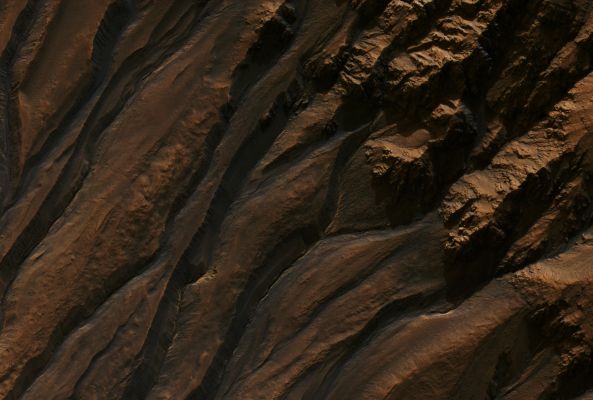
Gullies near Gorgonum Chaos (edm - Natural Colors; credits: Dr M. Faccin)
PSP_003583_1425 shows incredible details of an Unnamed Crater with Gullies that provides strong evidence for gully formation involving fluid flow.
Of note is the variety of gully morphologies along the crater walls. The North and West Walls have Gullies, while the South Wall has only Landslides. 
"Mass Wasting" is the more general term geologists use to describe Landslides, slumps, and other movements of the ground in response to gravity. It usually occurs on steep slopes when the force of gravity causes weak or loose material to travel downslope. Mass Wasting produces structures that are sometimes similar to gully channels, but which can usually be distinguished by their occurrence on steep slopes.

The Gullies on the North Wall have eroded all the way to the Crater Rim. They appear older than other nearby Gullies because they have existed long enough to be modified by permafrost processes as evidenced by the polgyonal fractures found on some of the channel and inter-gully walls. 
Another noticeable difference among the gullies is channel lengths. The Gullies on the North Wall and the group just to the left of these have much shorter channels than the Gullies on the North-Western Wall. It is possible that the Gullies with shorter channels had less fluid flow through their systems. The Gullies appear to originate around a sequence of rocky layers near the Crater Rim.

Many of the gully channels appear to have boulders littered throughout. This is suggestive of a fluid flowing in these channels; a fluid would preferentially transport smaller particles and leave behind the larger ones, such as the boulders seen here. 
There are many overprinted small channels in each gully, as can be seen in this edm. These are indicative of multiple flow events such that some channels experience flow, then are abandoned. 
The edm also shows several channels merging. 
Particularly interesting is the channel flowing from the top of the scene. There are several intertwining channels that merge into one just to the right of the center of the subimage. However, the way some channels truncate others suggests that there were at least three episodes of flow through this area. (written by Kerry Kolb)
Parole chiave: Mars from orbit - Craters - Unnamed Crater with Gullies

Gullies near Gorgonum Chaos (edm - Natural Colors; credits: Dr M. Faccin)

PSP_003583_1425 shows incredible details of an Unnamed Crater with Gullies that provides strong evidence for gully formation involving fluid flow.
Of note is the variety of gully morphologies along the crater walls. The North and West Walls have Gullies, while the South Wall has only Landslides.
"Mass Wasting" is the more general term geologists use to describe Landslides, slumps, and other movements of the ground in response to gravity. It usually occurs on steep slopes when the force of gravity causes weak or loose material to travel downslope. Mass Wasting produces structures that are sometimes similar to gully channels, but which can usually be distinguished by their occurrence on steep slopes.

The Gullies on the North Wall have eroded all the way to the Crater Rim. They appear older than other nearby Gullies because they have existed long enough to be modified by permafrost processes as evidenced by the polgyonal fractures found on some of the channel and inter-gully walls.
Another noticeable difference among the gullies is channel lengths. The Gullies on the North Wall and the group just to the left of these have much shorter channels than the Gullies on the North-Western Wall. It is possible that the Gullies with shorter channels had less fluid flow through their systems. The Gullies appear to originate around a sequence of rocky layers near the Crater Rim.

Many of the gully channels appear to have boulders littered throughout. This is suggestive of a fluid flowing in these channels; a fluid would preferentially transport smaller particles and leave behind the larger ones, such as the boulders seen here.
There are many overprinted small channels in each gully, as can be seen in this edm. These are indicative of multiple flow events such that some channels experience flow, then are abandoned.
The edm also shows several channels merging.
Particularly interesting is the channel flowing from the top of the scene. There are several intertwining channels that merge into one just to the right of the center of the subimage. However, the way some channels truncate others suggests that there were at least three episodes of flow through this area. (written by Kerry Kolb)

PSP_001513_1655_RED_abrowse-01.jpg PSP_003492_1405_RED_abrowse~0.jpg PSP_003608_1510_RED_abrowse-01.jpg PSP_005609_1470_RED_abrowse-00.jpg PSP_002066_1425_RED_browse-01~0.jpg
Informazioni sul file
Nome del file:PSP_003583_1425_RED_browse-02.jpg
Nome album:MareKromium / Mars Reconnaissance Orbiter (MRO)
Valutazione (5 voti):55555(Mostra dettagli)
Parole chiave:Mars / from / orbit / - / Craters / - / Unnamed / Crater / with / Gullies
Copyright:NASA/JPL/Univ. of Arizona, Marco Faccin e Lunar Explorer Italia per il processing addizionale e la colorizzazione
Dimensione del file:1554 KiB
Data di inserimento:Giu 30, 2009
Dimensioni:3944 x 2659 pixels
Visualizzato:54 volte
URL:https://www.lunexit.it/gallery/displayimage.php?pid=24785
Preferiti:Aggiungi ai preferiti


Powered by Coppermine Photo Gallery