Inizio Registrati Login

Elenco album Ultimi arrivi Ultimi commenti Più viste Più votate Preferiti Cerca

Inizio > MARS > Mars Reconnaissance Orbiter (MRO)
Ritorna alla pagina delle miniature FILE 2193/2237 Torna all'inizio Guarda foto precedente Guarda foto successiva Salta alla fine
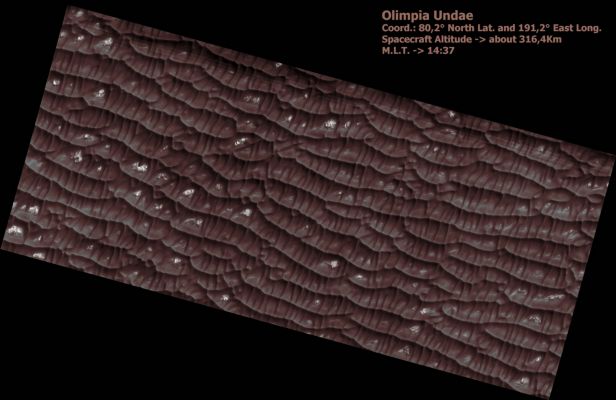
The Dunes of Olympia Undae (MULTISPECTRUM; credits: Lunexit)
This HiRISE image shows dark dunes and light polygonal terrain in Olympia Undae, also known as the North Polar Erg.
Two sets of dunes are obvious. The major set trends ~North-South, indicating winds from the East or West. Between the crests of these dunes is a second set oriented mostly East-West.
Zooming in on the dunes, a rippled texture is apparent, probably due to redistribution of sand at the scale of meters and less. Near the crests of some dunes are channel-like features, with some branching downslope. 
The origin of these channels is unknown, but they may result from the flow and displacement of sand that was fluidized by sublimating CO2 or water frost.
Bright patches of ground are found in some inter-dune areas, with many having a polygonal texture. Polygons on Earth form from contraction induced by stresses from dehydration, cooling, and other processes, so these features may have a similar origin. 

The CRISM instrument on MRO and OMEGA on Mars Express indicates that many dunes in Olympia Undae are rich in the mineral gypsum. 
Parole chiave: Mars from orbit - Dunes - Olympia Undae Region

The Dunes of Olympia Undae (MULTISPECTRUM; credits: Lunexit)

This HiRISE image shows dark dunes and light polygonal terrain in Olympia Undae, also known as the North Polar Erg.
Two sets of dunes are obvious. The major set trends ~North-South, indicating winds from the East or West. Between the crests of these dunes is a second set oriented mostly East-West.
Zooming in on the dunes, a rippled texture is apparent, probably due to redistribution of sand at the scale of meters and less. Near the crests of some dunes are channel-like features, with some branching downslope.
The origin of these channels is unknown, but they may result from the flow and displacement of sand that was fluidized by sublimating CO2 or water frost.
Bright patches of ground are found in some inter-dune areas, with many having a polygonal texture. Polygons on Earth form from contraction induced by stresses from dehydration, cooling, and other processes, so these features may have a similar origin.

The CRISM instrument on MRO and OMEGA on Mars Express indicates that many dunes in Olympia Undae are rich in the mineral gypsum.

PSP_007673_2575_RED_abrowse.jpg PSP_008585_2915_.jpg PSP_008591_2485_cut_b.jpg PSP_006237_1460_RED_abrowse.jpg PSP_006006_1715_RED_abrowse.jpg
Informazioni sul file
Nome del file:Psp_001736_2605_red.jpg
Nome album:MareKromium / Mars Reconnaissance Orbiter (MRO)
Valutazione (5 voti):55555(Mostra dettagli)
Parole chiave:Mars / from / orbit / - / Dunes / - / Olympia / Undae / Region
Copyright:NASA/JPL/University of Arizona e Lunar Explorer Italia per la colorizzazione del frame
Dimensione del file:461 KiB
Data di inserimento:Giu 10, 2008
Dimensioni:3156 x 2048 pixels
Visualizzato:55 volte
URL:https://www.lunexit.it/gallery/displayimage.php?pid=20669
Preferiti:Aggiungi ai preferiti


Powered by Coppermine Photo Gallery