Inizio Registrati Login

Elenco album Ultimi arrivi Ultimi commenti Più viste Più votate Preferiti Cerca

Inizio > MARS > Mars Reconnaissance Orbiter (MRO)
Ritorna alla pagina delle miniature FILE 2176/2237 Torna all'inizio Guarda foto precedente Guarda foto successiva Salta alla fine
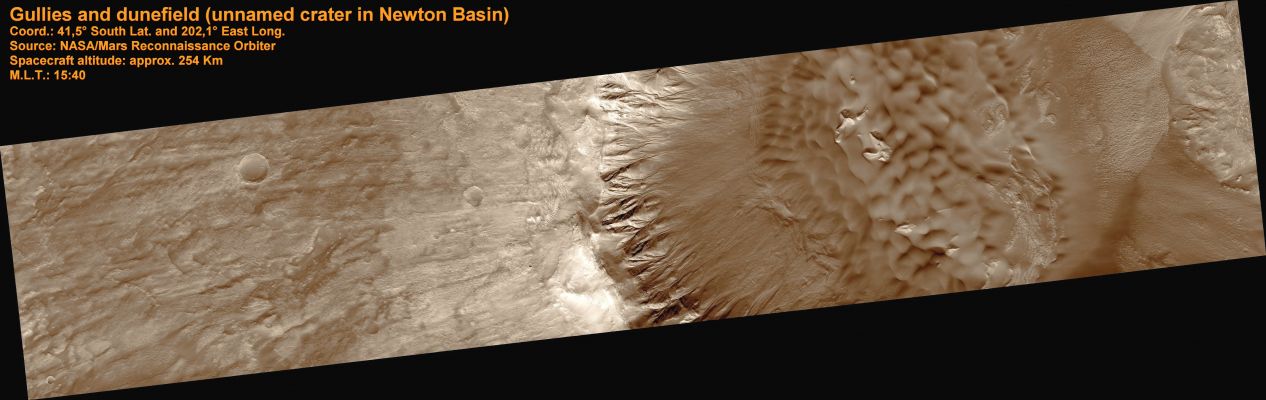
Gullies and Dunes in a Crater in Newton Basin (context image)
This frame shows gullies associated with distinct layers located at multiple elevations along one crater wall as well as multiple generations of dunes that are eroding or covering a more coherent rock structure. The gullies in this crater appear to originate at the layers that cover a large extent of the slope. Gullies can be seen emanating from layers in two distinct sets, each at a different elevation. Gullies are often, but not always, form near layers. 

Many of the gullies seen here have sinuous, or wavy, channels. 
The bends are called meanders and, on Earth, meanders form in streams that have sustained and/or repeated flow. Not all of the gullies seen in this image extend the same distance downslope. This could result from differences in water supply, sediment supply, slope angle, and time of formation, among other factors.
Dunes are also visible in this image; they indicate the prevailing wind direction. 

What is particularly interesting about this dune field is that there is exposed rock in the middle of it. This rock is either being exposed as the wind moves the dunes away from it or it is being covered. The dunes appear to outline the shape of the rock, which suggests that the rock has been uncovered long enough for dunes to form around it. 

As the dunes shift over time, they will probably expose more of the underlying rock.
Parole chiave: Mars from orbit - Gullies and dune-field

Gullies and Dunes in a Crater in Newton Basin (context image)

This frame shows gullies associated with distinct layers located at multiple elevations along one crater wall as well as multiple generations of dunes that are eroding or covering a more coherent rock structure. The gullies in this crater appear to originate at the layers that cover a large extent of the slope. Gullies can be seen emanating from layers in two distinct sets, each at a different elevation. Gullies are often, but not always, form near layers.

Many of the gullies seen here have sinuous, or wavy, channels.
The bends are called meanders and, on Earth, meanders form in streams that have sustained and/or repeated flow. Not all of the gullies seen in this image extend the same distance downslope. This could result from differences in water supply, sediment supply, slope angle, and time of formation, among other factors.
Dunes are also visible in this image; they indicate the prevailing wind direction.

What is particularly interesting about this dune field is that there is exposed rock in the middle of it. This rock is either being exposed as the wind moves the dunes away from it or it is being covered. The dunes appear to outline the shape of the rock, which suggests that the rock has been uncovered long enough for dunes to form around it.

As the dunes shift over time, they will probably expose more of the underlying rock.

Q-T-TerraCimmeria-PIA08052_modest.jpg PSP_002917_2175_RED_browse.jpg PSP_003464_1380_RED_browse-00.jpg PSP_002202_2250_RED_browse-00.jpg PSP_003516_1540_RED_browse.jpg
Informazioni sul file
Nome del file:PSP_003464_1380_RED_browse-00.jpg
Nome album:MareKromium / Mars Reconnaissance Orbiter (MRO)
Valutazione (5 voti):55555(Mostra dettagli)
Parole chiave:Mars / from / orbit / - / Gullies / and / dune-field
Copyright:NASA/JPL/University of Arizona e Lunar Explorer Italia per la colorizzazione del frame
Dimensione del file:1659 KiB
Data di inserimento:Mag 25, 2007
Dimensioni:6486 x 2048 pixels
Visualizzato:54 volte
URL:https://www.lunexit.it/gallery/displayimage.php?pid=16965
Preferiti:Aggiungi ai preferiti


Powered by Coppermine Photo Gallery