Inizio Registrati Login

Elenco album Ultimi arrivi Ultimi commenti Più viste Più votate Preferiti Cerca

Inizio > SOLAR SYSTEM > Pluto and Charon: The "Double Planet"
Ritorna alla pagina delle miniature FILE 35/76 Torna all'inizio Guarda foto precedente Guarda foto successiva Salta alla fine
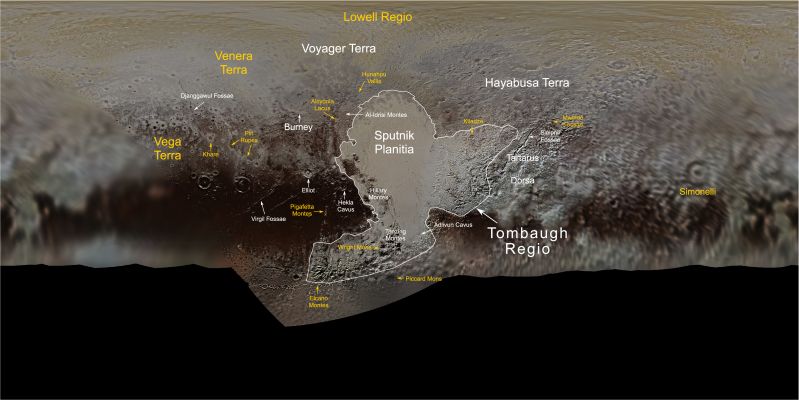
A few names for the Main Features of Pluto
Ecco i nomi di alcune delle aree e Regioni di maggior interesse di Plutone. Su molte, devo dire che la scelta é stata felice. Su qualcuna.... Beh, decidete Voi.

Alcyonia Lacus, a possible frozen Nitrogen Lake on Pluto's Surface, is named for the bottomless lake in or in the vicinity of Lerna, a region of Greece known for springs and swamps; the Alcyonian lake was one of the entrances to the underworld in Greek mythology.

Elcano Montes is a mountain range honoring Juan Sebastián Elcano (1476–1526), the Spanish explorer who in 1522 completed the first circumnavigation of the Earth (a voyage started in 1519 by Magellan).

Hunahpu Valles is a system of canyons named for one of the Hero Twins in Mayan mythology, who defeated the lords of the underworld in a ball game.

Khare crater honors planetary scientist Bishun Khare (1933–2013), an expert on the chemistry of planetary atmospheres who did laboratory work leading to several seminal papers on tholins – the organic molecules that probably account for the darkest and reddest regions on Pluto.

Kiladze crater honors Rolan Kiladze (1931–2010), the Georgian (Caucasus) astronomer who made pioneering early investigations the dynamics, astrometry and photometry of Pluto.

Lowell Regio is a large region honoring Percival Lowell (1855–1916), the American astronomer who founded Lowell Observatory and organized a systematic search for a planet beyond Neptune.

Mwindo Fossae is a network of long, narrow depressions named for the Nyanga (Eastern Dem. Rep. Congo/Zaire) epic hero who traveled to the Underworld and after returning home became a wise and powerful king.

Piccard Mons is Mountain and suspected Cryo-Volcano that honors Auguste Piccard (1884–1962), a 20th century inventor and physicist best known for his pioneering balloon flights into Earth's Upper Atmosphere.

Pigafetta Montes honors Antonio Pigafetta (c. 1491–c. 1531), the Italian scholar and explorer who chronicled the discoveries made during the first circumnavigation of the Earth, aboard Magellan's ships.

Piri Rupes is a long cliff honoring Ahmed Muhiddin Piri (c. 1470–1553), also known as Piri Reis, an Ottoman navigator and cartographer known for his world map. He also drew some of the earliest existing maps of North and Central America.

Simonelli Crater honors astronomer Damon Simonelli (1959–2004), whose wide-ranging research included the formation history of Pluto.

Wright Mons honors the Wright brothers, Orville (1871–1948) and Wilbur (1867–1912), American aviation pioneers credited with building and flying the world's first successful airplane.

Vega Terra is a large land mass named for the Soviet Vega 1 and 2 missions, the first Spacecraft to fly balloons on another planet (Venus) and to image the Nucleus of a Comet (1P/Halley).

Venera Terra is named for the Venera missions sent to Venus by the Soviet Union from 1961–1984; they included the first human-made device to enter the Atmosphere of another Planet, to make a soft landing over there and to return images from an alien planetary surface.
Parole chiave: Pluto - Map

A few names for the Main Features of Pluto

Ecco i nomi di alcune delle aree e Regioni di maggior interesse di Plutone. Su molte, devo dire che la scelta é stata felice. Su qualcuna.... Beh, decidete Voi.

Alcyonia Lacus, a possible frozen Nitrogen Lake on Pluto's Surface, is named for the bottomless lake in or in the vicinity of Lerna, a region of Greece known for springs and swamps; the Alcyonian lake was one of the entrances to the underworld in Greek mythology.

Elcano Montes is a mountain range honoring Juan Sebastián Elcano (1476–1526), the Spanish explorer who in 1522 completed the first circumnavigation of the Earth (a voyage started in 1519 by Magellan).

Hunahpu Valles is a system of canyons named for one of the Hero Twins in Mayan mythology, who defeated the lords of the underworld in a ball game.

Khare crater honors planetary scientist Bishun Khare (1933–2013), an expert on the chemistry of planetary atmospheres who did laboratory work leading to several seminal papers on tholins – the organic molecules that probably account for the darkest and reddest regions on Pluto.

Kiladze crater honors Rolan Kiladze (1931–2010), the Georgian (Caucasus) astronomer who made pioneering early investigations the dynamics, astrometry and photometry of Pluto.

Lowell Regio is a large region honoring Percival Lowell (1855–1916), the American astronomer who founded Lowell Observatory and organized a systematic search for a planet beyond Neptune.

Mwindo Fossae is a network of long, narrow depressions named for the Nyanga (Eastern Dem. Rep. Congo/Zaire) epic hero who traveled to the Underworld and after returning home became a wise and powerful king.

Piccard Mons is Mountain and suspected Cryo-Volcano that honors Auguste Piccard (1884–1962), a 20th century inventor and physicist best known for his pioneering balloon flights into Earth's Upper Atmosphere.

Pigafetta Montes honors Antonio Pigafetta (c. 1491–c. 1531), the Italian scholar and explorer who chronicled the discoveries made during the first circumnavigation of the Earth, aboard Magellan's ships.

Piri Rupes is a long cliff honoring Ahmed Muhiddin Piri (c. 1470–1553), also known as Piri Reis, an Ottoman navigator and cartographer known for his world map. He also drew some of the earliest existing maps of North and Central America.

Simonelli Crater honors astronomer Damon Simonelli (1959–2004), whose wide-ranging research included the formation history of Pluto.

Wright Mons honors the Wright brothers, Orville (1871–1948) and Wilbur (1867–1912), American aviation pioneers credited with building and flying the world's first successful airplane.

Vega Terra is a large land mass named for the Soviet Vega 1 and 2 missions, the first Spacecraft to fly balloons on another planet (Venus) and to image the Nucleus of a Comet (1P/Halley).

Venera Terra is named for the Venera missions sent to Venus by the Soviet Union from 1961–1984; they included the first human-made device to enter the Atmosphere of another Planet, to make a soft landing over there and to return images from an alien planetary surface.

ZZ-ZZ-ZZ-ZZ-ZZ-ZZ-ZZ-ZZ-Pluto_and_Charon-01-NewHorizons-1422.jpg ZZ-ZZ-ZZ-ZZ-ZZ-ZZ-Z-Pluto-Map.jpg ZYZ-Pluto_s System.2jpg.jpg ZZ-ZZ-ZZ-ZZ-ZZ-ZZ-ZZ-ZZ-ZZ-Pluto-PIA21863.jpg ZZ-ZZ-ZZ-ZZ-ZZ-ZZ-Pluto02-New_Horizons-1080-Annotated.jpg
Informazioni sul file
Nome del file:ZZ-ZZ-ZZ-ZZ-ZZ-ZZ-Z-Pluto-Map.jpg
Nome album:MareKromium / Pluto and Charon: The "Double Planet"
Valutazione (3 voti):55555(Mostra dettagli)
Parole chiave:Pluto / - / Map
Copyright:NASA - New Horizons Project
Dimensione del file:3693 KiB
Data di inserimento:Ott 25, 2019
Dimensioni:4237 x 2120 pixels
Visualizzato:72 volte
URL:https://www.lunexit.it/gallery/displayimage.php?pid=31259
Preferiti:Aggiungi ai preferiti


Powered by Coppermine Photo Gallery