Inizio Registrati Login

Elenco album Ultimi arrivi Ultimi commenti Più viste Più votate Preferiti Cerca

Inizio > SOLAR SYSTEM > Uranus and His Moons
Ritorna alla pagina delle miniature FILE 35/109 Torna all'inizio Guarda foto precedente Guarda foto successiva Salta alla fine
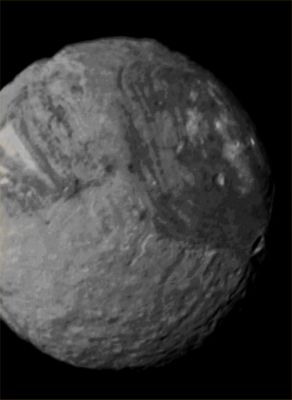
Miranda's Southern Hemisphere (Possible Absolute Natural Colors; credits for the additional process. and color.: Dr Paolo C. Fienga/Lunar Explorer Italia/Italian Planetary Foundation)
This image-mosaic of the Uranian moon Miranda was taken by the NASA - Voyager 2 Spacecraft on January 24, 1986, from a distance of approx. 147.000 Km (such as about 91.287 miles). This image-mosaic was constructed from images taken through the Spacecraft's Narrow-Angle Camera's Green, Violet and UltraViolet Filters. 
Miranda, just about 480 Km (such as approx. 299 miles) across, is the smallest of Uranus' five Major natural satellites. Miranda's Regional Geologic Provinces are shown very well in this view of its Southern Hemisphere, imaged at a resolution of roughly 2,7 Km (such as 1,67 miles) per pixel. The dark- and bright-Banded Region with its curvilinear traces, covers about half of the frame. Higher-resolution pictures taken some time later showed many Fault Valleys and Ridges, all parallel to these "Bands". Near the Terminator Line (on the right - Dx), another system of Ridges and Valleys abuts the Banded Terrain; furthermore, many Impact Craters pockmark the Surface of Miranda all over this Region. The largest of these Craters are about 30 Km (approx. 18,63 miles) in diameter and many more of them lie in the range of 5 to 10 Km (such as from 3,1 to 6,2 miles) in diameter. 

This frame (which is an Original NASA - Voyager 2 Spacecraft Natural Color image-mosaic published on the NASA - Planetary Photojournal with the ID n. PIA 00042) has been additionally processed, contrast enhanced, magnified to aid visibility of the Surface details and then re-colorized, according to an educated guess carried out by Dr Paolo C. Fienga/LXTT/IPF, in what they should be its Absolute Natural Colors (such as the colors that a human eye would actually perceive if someone were onboard the NASA - Voyager 2 Spacecraft and then looked outside, towards the Uranian moon Miranda), by using an original technique created - and, in time, dramatically improved - by the Lunar Explorer Italia Team. Different colors, as well as different shades of the same color, mean, among others, the existence of different Elements present on the Surface of Miranda, each having a different Albedo (---> Reflectivity) and Chemical Composition.

Note: it is possible (but we, as IPF, have no way to be one-hundred-percent sure of such a circumstance), that the actual luminosity of Miranda - as it is in this frame - would appear, to an average human eye, a little bit lower than it has been shown (or, better yet: interpreted) here.
Parole chiave: Uranian Moons - Miranda

Miranda's Southern Hemisphere (Possible Absolute Natural Colors; credits for the additional process. and color.: Dr Paolo C. Fienga/Lunar Explorer Italia/Italian Planetary Foundation)

This image-mosaic of the Uranian moon Miranda was taken by the NASA - Voyager 2 Spacecraft on January 24, 1986, from a distance of approx. 147.000 Km (such as about 91.287 miles). This image-mosaic was constructed from images taken through the Spacecraft's Narrow-Angle Camera's Green, Violet and UltraViolet Filters.
Miranda, just about 480 Km (such as approx. 299 miles) across, is the smallest of Uranus' five Major natural satellites. Miranda's Regional Geologic Provinces are shown very well in this view of its Southern Hemisphere, imaged at a resolution of roughly 2,7 Km (such as 1,67 miles) per pixel. The dark- and bright-Banded Region with its curvilinear traces, covers about half of the frame. Higher-resolution pictures taken some time later showed many Fault Valleys and Ridges, all parallel to these "Bands". Near the Terminator Line (on the right - Dx), another system of Ridges and Valleys abuts the Banded Terrain; furthermore, many Impact Craters pockmark the Surface of Miranda all over this Region. The largest of these Craters are about 30 Km (approx. 18,63 miles) in diameter and many more of them lie in the range of 5 to 10 Km (such as from 3,1 to 6,2 miles) in diameter.

This frame (which is an Original NASA - Voyager 2 Spacecraft Natural Color image-mosaic published on the NASA - Planetary Photojournal with the ID n. PIA 00042) has been additionally processed, contrast enhanced, magnified to aid visibility of the Surface details and then re-colorized, according to an educated guess carried out by Dr Paolo C. Fienga/LXTT/IPF, in what they should be its Absolute Natural Colors (such as the colors that a human eye would actually perceive if someone were onboard the NASA - Voyager 2 Spacecraft and then looked outside, towards the Uranian moon Miranda), by using an original technique created - and, in time, dramatically improved - by the Lunar Explorer Italia Team. Different colors, as well as different shades of the same color, mean, among others, the existence of different Elements present on the Surface of Miranda, each having a different Albedo (---> Reflectivity) and Chemical Composition.

Note: it is possible (but we, as IPF, have no way to be one-hundred-percent sure of such a circumstance), that the actual luminosity of Miranda - as it is in this frame - would appear, to an average human eye, a little bit lower than it has been shown (or, better yet: interpreted) here.

Miranda-PIA00042-PCF-LXTT-IPF.jpg VF-Cressida, Ophoelia, Portia.jpg VI-Puck-HR-V2.JPG Miranda-PIA00140.jpg VI-Puck-V2.jpg
Informazioni sul file
Nome del file:Miranda-PIA00042-PCF-LXTT-IPF.jpg
Nome album:MareKromium / Uranus and His Moons
Valutazione (4 voti):55555(Mostra dettagli)
Parole chiave:Uranian / Moons / - / Miranda
Copyright:NASA/JPL - Voyager 2 Project; credits for the additional process. and color.: Dr Paolo C. Fienga/Lunar Explorer Italia/Italian Planetary Foundation
Dimensione del file:168 KiB
Data di inserimento:Set 08, 2013
Dimensioni:1500 x 2048 pixels
Visualizzato:76 volte
URL:https://www.lunexit.it/gallery/displayimage.php?pid=31135
Preferiti:Aggiungi ai preferiti


Powered by Coppermine Photo Gallery