Inizio Registrati Login

Elenco album Ultimi arrivi Ultimi commenti Più viste Più votate Preferiti Cerca

Inizio > SOLAR SYSTEM > Uranus and His Moons
Ritorna alla pagina delle miniature FILE 96/109 Torna all'inizio Guarda foto precedente Guarda foto successiva Salta alla fine
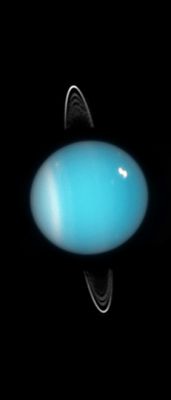
Going, Going, Gone: Hubble captures Uranus' Rings on Edge (2)
Caption NASA:"With further analysis of the Hubble data, Astronomer Mark Showalter of the SETI Institute in Mountain View, Calif., hopes to detect some of the small moons that may shepherd the debris into distinct rings.
Until Voyager 2 flew by Uranus in January 1986, the Rings were only known from the way they temporarily blocked the light of stars passing behind the Planet. Hubble provided some of the first images of the Ring System as viewed from Earth's distance of approx. 2 BMs. 
The advent of adaptive optics gave ground-based observers using large telescopes comparatively sharp views. 
The Rings were discovered in 1977, so this is the first time for a Uranus Ring crossing to be observed from Earth. Earth's orbit around the Sun permits 3 opportunities to view the Rings in an "edge-on" configuration: Uranus made its first ring crossing as seen from Earth on May 3; it made its second crossing on August 16 and will cross for the third time on February 20, 2008. 
Though the last ring crossing relative to Earth will be hidden behind the Sun, most of Earth's premier telescopes, including Keck, Hubble, the European Southern Observatory's Very Large Telescope and the Hale Telescope on Mt. Palomar, plan to focus on the planet again in the days following December 7, 2007. On December 7 the rings will be perfectly edge-on to the Sun".
Parole chiave: From Space Images - Hubble Space Telescope - Uranus

Going, Going, Gone: Hubble captures Uranus' Rings on Edge (2)

Caption NASA:"With further analysis of the Hubble data, Astronomer Mark Showalter of the SETI Institute in Mountain View, Calif., hopes to detect some of the small moons that may shepherd the debris into distinct rings.
Until Voyager 2 flew by Uranus in January 1986, the Rings were only known from the way they temporarily blocked the light of stars passing behind the Planet. Hubble provided some of the first images of the Ring System as viewed from Earth's distance of approx. 2 BMs.
The advent of adaptive optics gave ground-based observers using large telescopes comparatively sharp views.
The Rings were discovered in 1977, so this is the first time for a Uranus Ring crossing to be observed from Earth. Earth's orbit around the Sun permits 3 opportunities to view the Rings in an "edge-on" configuration: Uranus made its first ring crossing as seen from Earth on May 3; it made its second crossing on August 16 and will cross for the third time on February 20, 2008.
Though the last ring crossing relative to Earth will be hidden behind the Sun, most of Earth's premier telescopes, including Keck, Hubble, the European Southern Observatory's Very Large Telescope and the Hale Telescope on Mt. Palomar, plan to focus on the planet again in the days following December 7, 2007. On December 7 the rings will be perfectly edge-on to the Sun".

Uranus-HST-PIA01283.jpg Uranus-2007-01.jpg Uranus-2007-00.jpg Uranus-2003.jpg VA-UranusRings-1.jpg
Informazioni sul file
Nome del file:Uranus-2005.jpg
Nome album:MareKromium / Uranus and His Moons
Valutazione (6 voti):55555(Mostra dettagli)
Parole chiave:From / Space / Images / - / Hubble / Space / Telescope / - / Uranus
Copyright:NASA, ESA, and M. Showalter (SETI Institute)
Dimensione del file:62 KiB
Data di inserimento:Set 16, 2007
Dimensioni:282 x 657 pixels
Visualizzato:57 volte
URL:https://www.lunexit.it/gallery/displayimage.php?pid=18105
Preferiti:Aggiungi ai preferiti


Powered by Coppermine Photo Gallery