Inizio Registrati Login

Elenco album Ultimi arrivi Ultimi commenti Più viste Più votate Preferiti Cerca

Inizio > SOLAR SYSTEM > Uranus and His Moons
Ritorna alla pagina delle miniature FILE 72/109 Torna all'inizio Guarda foto precedente Guarda foto successiva Salta alla fine
Uranus from HST
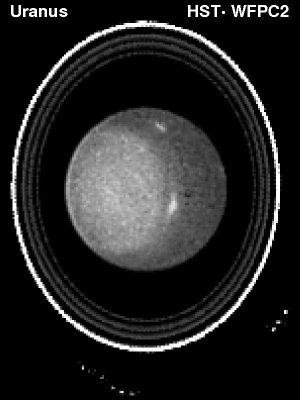
This NASA HST image of Uranus reveals the Planet's Rings and bright clouds and a high altitude haze above the Planet's South Pole.
Hubble's view was obtained on August 14, 1994, when Uranus was 1,7 BM (about 2,8 BKM) from Earth. These details, as imaged by the Wide Field Planetary Camera 2, were only previously seen by the Voyager 2 spacecraft, which flew by Uranus in 1986. Since then, none of these inner satellites has been further observed, and detailed observations of the Rings have not been possible.
Though Uranus' Rings were discovered indirectly in 1977 (through stellar occultation observations), they have never before been seen in visible light through a ground-based telescope.
Hubble resolves several of Uranus' Rings, including the outermost Epsilon-Ring. The Planet has a total of 11 concentric Rings of dark dust. Uranus is tipped such that its rotation axis lies in the plane of its orbit, so the Rings appear nearly face-on.
Three of Uranus' inner moons each appear as a string of three dots at the bottom of the picture. This is because the picture is a composite of three images, taken about six minutes apart, and then combined to show the moons' orbital motions. The satellites are, from left to right, Cressida, Juliet, and Portia. The moons move much more rapidly than our own Moon does as it moves around the Earth, so they noticeably change position over only a few minutes.

One of the four gas giant planets of our solar system, Uranus is largely featureless. HST does resolve a high altitude haze which appears as a bright "cap" above the planet's south pole, along with clouds at southern latitudes (similar structures were observed by Voyager). Unlike Earth, Uranus' south pole points toward the Sun during part of the planet's 84-year orbit. Thanks to its high resolution and ability to make observations over many years, Hubble can follow seasonal changes in Uranus's atmosphere, which should be unusual given the planet's large tilt.

The Wide Field/Planetary Camera 2 was developed by the Jet Propulsion Laboratory and managed by the Goddard Spaced Flight Center for NASA's Office of Space Science.


Parole chiave: From Space Images - Hubble Space Telescope - Uranus

Uranus from HST

This NASA HST image of Uranus reveals the Planet's Rings and bright clouds and a high altitude haze above the Planet's South Pole.
Hubble's view was obtained on August 14, 1994, when Uranus was 1,7 BM (about 2,8 BKM) from Earth. These details, as imaged by the Wide Field Planetary Camera 2, were only previously seen by the Voyager 2 spacecraft, which flew by Uranus in 1986. Since then, none of these inner satellites has been further observed, and detailed observations of the Rings have not been possible.
Though Uranus' Rings were discovered indirectly in 1977 (through stellar occultation observations), they have never before been seen in visible light through a ground-based telescope.
Hubble resolves several of Uranus' Rings, including the outermost Epsilon-Ring. The Planet has a total of 11 concentric Rings of dark dust. Uranus is tipped such that its rotation axis lies in the plane of its orbit, so the Rings appear nearly face-on.
Three of Uranus' inner moons each appear as a string of three dots at the bottom of the picture. This is because the picture is a composite of three images, taken about six minutes apart, and then combined to show the moons' orbital motions. The satellites are, from left to right, Cressida, Juliet, and Portia. The moons move much more rapidly than our own Moon does as it moves around the Earth, so they noticeably change position over only a few minutes.

One of the four gas giant planets of our solar system, Uranus is largely featureless. HST does resolve a high altitude haze which appears as a bright "cap" above the planet's south pole, along with clouds at southern latitudes (similar structures were observed by Voyager). Unlike Earth, Uranus' south pole points toward the Sun during part of the planet's 84-year orbit. Thanks to its high resolution and ability to make observations over many years, Hubble can follow seasonal changes in Uranus's atmosphere, which should be unusual given the planet's large tilt.

The Wide Field/Planetary Camera 2 was developed by the Jet Propulsion Laboratory and managed by the Goddard Spaced Flight Center for NASA's Office of Space Science.

AB-Ariel-vg2_2684535.jpg Uranus_and_Ariel.jpg Uranus-HST-PIA01283.jpg Uranus-2003.jpg UranusfromHST-4.JPG
Informazioni sul file
Nome del file:Uranus-HST-PIA01282.jpg
Nome album:MareKromium / Uranus and His Moons
Valutazione (4 voti):55555(Mostra dettagli)
Parole chiave:From / Space / Images / - / Hubble / Space / Telescope / - / Uranus
Copyright:NASA/JPL/Hubble Space Telescope
Dimensione del file:48 KiB
Data di inserimento:Lug 23, 2007
Dimensioni:600 x 800 pixels
Visualizzato:57 volte
URL:https://www.lunexit.it/gallery/displayimage.php?pid=17546
Preferiti:Aggiungi ai preferiti


Powered by Coppermine Photo Gallery