Inizio Registrati Login

Elenco album Ultimi arrivi Ultimi commenti Più viste Più votate Preferiti Cerca

Inizio > SOLAR SYSTEM > Uranus and His Moons
Ritorna alla pagina delle miniature FILE 64/109 Torna all'inizio Guarda foto precedente Guarda foto successiva Salta alla fine
Uranus Cloud Movement
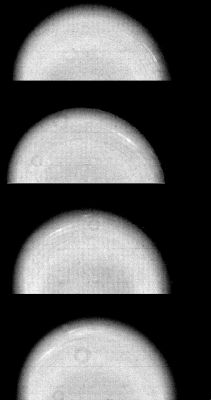
Time-lapse Voyager 2 images of Uranus show the movement of 2 small, bright, streaky clouds - the first such features ever seen on the Planet. The clouds were detected in this series of orange-filtered images taken Jan. 14, 1986, over a 4.6-hour interval (from top to bottom). At the time, the spacecraft was about 12,9 MKM (about 8 MMs) from the Planet, whose pole of rotation is near the center of each disk. Uranus, which is tipped on its side with respect to the other planets, is rotating in a counterclockwise direction, as are the 2 clouds seen here as bright streaks. 
(The occasional donut-shaped features that show up are shadows cast by dust in the camera optics. The processing necessary to bring out the faint features on the Planet also brings out these camera blemishes.) The larger of the 2 clouds is at a latitude of 33°; the smaller cloud, seen faintly in the 3 lower images, lies at 26° (a lower latitude and hence closer to the limb). Their counterclockwise periods of rotation are 16.2 and 16.9 hours, respectively. This difference implies that the lower-latitude feature is lagging behind the higher-latitude feature at a speed of almost 100 meters per second (220 mph). Latitudinal bands are also visible in these images. The faint bands, more numerous now than in previous Voyager images from longer range, are concentric with the pole of rotation -- that is, they circle the planet in lines of constant latitude.
Parole chiave: Uranus

Uranus Cloud Movement

Time-lapse Voyager 2 images of Uranus show the movement of 2 small, bright, streaky clouds - the first such features ever seen on the Planet. The clouds were detected in this series of orange-filtered images taken Jan. 14, 1986, over a 4.6-hour interval (from top to bottom). At the time, the spacecraft was about 12,9 MKM (about 8 MMs) from the Planet, whose pole of rotation is near the center of each disk. Uranus, which is tipped on its side with respect to the other planets, is rotating in a counterclockwise direction, as are the 2 clouds seen here as bright streaks.
(The occasional donut-shaped features that show up are shadows cast by dust in the camera optics. The processing necessary to bring out the faint features on the Planet also brings out these camera blemishes.) The larger of the 2 clouds is at a latitude of 33°; the smaller cloud, seen faintly in the 3 lower images, lies at 26° (a lower latitude and hence closer to the limb). Their counterclockwise periods of rotation are 16.2 and 16.9 hours, respectively. This difference implies that the lower-latitude feature is lagging behind the higher-latitude feature at a speed of almost 100 meters per second (220 mph). Latitudinal bands are also visible in these images. The faint bands, more numerous now than in previous Voyager images from longer range, are concentric with the pole of rotation -- that is, they circle the planet in lines of constant latitude.

Uranus-uppatm-PIA01488.jpg Uranus-HST-PIA01279.jpg UMBRIEL-vg2_p29502-B.jpg ZA-Uranus-IP-V2-PIA00346_modest.jpg ZB-Uranus-HP-V2-PIA01391_modest.jpg
Informazioni sul file
Nome del file:Uranus-Voyager2-PIA00369.jpg
Nome album:MareKromium / Uranus and His Moons
Valutazione (3 voti):55555(Mostra dettagli)
Parole chiave:Uranus
Copyright:NASA/JPL
Dimensione del file:61 KiB
Data di inserimento:Lug 23, 2007
Dimensioni:506 x 958 pixels
Visualizzato:58 volte
URL:https://www.lunexit.it/gallery/displayimage.php?pid=17544
Preferiti:Aggiungi ai preferiti


Powered by Coppermine Photo Gallery