Inizio Registrati Login

Elenco album Ultimi arrivi Ultimi commenti Più viste Più votate Preferiti Cerca

Inizio > SOLAR SYSTEM > Jupiter: the "King" and His Moons
Ritorna alla pagina delle miniature FILE 301/325 Torna all'inizio Guarda foto precedente Guarda foto successiva Salta alla fine
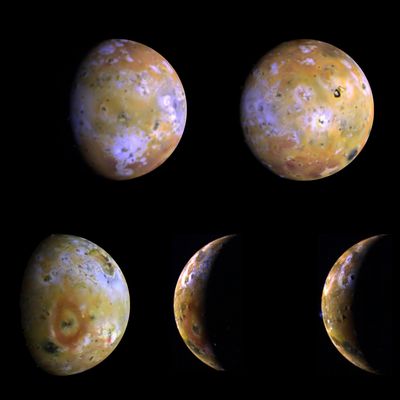
Io: five views of the one and the same
Five color views of Jupiter's moon Io, as seen by NASA's Galileo spacecraft camera, were taken between the 25th and the 29th of June, 1996 Universal Time. The color is a composite of the red, green, and violet filters of the on board imaging system with the brightness of the violet bandpass increased to provide better color discrimination. The full disk images were intended for color mapping of Io's surface and for comparison to Voyager images. Where images overlap several features can be seen to change in relative brightness, perhaps due to unusual light scattering behavior or active phenomena. The crescent images were intended primarily for color imaging of active volcanic plumes on the bright limb and these images showed that the Voyager-era Loki plumes were no longer active and revealed a new plume at Ra Patera. The smallest features which can be discerned in the 5 views range from 9 to 23 kilometers and provide our best look at Io since the 1979 Voyager flybys. Sub-spacecraft longitudes on Io (from upper left to lower right) are 69, 338, 264, 211, and 221 W. North is to the top.
Launched in October 1989, Galileo entered orbit around Jupiter on December 7, 1995. The spacecraft's mission is to conduct detailed studies of the giant planet, its largest moons and the Jovian magnetic environment.

Parole chiave: Jupiter Moons - Io

Io: five views of the one and the same

Five color views of Jupiter's moon Io, as seen by NASA's Galileo spacecraft camera, were taken between the 25th and the 29th of June, 1996 Universal Time. The color is a composite of the red, green, and violet filters of the on board imaging system with the brightness of the violet bandpass increased to provide better color discrimination. The full disk images were intended for color mapping of Io's surface and for comparison to Voyager images. Where images overlap several features can be seen to change in relative brightness, perhaps due to unusual light scattering behavior or active phenomena. The crescent images were intended primarily for color imaging of active volcanic plumes on the bright limb and these images showed that the Voyager-era Loki plumes were no longer active and revealed a new plume at Ra Patera. The smallest features which can be discerned in the 5 views range from 9 to 23 kilometers and provide our best look at Io since the 1979 Voyager flybys. Sub-spacecraft longitudes on Io (from upper left to lower right) are 69, 338, 264, 211, and 221 W. North is to the top.
Launched in October 1989, Galileo entered orbit around Jupiter on December 7, 1995. The spacecraft's mission is to conduct detailed studies of the giant planet, its largest moons and the Jovian magnetic environment.

Jupiter_s Rings-PIA01627.jpg Io-GalaiPatera-PIA00324.jpg Io-Pele-PIA01112.jpg Io-PIA00715.jpg Europa-PIA02500.jpg
Informazioni sul file
Nome del file:Io-PIA00491.jpg
Nome album:Jupiter: the "King" and His Moons
Valutazione (8 voti):55555(Mostra dettagli)
Parole chiave:Jupiter / Moons / - / Io
Copyright:NASA - Galileo Project
Dimensione del file:152 KiB
Data di inserimento:Ott 20, 2005
Dimensioni:2000 x 2000 pixels
Visualizzato:57 volte
URL:https://www.lunexit.it/gallery/displayimage.php?pid=7902
Preferiti:Aggiungi ai preferiti


Powered by Coppermine Photo Gallery