Inizio Registrati Login

Elenco album Ultimi arrivi Ultimi commenti Più viste Più votate Preferiti Cerca

Inizio > SOLAR SYSTEM > Jupiter: the "King" and His Moons
Ritorna alla pagina delle miniature FILE 65/325 Torna all'inizio Guarda foto precedente Guarda foto successiva Salta alla fine
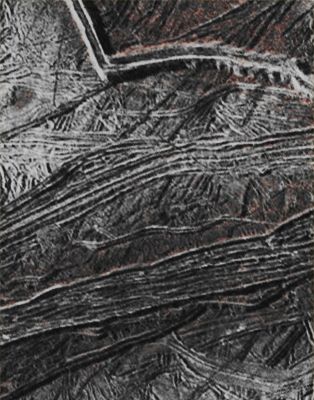
Features of Europa (Absolute Natural Colors; credits for the additional process. and color.: Dr Paolo C. Fienga/Lunar Explorer Italia/Italian Planetary Foundation)
This image, taken by the NASA - Galileo Spacecraft on February, 2, 1999, shows us huge Cracks and Ridges on the Surface of the Jovian moon Europa. These (absolutely fascinating) Features reveal a complex Geologic History of Europa. Some Ridges, such as the prominent one, at the top right of the frame, develop into several long, arc-shaped "Cycloids" (---> a Cycloid is the curve traced by a point on the rim of a circular wheel as the wheel rolls along a straight line), that could reasonably be related to the changing Tidal Forces as Europa orbits the Gas-Giant Planet Jupiter. The Wall of this Ridge stands perhaps a third of a mile (approx. 0,5 Km) above the surrounding Ridged Plains, although their Edges are - likely - NOT as steep as they appear in this view.

The view was captured by the NASA - Galileo Spacecraft on February 2, 1999, during its E19 orbit, when the spacecraft was about 2500 miles (such as approx. 4023 km) from the Surface of Europa. The Resolution in the scene is roughly 295 feet (such as approx. 89.91 meters) per pixel. North is toward bottom left side of the picture.

This frame (which is a crop taken from an Original NASA - Galileo Spacecraft enhanced color image published on the NASA - Planetary Photojournal with the ID n. PIA 17737) has been additionally processed, contrast enhanced, magnified to aid visibility of the Surface details and then re-colorized, according to an educated guess carried out by Dr Paolo C. Fienga/LXTT/IPF, in what they should be its Absolute Natural Colors (such as the colors that a human eye would actually perceive if someone were onboard the NASA - Galileo Spacecraft and then looked outside, towards the Surface of the Jovian moon Europa), by using an original technique created - and, in time, dramatically improved - by the Lunar Explorer Italia Team. Different colors, as well as different shades of the same color, mean, among others, the existence of different Elements present on the Surface of Europa, each having a different Albedo (---> Reflectivity) and Chemical Composition.

Note: it is possible (but we, as IPF, have no way to be one-hundred-percent sure of such a circumstance), that the actual luminosity of Europa- as it is in this frame - would appear, to an average human eye, a little bit lower than it has been shown (or, better yet: interpreted) here.
Parole chiave: Jovian Moons - Europa

Features of Europa (Absolute Natural Colors; credits for the additional process. and color.: Dr Paolo C. Fienga/Lunar Explorer Italia/Italian Planetary Foundation)

This image, taken by the NASA - Galileo Spacecraft on February, 2, 1999, shows us huge Cracks and Ridges on the Surface of the Jovian moon Europa. These (absolutely fascinating) Features reveal a complex Geologic History of Europa. Some Ridges, such as the prominent one, at the top right of the frame, develop into several long, arc-shaped "Cycloids" (---> a Cycloid is the curve traced by a point on the rim of a circular wheel as the wheel rolls along a straight line), that could reasonably be related to the changing Tidal Forces as Europa orbits the Gas-Giant Planet Jupiter. The Wall of this Ridge stands perhaps a third of a mile (approx. 0,5 Km) above the surrounding Ridged Plains, although their Edges are - likely - NOT as steep as they appear in this view.

The view was captured by the NASA - Galileo Spacecraft on February 2, 1999, during its E19 orbit, when the spacecraft was about 2500 miles (such as approx. 4023 km) from the Surface of Europa. The Resolution in the scene is roughly 295 feet (such as approx. 89.91 meters) per pixel. North is toward bottom left side of the picture.

This frame (which is a crop taken from an Original NASA - Galileo Spacecraft enhanced color image published on the NASA - Planetary Photojournal with the ID n. PIA 17737) has been additionally processed, contrast enhanced, magnified to aid visibility of the Surface details and then re-colorized, according to an educated guess carried out by Dr Paolo C. Fienga/LXTT/IPF, in what they should be its Absolute Natural Colors (such as the colors that a human eye would actually perceive if someone were onboard the NASA - Galileo Spacecraft and then looked outside, towards the Surface of the Jovian moon Europa), by using an original technique created - and, in time, dramatically improved - by the Lunar Explorer Italia Team. Different colors, as well as different shades of the same color, mean, among others, the existence of different Elements present on the Surface of Europa, each having a different Albedo (---> Reflectivity) and Chemical Composition.

Note: it is possible (but we, as IPF, have no way to be one-hundred-percent sure of such a circumstance), that the actual luminosity of Europa- as it is in this frame - would appear, to an average human eye, a little bit lower than it has been shown (or, better yet: interpreted) here.

Jupiter_JUNO.gif Jupiter-Juno-2024-Fra-5.jpg Jupiter-Impact-2010-005.jpg Callisto-full disk-PIA03456_modest.jpg Ganymede-V1-PIA02233-PCF-LXTT-IPF.jpg
Informazioni sul file
Nome del file:Europa-Ridges-PIA17737-PCF-LXTT-IPF-1.jpg
Nome album:MareKromium / Jupiter: the "King" and His Moons
Valutazione (3 voti):55555(Mostra dettagli)
Parole chiave:Jovian / Moons / - / Europa
Copyright:NASA/JPL-CaltecH - Galileo Project e Dr Paolo C. Fienga - Lunar Explorer Italia - Italian Planetary Foundation per l'additional process. e la colorizzazione
Dimensione del file:856 KiB
Data di inserimento:Gen 30, 2014
Dimensioni:2360 x 2998 pixels
Visualizzato:92 volte
URL:https://www.lunexit.it/gallery/displayimage.php?pid=31196
Preferiti:Aggiungi ai preferiti

Commento 1 a 2 di 2
Pagina: 1

walthari   [Feb 07, 2014 at 01:15 PM]
la sotto da qualche parte in oceani alieni la vita prospera...un sogno?Speriamo realtà e speriamo un giorno di poterla confutare...."succederà qualcosa di meraviglioso...." 2010, l'anno del contatto"
MareKromium   [Feb 07, 2014 at 03:22 PM]
Bellissima Citazione Walt! Un Capolavoro. Quoto la frase storica del film:

"TUTTI QUESTI MONDI VI APPARTENGONO, TRANNE EUROPA: NON TENTATE DI ATTERRARVI.
VIVETECI INSIEME. VIVETECI IN PACE".

Commento 1 a 2 di 2
Pagina: 1


Powered by Coppermine Photo Gallery