Inizio Registrati Login

Elenco album Ultimi arrivi Ultimi commenti Più viste Più votate Preferiti Cerca

Inizio > SOLAR SYSTEM > Jupiter: the "King" and His Moons
Ritorna alla pagina delle miniature FILE 217/325 Torna all'inizio Guarda foto precedente Guarda foto successiva Salta alla fine
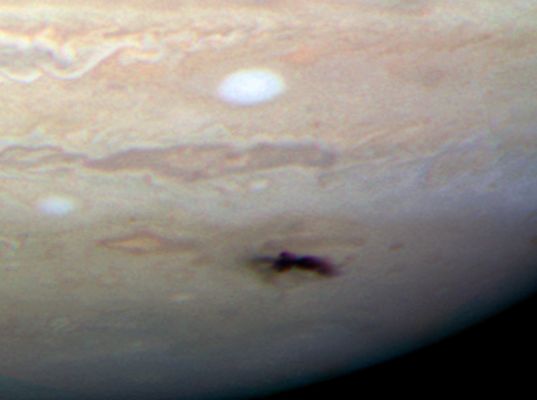
Impact on Jupiter! (from Hubble Space Telescope - edm)
Discovered by Australian amateur astronomer Anthony Wesley on Sunday, July 19, 2009, the spot was created when a small object plunged into Jupiter's atmosphere and disintegrated. The only other time in history such a feature has been seen on Jupiter was 15 years ago.

"This is strikingly similar to the comet Shoemaker Levy 9 that impacted Jupiter in July 1994" said team member Keith Noll of the Space Telescope Science Institute in Baltimore, Md.

"Since we believe this magnitude of impact is rare, we are very fortunate to see it with Hubble" added Amy Simon-Miller of NASA's Goddard Space Flight Center in Greenbelt, Md. She explained that the details seen in the Hubble view shows a lumpiness to the debris plume caused by turbulence in Jupiter's atmosphere. The spot is presently twice the length of the United States.

Simon-Miller estimated that the diameter of the object that slammed into Jupiter was at least the size of several football fields. The force of the explosion on Jupiter was thousands of times more powerful than the suspected comet or asteroid that exploded over the Tunguska River Valley in Siberia in June 1908.

The WFC3, installed by the STS-125 astronauts in May, is not yet fully calibrated. So while it is possible to obtain celestial images, the camera's full power cannot yet be realized for most observations. The WFC3 can still return meaningful science images that will complement the Jupiter pictures being taken with ground-based telescopes.

This is a Natural Color image of Jupiter as seen in Visible Light.

Credit: NASA, ESA, and H. Hammel (Space Science Institute, Boulder, Colo.), and the Jupiter Impact Team

The members of the Jupiter Impact Team are:

Dr. Heidi B. Hammel (Space Science Institute, Boulder, Colo.) 
Dr. Amy Simon-Miller (NASA's Goddard Space Flight Center, Greenbelt, Md.) 
Dr. Keith S. Noll (Space Telescope Science Institute, Baltimore, Md.) 
Dr. Michael H. Wong (Space Telescope Science Institute, Baltimore, Md.) 
Prof. John T. Clarke (Boston University, Boston, Mass.) 
Prof. Imke de Pater (University of California, Berkeley, Calif.) 
Dr. Glenn S. Orton (Jet Propulsion Laboratory, Pasadena, Calif.) 
Dr. Agustin Sanchez-Lavega (University of the Basque Country, Spain)

CONTACT
Dwayne Brown
HQ, Washington
202-358-1726
dwayne.c.brown@nasa.gov

Ray Villard
Space Telescope Science Institute, Baltimore, Md.
410-338-4514
villard@stsci.edu
Parole chiave: From Space Images - Hubble Space Telescope (HST)

Impact on Jupiter! (from Hubble Space Telescope - edm)

Discovered by Australian amateur astronomer Anthony Wesley on Sunday, July 19, 2009, the spot was created when a small object plunged into Jupiter's atmosphere and disintegrated. The only other time in history such a feature has been seen on Jupiter was 15 years ago.

"This is strikingly similar to the comet Shoemaker Levy 9 that impacted Jupiter in July 1994" said team member Keith Noll of the Space Telescope Science Institute in Baltimore, Md.

"Since we believe this magnitude of impact is rare, we are very fortunate to see it with Hubble" added Amy Simon-Miller of NASA's Goddard Space Flight Center in Greenbelt, Md. She explained that the details seen in the Hubble view shows a lumpiness to the debris plume caused by turbulence in Jupiter's atmosphere. The spot is presently twice the length of the United States.

Simon-Miller estimated that the diameter of the object that slammed into Jupiter was at least the size of several football fields. The force of the explosion on Jupiter was thousands of times more powerful than the suspected comet or asteroid that exploded over the Tunguska River Valley in Siberia in June 1908.

The WFC3, installed by the STS-125 astronauts in May, is not yet fully calibrated. So while it is possible to obtain celestial images, the camera's full power cannot yet be realized for most observations. The WFC3 can still return meaningful science images that will complement the Jupiter pictures being taken with ground-based telescopes.

This is a Natural Color image of Jupiter as seen in Visible Light.

Credit: NASA, ESA, and H. Hammel (Space Science Institute, Boulder, Colo.), and the Jupiter Impact Team

The members of the Jupiter Impact Team are:

Dr. Heidi B. Hammel (Space Science Institute, Boulder, Colo.)
Dr. Amy Simon-Miller (NASA's Goddard Space Flight Center, Greenbelt, Md.)
Dr. Keith S. Noll (Space Telescope Science Institute, Baltimore, Md.)
Dr. Michael H. Wong (Space Telescope Science Institute, Baltimore, Md.)
Prof. John T. Clarke (Boston University, Boston, Mass.)
Prof. Imke de Pater (University of California, Berkeley, Calif.)
Dr. Glenn S. Orton (Jet Propulsion Laboratory, Pasadena, Calif.)
Dr. Agustin Sanchez-Lavega (University of the Basque Country, Spain)

CONTACT
Dwayne Brown
HQ, Washington
202-358-1726
dwayne.c.brown@nasa.gov

Ray Villard
Space Telescope Science Institute, Baltimore, Md.
410-338-4514
villard@stsci.edu

Metis-Galileo.jpg Jupiter-Impact-2010-002.jpg Jupiter-Impact-2010-001.jpg Jupiter-Impact006-ALPO.gif Jupiter-PIA12869.jpg
Informazioni sul file
Nome del file:Jupiter-Impact-2010-004.jpg
Nome album:MareKromium / Jupiter: the "King" and His Moons
Valutazione (5 voti):55555(Mostra dettagli)
Parole chiave:From / Space / Images / - / Hubble / Space / Telescope / (HST)
Copyright:NASA, ESA, and H. Hammel (Space Science Institute, Boulder, Colo.), and the Jupiter Impact Team
Dimensione del file:382 KiB
Data di inserimento:Lug 31, 2009
Dimensioni:987 x 735 pixels
Visualizzato:59 volte
URL:https://www.lunexit.it/gallery/displayimage.php?pid=25047
Preferiti:Aggiungi ai preferiti

Commento 1 a 5 di 5
Pagina: 1

MareKromium   [Lug 31, 2009 at 04:26 PM]
...Chiamatemi rompiscatole, ma io vorrei che la NASA mi spiegasse perchè tutto questo (per altro GIUSTO e LEGITTIMISSIMO) interesse per l'impatto su Giove e ZERO (RIPETO: ZERO!!!) informazioni sulla presunta eruzione del Vulcano Arsia su Marte. Giuro che non capisco! E Voi?... - PCF

p.s.: mia opinione: forse una eventuale eruzione su Marte "costringerebbe" un sacco di gente a dare un sacco di spiegazioni e quindi, mantenendo l'evento sotto silenzio, si spera di evitare imbarazzi a personaggi illustri...
Ufologo   [Lug 31, 2009 at 04:50 PM]
E di questo carissimo Paolo ne ho parlato sul Forum! La NASA sta facendo troppo la...vaga, ultimamente! Anche su Venere sembra sia precipitato un bolide, vi sono le foto con l'aumento di luce del pianeta! Mah... Tutti questi asteroidi che precipitano .. Siamo sotto ... attacco!? Sempre grato! Un abbraccio! Massimo
gurosao   [Lug 31, 2009 at 07:23 PM]
Vi chiedete mai per quanto ancora? Io spesso. Il rilascio di informazione avverra' sempre in maniera lentissima/graduale/nulla oppure siamo vicini ad un salto esponenziale? Io credo che sia questione di pochi anni e come gia' successo nella nostra storia molti testi andranno riscritti...e allora ci prenderemo una piccola rivincita sui fossili che scaldano le poltrone di molti enti...piu' che scienziati a me ricordano i preti...Ciao!
Anakin   [Ago 01, 2009 at 01:16 PM]
.... e se non fosse stata una fumata quella del vulcano Arsia?
MareKromium   [Ago 01, 2009 at 02:02 PM]
Carissimo Anakin, anche se si fosse trattato di una semplice nuvola, le dimensioni della medesima avrebbero dovuto - come minimo! - "incuriosire" la NASA la quale, dato che possiede mezzi al suolo ed in orbita, non avrebbe fatto grossi sforzi per "vedere meglio". E invece nulla. Nulla. Nulla. E questo è dannatamente strano ed irritante... Un abbraccio - paolo

Commento 1 a 5 di 5
Pagina: 1


Powered by Coppermine Photo Gallery