Inizio Registrati Login

Elenco album Ultimi arrivi Ultimi commenti Più viste Più votate Preferiti Cerca

Inizio > SOLAR SYSTEM > Jupiter: the "King" and His Moons
Ritorna alla pagina delle miniature FILE 125/325 Torna all'inizio Guarda foto precedente Guarda foto successiva Salta alla fine
Potential Source of Sulphur Flow on Io
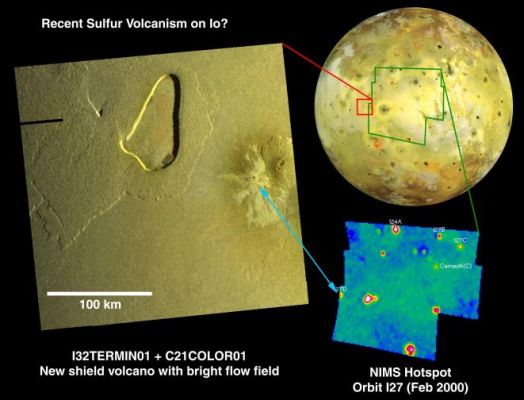
A field of bright lava flows next to a shield volcano could be a source of recent sulfur volcanism on Io, as detected by instruments aboard NASA's Galileo spacecraft.
The mosaic at left combines higher-resolution images (330 meters or about 1080 feet per picture element) taken in October 2001 with lower-resolution color images (1.4 kilometers or 0.9 mile per picture element) taken in July 1999 by Galileo's solid-state imaging camera.

By comparing these images with a map of hot spots taken in February by Galileo's near-infrared mapping spectrometer (lower right), Galileo scientists noted that a new hot spot west of the active volcano Prometheus became bright in February 2000 and dimmed later. This hot spot appears to correspond with the bright flow field just west of a recently discovered shield volcano (see PIA03532), which is the only fresh volcanic material in the area.

The relatively low intensity of the February 2000 hot spot in the infrared data suggests a low-temperature eruption, consistent with sulfur lava rather than silicate lava as found elsewhere on Io and also on Earth. Sulfur lavas are thought to cool to a gray-yellow color on Io, as seen in the new flow field visible in the camera image. This bright flow field could be the best example of active sulfur lava flows deposited on Io during the Galileo mission. At upper right is a global view of Io showing the location of the more-detailed images.

The low temperature of this hot spot differs from many of Io's other active volcanoes, such as Pele, Tvashtar and Prometheus. Intense tidal flexing of Io helps keep the moon's interior molten, at some places producing silicate lavas hotter than any seen on Earth in billions of years. Io has the greatest known diversity of volcanic activity in the solar system.

North is to the top of all these images.


Parole chiave: Jupiter's moons - Io

Potential Source of Sulphur Flow on Io

A field of bright lava flows next to a shield volcano could be a source of recent sulfur volcanism on Io, as detected by instruments aboard NASA's Galileo spacecraft.
The mosaic at left combines higher-resolution images (330 meters or about 1080 feet per picture element) taken in October 2001 with lower-resolution color images (1.4 kilometers or 0.9 mile per picture element) taken in July 1999 by Galileo's solid-state imaging camera.

By comparing these images with a map of hot spots taken in February by Galileo's near-infrared mapping spectrometer (lower right), Galileo scientists noted that a new hot spot west of the active volcano Prometheus became bright in February 2000 and dimmed later. This hot spot appears to correspond with the bright flow field just west of a recently discovered shield volcano (see PIA03532), which is the only fresh volcanic material in the area.

The relatively low intensity of the February 2000 hot spot in the infrared data suggests a low-temperature eruption, consistent with sulfur lava rather than silicate lava as found elsewhere on Io and also on Earth. Sulfur lavas are thought to cool to a gray-yellow color on Io, as seen in the new flow field visible in the camera image. This bright flow field could be the best example of active sulfur lava flows deposited on Io during the Galileo mission. At upper right is a global view of Io showing the location of the more-detailed images.

The low temperature of this hot spot differs from many of Io's other active volcanoes, such as Pele, Tvashtar and Prometheus. Intense tidal flexing of Io helps keep the moon's interior molten, at some places producing silicate lavas hotter than any seen on Earth in billions of years. Io has the greatest known diversity of volcanic activity in the solar system.

North is to the top of all these images.

Amalthea-PIA01072.jpg Callisto-PIA00080-PCF-LXTT-IPF.jpg Jupitercrescent_cassini_big.jpg Europa-PIA03878_modest.jpg Io-Southern Limb and light-PIA02250.jpg
Informazioni sul file
Nome del file:Io-Sulphur volcanism-PIA03887_modest.jpg
Nome album:Jupiter: the "King" and His Moons
Valutazione (12 voti):55555(Mostra dettagli)
Parole chiave:Jupiter's / moons / - / Io
Copyright:NASA - Galileo Project
Dimensione del file:48 KiB
Data di inserimento:Set 08, 2004
Dimensioni:661 x 504 pixels
Visualizzato:68 volte
URL:https://www.lunexit.it/gallery/displayimage.php?pid=2402
Preferiti:Aggiungi ai preferiti


Powered by Coppermine Photo Gallery