Inizio Registrati Login

Elenco album Ultimi arrivi Ultimi commenti Più viste Più votate Preferiti Cerca

Inizio > SOLAR SYSTEM > Jupiter: the "King" and His Moons
Ritorna alla pagina delle miniature FILE 235/325 Torna all'inizio Guarda foto precedente Guarda foto successiva Salta alla fine
The Inner Ocean of Europa
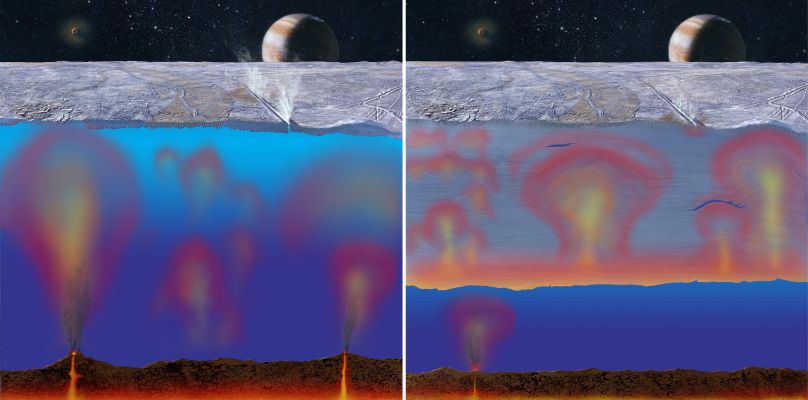
Caption NASA:"Scientists are all but certain that Europa has an ocean underneath its icy surface, but they do not know how thick this ice might be. This artist concept illustrates 2 possible cut-away views through Europa's ice shell. In both, heat escapes, possibly volcanically, from Europa's rocky mantle and is carried upward by buoyant oceanic currents. If the heat from below is intense and the ice shell is thin enough (left), the ice shell can directly melt, causing what are called "chaos" on Europa, regions of what appear to be broken, rotated and tilted ice blocks. On the other hand, if the ice shell is sufficiently thick (right), the less intense interior heat will be transferred to the warmer ice at the bottom of the shell, and additional heat is generated by tidal squeezing of the warmer ice. This warmer ice will slowly rise, flowing as glaciers do on Earth, and the slow but steady motion may also disrupt the extremely cold, brittle ice at the surface. 
Europa is no larger than Earth's moon, and its internal heating stems from its eccentric orbit about Jupiter, seen in the distance. As tides raised by Jupiter in Europa's ocean rise and fall, they may cause cracking, additional heating and even venting of water vapor into the airless sky above Europa's icy surface".
Parole chiave: Maps

The Inner Ocean of Europa

Caption NASA:"Scientists are all but certain that Europa has an ocean underneath its icy surface, but they do not know how thick this ice might be. This artist concept illustrates 2 possible cut-away views through Europa's ice shell. In both, heat escapes, possibly volcanically, from Europa's rocky mantle and is carried upward by buoyant oceanic currents. If the heat from below is intense and the ice shell is thin enough (left), the ice shell can directly melt, causing what are called "chaos" on Europa, regions of what appear to be broken, rotated and tilted ice blocks. On the other hand, if the ice shell is sufficiently thick (right), the less intense interior heat will be transferred to the warmer ice at the bottom of the shell, and additional heat is generated by tidal squeezing of the warmer ice. This warmer ice will slowly rise, flowing as glaciers do on Earth, and the slow but steady motion may also disrupt the extremely cold, brittle ice at the surface.
Europa is no larger than Earth's moon, and its internal heating stems from its eccentric orbit about Jupiter, seen in the distance. As tides raised by Jupiter in Europa's ocean rise and fall, they may cause cracking, additional heating and even venting of water vapor into the airless sky above Europa's icy surface".

Jupiter-HST.jpg Europa.jpg Jupiter-PIA10076.jpg Jupiter-02.jpg Io-100907_8.jpg
Informazioni sul file
Nome del file:Europa-PIA10131.jpg
Nome album:MareKromium / Jupiter: the "King" and His Moons
Valutazione (3 voti):55555(Mostra dettagli)
Parole chiave:Maps
Copyright:NASA/JPL - Michael Carrol
Dimensione del file:1824 KiB
Data di inserimento:Dic 18, 2007
Dimensioni:6060 x 3000 pixels
Visualizzato:58 volte
URL:https://www.lunexit.it/gallery/displayimage.php?pid=18964
Preferiti:Aggiungi ai preferiti


Powered by Coppermine Photo Gallery