Inizio Registrati Login

Elenco album Ultimi arrivi Ultimi commenti Più viste Più votate Preferiti Cerca

Inizio > SOLAR SYSTEM > Jupiter: the "King" and His Moons
Ritorna alla pagina delle miniature FILE 228/325 Torna all'inizio Guarda foto precedente Guarda foto successiva Salta alla fine
As Time goes by...On Io!
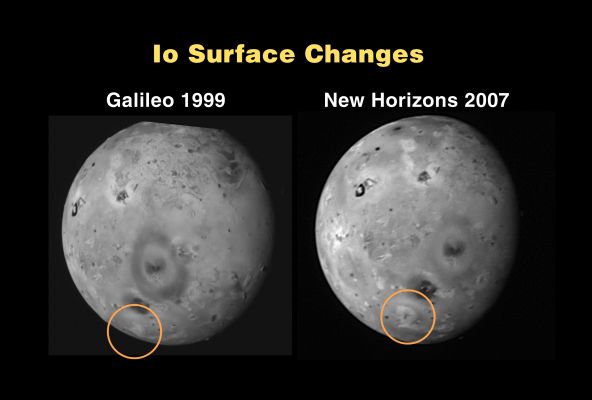
This montage compares similar sides of Io photographed by the Galileo spacecraft in October 1999 and the New Horizons spacecraft on February 27, 2007. 
The New Horizons image was taken with its Long Range Reconnaissance Imager (LORRI) from a range of 2,7 MKM (about 1,7 MMs).
Most features on Io have changed little in the 7-plus years between these images, despite continued intense volcanic activity. The largest visible feature is the dark oval composed of deposits from the Pele Volcano, nearly 1200 Km (about 750 miles) across its longest dimension. At high Northern Latitudes, the volcano Dazhbog is prominent as a dark spot in the New Horizons image, near the edge of the disk at the 11 o'clock position. This volcano is much less conspicuous in the Galileo image. This darkening happened after this 1999 Galileo image but before Galileo took its last images of Io in 2001.
A more recent change, discovered by New Horizons, can be seen in the Southern Hemisphere (circled). 
A new volcanic eruption - near 55° South and 290° West - has created a roughly circular deposit nearly 500 Km (about 300 miles) in diameter that was not seen by Galileo. Other New Horizons images show that the plume that created this deposit is still active.

The New Horizons image is centered at Io coordinates 8° South and 269° West.


Parole chiave: Jupiter's Moon - Io

As Time goes by...On Io!

This montage compares similar sides of Io photographed by the Galileo spacecraft in October 1999 and the New Horizons spacecraft on February 27, 2007.
The New Horizons image was taken with its Long Range Reconnaissance Imager (LORRI) from a range of 2,7 MKM (about 1,7 MMs).
Most features on Io have changed little in the 7-plus years between these images, despite continued intense volcanic activity. The largest visible feature is the dark oval composed of deposits from the Pele Volcano, nearly 1200 Km (about 750 miles) across its longest dimension. At high Northern Latitudes, the volcano Dazhbog is prominent as a dark spot in the New Horizons image, near the edge of the disk at the 11 o'clock position. This volcano is much less conspicuous in the Galileo image. This darkening happened after this 1999 Galileo image but before Galileo took its last images of Io in 2001.
A more recent change, discovered by New Horizons, can be seen in the Southern Hemisphere (circled).
A new volcanic eruption - near 55° South and 290° West - has created a roughly circular deposit nearly 500 Km (about 300 miles) in diameter that was not seen by Galileo. Other New Horizons images show that the plume that created this deposit is still active.

The New Horizons image is centered at Io coordinates 8° South and 269° West.

Jupiter-20070323.gif Jupiter-lor_0035089864_0x630_sci_1.jpg Io-050107_08.jpg Io-050107_03.jpg Io-050107_08~0.jpg
Informazioni sul file
Nome del file:Io-050107_07.jpg
Nome album:MareKromium / Jupiter: the "King" and His Moons
Valutazione (6 voti):55555(Mostra dettagli)
Parole chiave:Jupiter's / Moon / - / Io
Copyright:NASA/Johns Hopkins University Applied Physics Laboratory/Southwest Research Institute
Dimensione del file:1124 KiB
Data di inserimento:Mag 02, 2007
Dimensioni:3000 x 2025 pixels
Visualizzato:58 volte
URL:https://www.lunexit.it/gallery/displayimage.php?pid=16684
Preferiti:Aggiungi ai preferiti


Powered by Coppermine Photo Gallery