Inizio Registrati Login

Elenco album Ultimi arrivi Ultimi commenti Più viste Più votate Preferiti Cerca

Inizio > SOLAR SYSTEM > Jupiter: the "King" and His Moons
Ritorna alla pagina delle miniature FILE 277/325 Torna all'inizio Guarda foto precedente Guarda foto successiva Salta alla fine
Storm Spectra
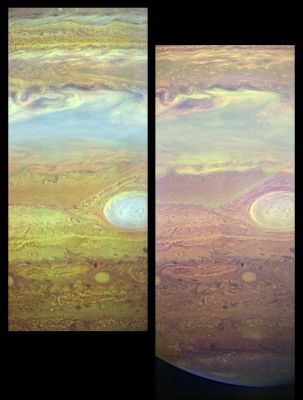
These images, taken with the LEISA infrared camera on the New Horizons Ralph instrument, show fine details in Jupiter's turbulent atmosphere using light that can only be seen using infrared sensors. These are "false color" pictures made by assigning infrared wavelengths to the colors red, green and blue. LEISA (Linear Etalon Imaging Spectral Array) takes images across 250 IR wavelengths in the range from 1.25 to 2.5 microns, allowing scientists to obtain an infrared spectrum at every location on Jupiter. A micron is one millionth of a meter. 

These pictures were taken at 05:58 UT on February 27, 2007, from a distance of 2.9 million kilometers (1.6 million miles). They are centered at 8 degrees south, 32 degrees east in Jupiter "System III" coordinates. The large oval-shaped feature is the well-known Great Red Spot. The resolution of each pixel in these images is about 175 kilometers (110 miles); Jupiter's diameter is approximately 145,000 kilometers (97,000 miles). 

The image on the left is an altitude map made by assigning the color red to 1.60 microns, green to 1.89 microns and blue to 2.04 microns. Because Jupiter's atmosphere absorbs light strongly at 2.04 microns, only clouds at very high altitude will reflect light at this wavelength. Light at 1.89 microns can go deeper in the atmosphere and light at 1.6 microns can go deeper still. In this map, bluish colors indicate high clouds and reddish colors indicate lower clouds. This picture shows, for example, that the Great Red Spot extends far up into the atmosphere.

In the image at right, red equals 1.28 microns, green equals 1.30 microns and blue equals 1.36 microns, a range of wavelengths that similarly probes different altitudes in the atmosphere. This choice of wavelengths highlights Jupiter's high-altitude south polar hood of haze. The edge of Jupiter's disk at the bottom of the panel appears slightly non-circular because the left-hand portion is the true edge of the disk, while the right portion is defined by the day/night boundary (known as the terminator).

These two images illustrate only a small fraction of the information contained in a single LEISA scan, highlighting just one aspect of the power of infrared spectra for atmospheric studies.


Parole chiave: Jupiter from Space

Storm Spectra

These images, taken with the LEISA infrared camera on the New Horizons Ralph instrument, show fine details in Jupiter's turbulent atmosphere using light that can only be seen using infrared sensors. These are "false color" pictures made by assigning infrared wavelengths to the colors red, green and blue. LEISA (Linear Etalon Imaging Spectral Array) takes images across 250 IR wavelengths in the range from 1.25 to 2.5 microns, allowing scientists to obtain an infrared spectrum at every location on Jupiter. A micron is one millionth of a meter.

These pictures were taken at 05:58 UT on February 27, 2007, from a distance of 2.9 million kilometers (1.6 million miles). They are centered at 8 degrees south, 32 degrees east in Jupiter "System III" coordinates. The large oval-shaped feature is the well-known Great Red Spot. The resolution of each pixel in these images is about 175 kilometers (110 miles); Jupiter's diameter is approximately 145,000 kilometers (97,000 miles).

The image on the left is an altitude map made by assigning the color red to 1.60 microns, green to 1.89 microns and blue to 2.04 microns. Because Jupiter's atmosphere absorbs light strongly at 2.04 microns, only clouds at very high altitude will reflect light at this wavelength. Light at 1.89 microns can go deeper in the atmosphere and light at 1.6 microns can go deeper still. In this map, bluish colors indicate high clouds and reddish colors indicate lower clouds. This picture shows, for example, that the Great Red Spot extends far up into the atmosphere.

In the image at right, red equals 1.28 microns, green equals 1.30 microns and blue equals 1.36 microns, a range of wavelengths that similarly probes different altitudes in the atmosphere. This choice of wavelengths highlights Jupiter's high-altitude south polar hood of haze. The edge of Jupiter's disk at the bottom of the panel appears slightly non-circular because the left-hand portion is the true edge of the disk, while the right portion is defined by the day/night boundary (known as the terminator).

These two images illustrate only a small fraction of the information contained in a single LEISA scan, highlighting just one aspect of the power of infrared spectra for atmospheric studies.

Callisto-HR-02.jpg Io-Tohill-Scarp-01.jpg Io-Sulphur_Volcanism-Original_NASA_Galileo.jpg Io-New_Horizons.jpg Callisto-040507.jpg
Informazioni sul file
Nome del file:Jupiter-033007.jpg
Nome album:Jupiter: the "King" and His Moons
Valutazione (4 voti):55555(Mostra dettagli)
Parole chiave:Jupiter / from / Space
Copyright:NASA/Johns Hopkins University Applied Physics Laboratory/Southwest Research Institute
Dimensione del file:72 KiB
Data di inserimento:Apr 02, 2007
Dimensioni:550 x 726 pixels
Visualizzato:57 volte
URL:https://www.lunexit.it/gallery/displayimage.php?pid=16383
Preferiti:Aggiungi ai preferiti


Powered by Coppermine Photo Gallery