|
|
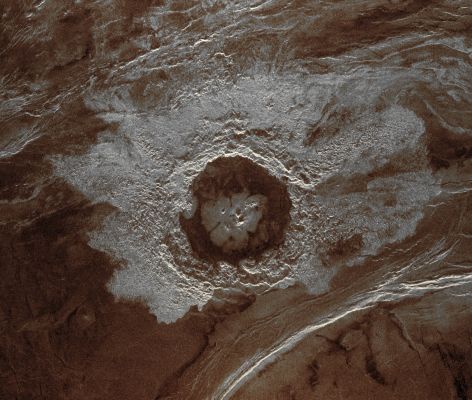
Dickinson Crater (possible Natural Colors; credits: Dr Paolo C. Fienga - Lunexit Team)
|
This Magellan image is centered at 74,6° North Latitude and 177,3° East Longitude, in the North/Eastern Atalanta Region of Venus.
The image is approximately 185 Km (about 115 miles) wide at the base, and shows Dickinson, an Impact Crater of about 69 Km (approx. 43 miles) in diameter. The Crater is complex, characterized by a partial Central Ring and a Floor flooded by radar-dark and radar-bright materials.
Hummocky, rough-textured ejecta extend all around the Crater, except to the West. The lack of ejecta to the West may indicate that the Impactor that produced the Crater reached the Surface on an oblique angle, and from the West.
Extensive radar-bright flows that emanate from the Crater's Eastern Walls may represent large volumes of impact melt, or they may be the result of volcanic material released from the Subsurface during the cratering event.
|
|










Ma la verità è che, se i processi che portano alla creazione di un cratere da impatto, in fondo, sono sempre gli stessi, ovunque l'impatto occorra (le Varianti Maggiori, lo sai, son sempre quelle e cioè: Densità dell'Atmosfera del Corpo Ricevente; Dimensioni e Densità del Corpo Impattante; Velocità ed Angolo d'Impatto; Tipologia di Superficie Impattata - in termini di composizione e durezza), è altresì vero che le condizioni dell'ambiente Lunare sono profondamente diverse da quelle dell'ambiente Venusiano.
Per l'esattezza: l'ambiente Lunare è sostanzialmente statico, quello Venusiano, invece, è - per quanto ne sappiamo - PROFONDAMENTE dinamico.
Su Venere, infatti, a parte l'enorme Pressione al Datum e la spessissima ed assai densa Coltre Atmosferica, c'è vento, c'è pioggia, c'è vulcanismo attivo ed attività sismica ricorrente (non residuale).
In breve: l'ambiente Venusiano è in condizione di modificare, nel tempo e profondamente, i Crateri da Impatto. L'ambiente Lunare...no.
Ciò premesso, le uniche affinità sulle quali possiamo speculare, tra Crateri d'Impatto Lunari e Venusiani, sono proprio quelle attinenti le forme dei Crateri stessi (dato e premesso che quelli Lunari resteranno identici - o con modifiche minime - nelle ere, mentre quelli Venusiani tenderanno a cambiare e, di fatto, cambieranno). Ma tutto il resto...E' diverso.
Un abbraccio - doc