Inizio Registrati Login

Elenco album Ultimi arrivi Ultimi commenti Più viste Più votate Preferiti Cerca

Inizio > SOLAR SYSTEM > Venus
Ritorna alla pagina delle miniature FILE 74/126 Torna all'inizio Guarda foto precedente Guarda foto successiva Salta alla fine
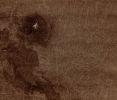
Outflow Channel in South Nawka Vallis (possible Natural Colors; credits: Dr Paolo C. Fienga - Lunexit Team)
This SAR image from the Southern portion of Navka (24,4-25,3° South Latitude and 338,5-340,5° East Longitude) is a mosaic of twelve Magellan orbits that covers approx. 180 Km (about 108 miles) in width and approx. 78 Km (about 47 miles) in length. 
In the center of this image are two bright Deposits running North to South. 
These Deposits outline an Outflow Channel that flowed from an about 60-Km diameter Crater that is to the South of the Channel itself. Inside the Outflow Channel and outlined by some so-called 'Bathtub Ring' Deposits are small Cones, most likely of volcanic origin. 
At the end of the Outflow Channel, where one would expect the smallest particles to be deposited, are specular features which may represent Sand Dunes. 

Seasat and space shuttle radar images of sand dunes on Earth also show specular reflections from smooth dune faces that are near-normal to the radar beam. 
Other evidence for aeolian activity are the dark and bright Windstreaks running East to West and that formed behind the Cones. Notice how the wind changes direction from a South/East-North/West flow at the right of the image to an East-West flow at the eastern edge of the Outflow Channel.
Parole chiave: Venus from orbit - Bright Deposits and Outflow Channel

Outflow Channel in South Nawka Vallis (possible Natural Colors; credits: Dr Paolo C. Fienga - Lunexit Team)

This SAR image from the Southern portion of Navka (24,4-25,3° South Latitude and 338,5-340,5° East Longitude) is a mosaic of twelve Magellan orbits that covers approx. 180 Km (about 108 miles) in width and approx. 78 Km (about 47 miles) in length.
In the center of this image are two bright Deposits running North to South.
These Deposits outline an Outflow Channel that flowed from an about 60-Km diameter Crater that is to the South of the Channel itself. Inside the Outflow Channel and outlined by some so-called 'Bathtub Ring' Deposits are small Cones, most likely of volcanic origin.
At the end of the Outflow Channel, where one would expect the smallest particles to be deposited, are specular features which may represent Sand Dunes.

Seasat and space shuttle radar images of sand dunes on Earth also show specular reflections from smooth dune faces that are near-normal to the radar beam.
Other evidence for aeolian activity are the dark and bright Windstreaks running East to West and that formed behind the Cones. Notice how the wind changes direction from a South/East-North/West flow at the right of the image to an East-West flow at the eastern edge of the Outflow Channel.

Venusian_Clouds_and_winds_in_the_infrared_H.jpg 7-Venus_orbit31V3_fc_H.jpg Craters-Mona_Lisa_Crater-PCF-LXTT-01.jpg Craters-Unnamed_Craters-Lakshmi_Region-PIA00477.jpg Volcanoes-Sacajawea_Patera-PIA00485.jpg
Informazioni sul file
Nome del file:Channels-Unnamed_Outflow_Channel-PIA00483.jpg
Nome album:MareKromium / Venus
Valutazione (4 voti):55555(Mostra dettagli)
Parole chiave:Venus / from / orbit / - / Bright / Deposits / and / Outflow / Channel
Copyright:NASA/JPL - Magellan Probe Project e Paolo C. Fienga/Lunexit Team per l'additional process. e la colorizzazione
Dimensione del file:1397 KiB
Data di inserimento:Gen 14, 2010
Dimensioni:5000 x 2000 pixels
Visualizzato:60 volte
URL:https://www.lunexit.it/gallery/displayimage.php?pid=26098
Preferiti:Aggiungi ai preferiti


Powered by Coppermine Photo Gallery