Inizio Registrati Login

Elenco album Ultimi arrivi Ultimi commenti Più viste Più votate Preferiti Cerca

Inizio > SOLAR SYSTEM > Saturn: the "Ringed Beauty" and His Moons
Ritorna alla pagina delle miniature FILE 651/2245 Torna all'inizio Guarda foto precedente Guarda foto successiva Salta alla fine
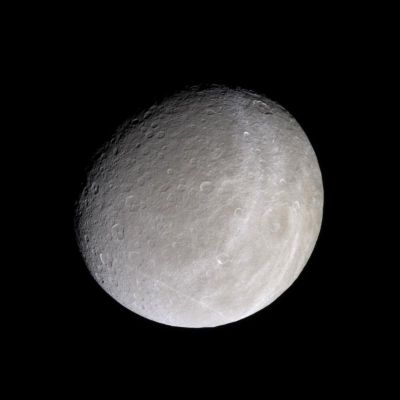
Rhea: a Moon made of "frozen water"! (possible ANOMALY)
Da "NASA - Picture of the Day" del 15 Febbraio 2005:"Rhea, Saturn's second largest moon behind Titan, shows unusual wisps (wisp---> piccola striscia), visible above as light colored streaks. HR images of the wisps show them to be made of long braided fractures. Rhea is composed mostly of water ice, but likely has a small rocky core. Rhea's rotation and orbit are locked together, just like Earth's Moon, so that one side always faces Saturn; a consequence of this is that one side always leads the other. Rhea's leading surface is much more heavily cratered than the above pictured trailing surface". 
Vi segnaliamo inoltre una possibile "Anomalia" (e non crediamo che si tratti di un photo-artifact o di un difetto del frame derivante da un'incompleta trasmissione dei dati): se osservate il lato Sn di Rhea, in prossimità del bordo e circa ad ore 8, vedrete un "disco scuro" stagliarsi contro il grigio della sua superficie. Noi crediamo che sia un "corpo in transito" (magari una "luna di Rhea!).
Parole chiave: Saturn's Moons - Rhea

Rhea: a Moon made of "frozen water"! (possible ANOMALY)

Da "NASA - Picture of the Day" del 15 Febbraio 2005:"Rhea, Saturn's second largest moon behind Titan, shows unusual wisps (wisp---> piccola striscia), visible above as light colored streaks. HR images of the wisps show them to be made of long braided fractures. Rhea is composed mostly of water ice, but likely has a small rocky core. Rhea's rotation and orbit are locked together, just like Earth's Moon, so that one side always faces Saturn; a consequence of this is that one side always leads the other. Rhea's leading surface is much more heavily cratered than the above pictured trailing surface".
Vi segnaliamo inoltre una possibile "Anomalia" (e non crediamo che si tratti di un photo-artifact o di un difetto del frame derivante da un'incompleta trasmissione dei dati): se osservate il lato Sn di Rhea, in prossimità del bordo e circa ad ore 8, vedrete un "disco scuro" stagliarsi contro il grigio della sua superficie. Noi crediamo che sia un "corpo in transito" (magari una "luna di Rhea!).

Saturn-PIA07008.jpg Saturn-PIA06177.jpg Epimetheus-N00027756.jpg Enceladus-N00028181.jpg Janus-N00028725.jpg
Informazioni sul file
Nome del file:RHEA~0.jpg
Nome album:Saturn: the "Ringed Beauty" and His Moons
Valutazione (9 voti):55555(Mostra dettagli)
Parole chiave:Saturn's / Moons / - / Rhea
Copyright:Cassini Imaging Team, SSI, JPL, ESA, NASA
Dimensione del file:34 KiB
Data di inserimento:Feb 15, 2005
Dimensioni:800 x 800 pixels
Visualizzato:60 volte
URL:https://www.lunexit.it/gallery/displayimage.php?pid=4394
Preferiti:Aggiungi ai preferiti

Commento 1 a 1 di 1
Pagina: 1

MareKromium   [Dic 12, 2020 at 04:08 PM]
...o forse quel corpo errante che, frantumandosi, generò quel fenomeno temporaneo noto come "Anelli di Rhea". E se così fosse (ma non lo sapremo mai), anche questo dettaglio sarebbe "storico".

Commento 1 a 1 di 1
Pagina: 1


Powered by Coppermine Photo Gallery