Inizio Registrati Login

Elenco album Ultimi arrivi Ultimi commenti Più viste Più votate Preferiti Cerca

Inizio > SOLAR SYSTEM > Saturn: the "Ringed Beauty" and His Moons
Ritorna alla pagina delle miniature FILE 325/2245 Torna all'inizio Guarda foto precedente Guarda foto successiva Salta alla fine
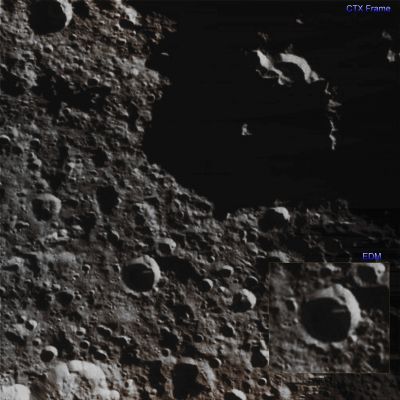
Farewell to Rhea (Absolute Natural Colors; credits for the additional process. and color.: Dr Paolo C. Fienga/Lunar Explorer Italia/Italian Planetary Foundation)
On its fourth and final targeted Fly-By of Rhea, the NASA - Cassini Spacecraft provided many stunning views its ancient, tormented and heavily cratered Surface. Billions of years of impacts, in fact, have sculpted Rhea's Surface into the form we see today and, with a diameter of approx. 950 miles (such as about 1528,8 Km), Rhea is the second-largest moon of Saturn. 
In the EDM here (is on the lower right - Dx - of the CTX Frame), you can see an extremely interesting and, in a way, really mysterious and bizarre-looking Horizontal Linear Structure that looks like a Wall and whose upper edge is still illuminated by the Sun; the Structure - whose origin is and, most likely, will remain unknown - is located within a relatively small-sized and Unnamed Impact Crater and it extends for about one/third of its Inner Diameter. This view was taken in Visible Light on December 22, 2012, at a distance of approximately 16.805 miles (such as a little less than 27.045 Km) from the Surface of Rhea. 

This frame (which is an Original NASA - Cassini Spacecraft b/w image identified by the serial n. N00199484) has been additionally processed, contrast enhanced, and then colorized in Absolute Natural Colors (such as the colors that a human eye would actually perceive if someone were onboard the NASA - Cassini Spacecraft and then looked down, towards the Surface of the Saturnian moon Rhea), by using an original technique created - and, in time, dramatically improved - by the Lunar Explorer Italia Team. Different colors, as well as different shades of the same color, mean, among others, the existence of different Elements present on the Surface of Rhea, each having a different Albedo (---> Reflectivity) and Chemical Composition.

Note: it is possible (but we, as IPF, have no way to be one-hundred-percent sure of such a circumstance), that the actual luminosity of the Surface of Rhea - as it is presented in this image - would appear, to an average human eye, way lower than it has been shown (or, better yet: interpreted) here.
Parole chiave: Saturnian Moons - Rhea

Farewell to Rhea (Absolute Natural Colors; credits for the additional process. and color.: Dr Paolo C. Fienga/Lunar Explorer Italia/Italian Planetary Foundation)

On its fourth and final targeted Fly-By of Rhea, the NASA - Cassini Spacecraft provided many stunning views its ancient, tormented and heavily cratered Surface. Billions of years of impacts, in fact, have sculpted Rhea's Surface into the form we see today and, with a diameter of approx. 950 miles (such as about 1528,8 Km), Rhea is the second-largest moon of Saturn.
In the EDM here (is on the lower right - Dx - of the CTX Frame), you can see an extremely interesting and, in a way, really mysterious and bizarre-looking Horizontal Linear Structure that looks like a Wall and whose upper edge is still illuminated by the Sun; the Structure - whose origin is and, most likely, will remain unknown - is located within a relatively small-sized and Unnamed Impact Crater and it extends for about one/third of its Inner Diameter. This view was taken in Visible Light on December 22, 2012, at a distance of approximately 16.805 miles (such as a little less than 27.045 Km) from the Surface of Rhea.

This frame (which is an Original NASA - Cassini Spacecraft b/w image identified by the serial n. N00199484) has been additionally processed, contrast enhanced, and then colorized in Absolute Natural Colors (such as the colors that a human eye would actually perceive if someone were onboard the NASA - Cassini Spacecraft and then looked down, towards the Surface of the Saturnian moon Rhea), by using an original technique created - and, in time, dramatically improved - by the Lunar Explorer Italia Team. Different colors, as well as different shades of the same color, mean, among others, the existence of different Elements present on the Surface of Rhea, each having a different Albedo (---> Reflectivity) and Chemical Composition.

Note: it is possible (but we, as IPF, have no way to be one-hundred-percent sure of such a circumstance), that the actual luminosity of the Surface of Rhea - as it is presented in this image - would appear, to an average human eye, way lower than it has been shown (or, better yet: interpreted) here.

Enceladus-N00160966-79-EB-LXTT.jpg Hyperion-MF-PCF-LXTT-3.jpg Hyperion-MF-PCF-LXTT-2.jpg Enceladus from Voyager 2.jpg Japetus-A-W-Deathstar-28.jpg
Informazioni sul file
Nome del file:Rhea-IMG004709-br500-PCF-LXTT-IPF.jpg
Nome album:MareKromium / Saturn: the "Ringed Beauty" and His Moons
Valutazione (3 voti):55555(Mostra dettagli)
Parole chiave:Saturnian / Moons / - / Rhea
Copyright:NASA/JPL/Space Science Institute and Dr Paolo C. Fienga - Lunar Explorer Italia/IPF per l'additional process. e la colorizzazione del frame
Dimensione del file:686 KiB
Data di inserimento:Mag 26, 2013
Dimensioni:2990 x 2990 pixels
Visualizzato:74 volte
URL:https://www.lunexit.it/gallery/displayimage.php?pid=31113
Preferiti:Aggiungi ai preferiti


Powered by Coppermine Photo Gallery