Inizio Registrati Login

Elenco album Ultimi arrivi Ultimi commenti Più viste Più votate Preferiti Cerca

Inizio > SOLAR SYSTEM > Saturn: the "Ringed Beauty" and His Moons
Ritorna alla pagina delle miniature FILE 40/2245 Torna all'inizio Guarda foto precedente Guarda foto successiva Salta alla fine
Saturnian Lightnings
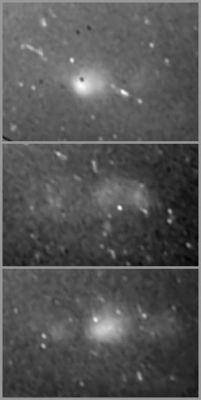
NASA's Cassini Spacecraft captured images of lightning at Saturn that allowed scientists to create the first movie showing lightning flashing on another Planet. 
"The Visible Light images tell us a lot about the lightning," said Ulyana Dyudina, a Cassini imaging team associate based at the California Institute of Technology (Caltech) in Pasadena, Calif., who was the first to see the flashes. "Now we can begin to measure how powerful these storms are, where they form in the cloud layer and how the optical intensity relates to the total energy of the thunderstorms."

After waiting years for Saturn to dim enough for the Spacecraft's cameras to be able to detect bursts of light, scientists were able to create the movie, complete with an accompanying soundtrack that features the crackle of radio waves emitted when lightning bolts struck.

"This is the first time we have the visible lightning flash together with the radio data," said Georg Fischer, a radio and plasma wave science team associate based at the Space Research Institute in Graz, Austria. "Now that the radio and visible light data line up, we know for sure we are seeing powerful lightning storms."

Cassini, launched in 1997, and NASA's Voyager mission, launched in 1977, had previously captured radio emissions from storms on Saturn. 

A belt around the gas giant, where Cassini previously detected radio emissions and bright, conservative clouds, even earned the nickname "storm alley." Cassini's cameras, however, had been unable to obtain pictures of lightning flashing.

Since the Robotic Spacecraft's arrival at Saturn in 2004, it has been difficult for Cassini to see lightning because the planet is very bright and reflective. Sunlight that shines off of Saturn's enormous Rings makes even the night side of Saturn brighter than a full-moon night on Earth. 
The Equinox period around August 2009 finally brought enough darkness needed for Cassini's cameras. During Equinox, the Sun shone directly over the Planet's Equator, lighting the Rings edge-on only, leaving the bulk of the Rings in shadow. 

The movie and radio data collected by the scientists suggest extremely powerful storms, with lightning that flashes as brightly as the brightest super-bolts of lightning on Earth, according to Andrew Ingersoll, a Cassini imaging science subsystem team member at Caltech. 

"What's interesting is that the storms are as powerful or even more powerful at Saturn as on Earth," Ingersoll said. "But they occur much less frequently, with usually only one happening on the planet at any given time, though it can last for months."

The first images of lightning on Saturn were captured in August 2009, during a storm that lasted from January to October 2009, longer than any other observed lightning storm in the Solar System. 

In order to make a video, scientists needed more pictures with brighter lightning and strong radio signals. Data collected during a shorter subsequent storm, which occurred from November through mid-December 2009, was also used. 

The frames in the video were obtained over a period of 16 minutes on Nov. 30, 2009. The flashes lasted less than one second. The images also show a cloud as long as 1900 miles (3057,746 Km) across, with the regions illuminated by the lightning flashes reaching approx. 190 miles (305,7746 Km) in diameter. Scientists used the width of the lightning flashes to gauge the depth of the bolts below the cloud tops. 

Lightning that strikes on Earth and Saturn emit radio waves at a frequency that can cause static on an AM radio. The audio in the video approximate that static sound, based on Saturn's electrostatic discharge signals that were detected by Cassini's radio and plasma wave science instrument. 

Scientists monitoring the Cassini Orbiter were busy during this Equinox period, having already observed clumps in Saturn's Rings that are as high as the Rocky Mountains. 

The Cassini-Huygens mission is a joint project involving NASA, the European Space Agency and the Italian Space Agency. The Jet Propulsion Laboratory, a division of Caltech, manages the Cassini-Huygens mission for NASA's Science Mission Directorate in Washington. The Cassini orbiter and its two onboard cameras were designed, developed and assembled at the Jet Propulsion Laboratory.
Parole chiave: Saturn - Upper Atmosphere

Saturnian Lightnings

NASA's Cassini Spacecraft captured images of lightning at Saturn that allowed scientists to create the first movie showing lightning flashing on another Planet.
"The Visible Light images tell us a lot about the lightning," said Ulyana Dyudina, a Cassini imaging team associate based at the California Institute of Technology (Caltech) in Pasadena, Calif., who was the first to see the flashes. "Now we can begin to measure how powerful these storms are, where they form in the cloud layer and how the optical intensity relates to the total energy of the thunderstorms."

After waiting years for Saturn to dim enough for the Spacecraft's cameras to be able to detect bursts of light, scientists were able to create the movie, complete with an accompanying soundtrack that features the crackle of radio waves emitted when lightning bolts struck.

"This is the first time we have the visible lightning flash together with the radio data," said Georg Fischer, a radio and plasma wave science team associate based at the Space Research Institute in Graz, Austria. "Now that the radio and visible light data line up, we know for sure we are seeing powerful lightning storms."

Cassini, launched in 1997, and NASA's Voyager mission, launched in 1977, had previously captured radio emissions from storms on Saturn.

A belt around the gas giant, where Cassini previously detected radio emissions and bright, conservative clouds, even earned the nickname "storm alley." Cassini's cameras, however, had been unable to obtain pictures of lightning flashing.

Since the Robotic Spacecraft's arrival at Saturn in 2004, it has been difficult for Cassini to see lightning because the planet is very bright and reflective. Sunlight that shines off of Saturn's enormous Rings makes even the night side of Saturn brighter than a full-moon night on Earth.
The Equinox period around August 2009 finally brought enough darkness needed for Cassini's cameras. During Equinox, the Sun shone directly over the Planet's Equator, lighting the Rings edge-on only, leaving the bulk of the Rings in shadow.

The movie and radio data collected by the scientists suggest extremely powerful storms, with lightning that flashes as brightly as the brightest super-bolts of lightning on Earth, according to Andrew Ingersoll, a Cassini imaging science subsystem team member at Caltech.

"What's interesting is that the storms are as powerful or even more powerful at Saturn as on Earth," Ingersoll said. "But they occur much less frequently, with usually only one happening on the planet at any given time, though it can last for months."

The first images of lightning on Saturn were captured in August 2009, during a storm that lasted from January to October 2009, longer than any other observed lightning storm in the Solar System.

In order to make a video, scientists needed more pictures with brighter lightning and strong radio signals. Data collected during a shorter subsequent storm, which occurred from November through mid-December 2009, was also used.

The frames in the video were obtained over a period of 16 minutes on Nov. 30, 2009. The flashes lasted less than one second. The images also show a cloud as long as 1900 miles (3057,746 Km) across, with the regions illuminated by the lightning flashes reaching approx. 190 miles (305,7746 Km) in diameter. Scientists used the width of the lightning flashes to gauge the depth of the bolts below the cloud tops.

Lightning that strikes on Earth and Saturn emit radio waves at a frequency that can cause static on an AM radio. The audio in the video approximate that static sound, based on Saturn's electrostatic discharge signals that were detected by Cassini's radio and plasma wave science instrument.

Scientists monitoring the Cassini Orbiter were busy during this Equinox period, having already observed clumps in Saturn's Rings that are as high as the Rocky Mountains.

The Cassini-Huygens mission is a joint project involving NASA, the European Space Agency and the Italian Space Agency. The Jet Propulsion Laboratory, a division of Caltech, manages the Cassini-Huygens mission for NASA's Science Mission Directorate in Washington. The Cassini orbiter and its two onboard cameras were designed, developed and assembled at the Jet Propulsion Laboratory.

Rhea-PIA12746.jpg Enceladus-PIA14858-PCF-LXTT.jpg Saturnian_Lightnings-03.jpg A - Saturn_s sky before the Streak (1).jpg Enceladus-PIA12762-PCF-LXTT.jpg
Informazioni sul file
Nome del file:Saturnian_Lightnings-03.jpg
Nome album:MareKromium / Saturn: the "Ringed Beauty" and His Moons
Valutazione (3 voti):55555(Mostra dettagli)
Parole chiave:Saturn / - / Upper / Atmosphere
Copyright:NASA/JPL/Space Science Institute
Dimensione del file:14 KiB
Data di inserimento:Apr 01, 2011
Dimensioni:350 x 695 pixels
Visualizzato:152 volte
URL:https://www.lunexit.it/gallery/displayimage.php?pid=28776
Preferiti:Aggiungi ai preferiti

Commento 1 a 3 di 3
Pagina: 1

MareKromium   [Feb 28, 2020 at 05:29 PM]
Ma ve li immaginate i "fulmini" nell'Atmosfera di Saturno o di Giove?!?.... Io ci provo, ma non riesco.
walthari   [Mar 01, 2020 at 12:18 PM]
micidiali.....
MareKromium   [Mar 02, 2020 at 06:05 PM]
IMMENSI!

Commento 1 a 3 di 3
Pagina: 1


Powered by Coppermine Photo Gallery