Inizio Registrati Login

Elenco album Ultimi arrivi Ultimi commenti Più viste Più votate Preferiti Cerca

Inizio > SOLAR SYSTEM > Saturn: the "Ringed Beauty" and His Moons
Ritorna alla pagina delle miniature FILE 240/2245 Torna all'inizio Guarda foto precedente Guarda foto successiva Salta alla fine
The (enhanced) "True Colors" of the Saturninan Inner Moons
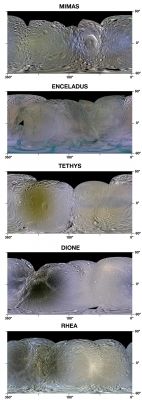
This set of enhanced-color maps made from data obtained by NASA's Cassini Spacecraft show Saturn's moons Mimas, Enceladus, Tethys, Dione and Rhea. The global maps show the colorful splotches and bands on the icy moons' Surfaces that scientists believe came from bombardments large and small.

Icy material sprayed by Enceladus, which makes up the misty E-Ring around Saturn, appears to leave a brighter, blue signature. 
The pattern of bluish material on Enceladus, for example, indicates that the moon is covered by the fallback of its own "breath". Enceladean spray also appears to splatter the parts of Tethys, Dione and Rhea that run into the spray head-on in their orbits around Saturn. But scientists are still puzzling over the reason why the Enceladean Frost on the Leading Hemisphere of these moons bears a coral-colored, rather than bluish, tint.

On Tethys, Dione and Rhea, darker, rust-colored reddish hues paint the entire Trailing Hemisphere, or the side that faces backward in the orbit around Saturn. The reddish hues are thought to be caused by tiny particle strikes from circulating Plasma, a gas-like state of matter so hot that atoms split into an ion and an electron, in Saturn's magnetic environment. Tiny, iron-rich "nanoparticles" may also be involved, based on earlier analyses by the Cassini Visual and InfraRed Mapping Spectrometer Team.

Mimas is touched by the tint of Enceladean spray, but it appears on the trailing side of Mimas. This probably occurs because it orbits inside the path of Enceladus, or closer to Saturn, than Tethys, Dione and Rhea.

Mimas and Tethys also sport a dark, bluish band. 
The bands match patterns one might expect if their Surface were being irradiated by high-energy electrons that drift in a direction opposite to the flow of Plasma in the magnetic bubble around Saturn. Scientists are still figuring out exactly what is happening on Mimas, but the electrons appear to be zapping the Surface in a way that matches the Pac-Man pattern detected by Cassini's Composite InfraRed Spectrometer.

On Rhea, a unique chain of bluish splotches appears where fresh, bluish ice has been exposed on older crater rims. Cassini imaging scientists recently reported that they did not see evidence in Cassini images of a ring around Rhea. However, scientists analyzing these new enhanced-color maps suggest the crash of orbiting material, perhaps a ring, to the surface of Rhea in the not too distant past, could explain the bluish splotches.

These new maps were made by processing raw images obtained by Cassini's imaging cameras from 2004 to 2009. Scientists analyzed frames shot through Visible-Light, UltraViolet and InfraRed filters. The processing enhanced our views of these moons beyond what could be seen by the human eye.

The maps are in a simple cylindrical projection from 90° South Latitude (bottom) to 90° North Latitude (top). From left to right, they cover 360° to - 2° West Longitude. The Leading Hemisphere appears on the right side of each map and Trailing Hemisphere appears on the left.
Parole chiave: Saturnian Moons - Inner Moons

The (enhanced) "True Colors" of the Saturninan Inner Moons

This set of enhanced-color maps made from data obtained by NASA's Cassini Spacecraft show Saturn's moons Mimas, Enceladus, Tethys, Dione and Rhea. The global maps show the colorful splotches and bands on the icy moons' Surfaces that scientists believe came from bombardments large and small.

Icy material sprayed by Enceladus, which makes up the misty E-Ring around Saturn, appears to leave a brighter, blue signature.
The pattern of bluish material on Enceladus, for example, indicates that the moon is covered by the fallback of its own "breath". Enceladean spray also appears to splatter the parts of Tethys, Dione and Rhea that run into the spray head-on in their orbits around Saturn. But scientists are still puzzling over the reason why the Enceladean Frost on the Leading Hemisphere of these moons bears a coral-colored, rather than bluish, tint.

On Tethys, Dione and Rhea, darker, rust-colored reddish hues paint the entire Trailing Hemisphere, or the side that faces backward in the orbit around Saturn. The reddish hues are thought to be caused by tiny particle strikes from circulating Plasma, a gas-like state of matter so hot that atoms split into an ion and an electron, in Saturn's magnetic environment. Tiny, iron-rich "nanoparticles" may also be involved, based on earlier analyses by the Cassini Visual and InfraRed Mapping Spectrometer Team.

Mimas is touched by the tint of Enceladean spray, but it appears on the trailing side of Mimas. This probably occurs because it orbits inside the path of Enceladus, or closer to Saturn, than Tethys, Dione and Rhea.

Mimas and Tethys also sport a dark, bluish band.
The bands match patterns one might expect if their Surface were being irradiated by high-energy electrons that drift in a direction opposite to the flow of Plasma in the magnetic bubble around Saturn. Scientists are still figuring out exactly what is happening on Mimas, but the electrons appear to be zapping the Surface in a way that matches the Pac-Man pattern detected by Cassini's Composite InfraRed Spectrometer.

On Rhea, a unique chain of bluish splotches appears where fresh, bluish ice has been exposed on older crater rims. Cassini imaging scientists recently reported that they did not see evidence in Cassini images of a ring around Rhea. However, scientists analyzing these new enhanced-color maps suggest the crash of orbiting material, perhaps a ring, to the surface of Rhea in the not too distant past, could explain the bluish splotches.

These new maps were made by processing raw images obtained by Cassini's imaging cameras from 2004 to 2009. Scientists analyzed frames shot through Visible-Light, UltraViolet and InfraRed filters. The processing enhanced our views of these moons beyond what could be seen by the human eye.

The maps are in a simple cylindrical projection from 90° South Latitude (bottom) to 90° North Latitude (top). From left to right, they cover 360° to - 2° West Longitude. The Leading Hemisphere appears on the right side of each map and Trailing Hemisphere appears on the left.

New_Moon-PIA08369_full_movie.gif Rhea-N00154965-66-67-EB-LXTT.jpg Dione-PIA12711.jpg Enceladus-N00165320-21-22-23-cl1-cl2-MF-LXTT.jpg The_Rings-PIA08306-PCF-LXTT-IPF.jpg
Informazioni sul file
Nome del file:Saturnian_Inner_Moons-PIA13423.jpg
Nome album:MareKromium / Saturn: the "Ringed Beauty" and His Moons
Valutazione (2 voti):55555(Mostra dettagli)
Parole chiave:Saturnian / Moons / - / Inner / Moons
Copyright:NASA/JPL/SSI/LPI
Dimensione del file:751 KiB
Data di inserimento:Ott 11, 2010
Dimensioni:1454 x 4068 pixels
Visualizzato:83 volte
URL:https://www.lunexit.it/gallery/displayimage.php?pid=27633
Preferiti:Aggiungi ai preferiti


Powered by Coppermine Photo Gallery