|
|
The Saturnian "Hexagon" and Aurora
|
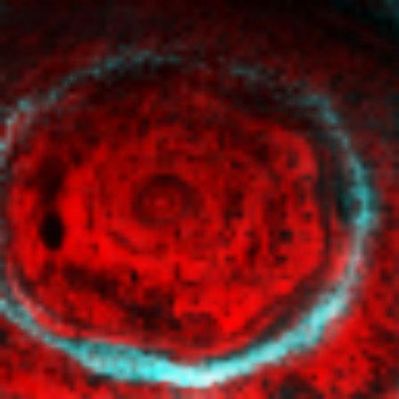
This nighttime view of Saturn's north pole by the visual and infrared mapping spectrometer on NASA's Cassini orbiter reveals a dynamic, active planet at least 75 kilometers (47 miles) below the normal cloud tops seen in visible light. Clearly revealed is the bizarre six-sided hexagon feature present at the north pole.
This image is one of the first clear images of the north polar region ever acquired from a unique polar perspective. In this image, the blue color shows high-altitude emissions from atmospheric molecules excited by charged particles smashing into the atmosphere along Saturn's powerful magnetic field lines, producing the aurora at very high altitudes in Saturn's atmosphere. The red color indicates the amount of 5-micron wavelength radiation, or heat, generated in the depths of the warm interior of Saturn that escapes the planet. Clouds blocking this light are revealed as silhouettes against the background thermal glow of the planet.
This image is among the first to capture the entire hexagonal feature and north polar region in one shot. It is also one of the first polar views using Saturn's thermal glow at 5 microns (seven times the wavelength visible to the human eye) as the light source. This allows polar cloud features to be revealed during the persistent nighttime conditions under way during north polar winter.
The hexagonal feature was originally discovered by NASA's Voyager spacecraft in 1980, but those images and subsequent ground-based telescope images suffered from poor viewing perspectives, which placed the feature and the north pole at the extreme northern limb (edge) in those images.
The strong brightness of the hexagon feature indicates that it is primarily a clearing in the clouds, which extends deep into the atmosphere, at least down to the 3-bar (3-Earth atmospheres pressure) level, about 75 kilometers (47 miles) below the clouds and hazes seen in visible wavelengths. Thick clouds border both sides of the narrow feature, as indicated by the adjacent dark lanes paralleling the bright hexagon. This image and other images acquired over a 12-day period between Oct. 30 and Nov. 11, 2006, show that the feature is nearly stationary, and likely is an unusually strong pole-encircling planetary wave that extends deep into the atmosphere.
This image was acquired by the Cassini visual and infrared mapping spectrometer on Oct. 29, 2006, from an average distance of 905,000 kilometers (562,340 miles) above the clouds.
|
|








Si sa che l’esagono esiste perché una sonda Voyager nel 1988 passò sopra il Polo Nord del pianeta e scattò una serie di fotografie. Dalle immagini si vide che la superficie di Saturno era formata da strisce circolari forse dovute a correnti che vanno da est a ovest nell’atmosfera. Nella zona del Polo Nord, però, assumevano una strana forma esagonale. Come mai? La causa fu attribuita a un enorme vortice tempestoso accanto all’esagono. Il vortice, col suo girare, avrebbe alterato la corrente, un po’ come un grosso masso in mezzo a un fiume altera il percorso del flusso d’acqua. Sembrava che tutto avesse avuto una spiegazione, e invece ecco la sorpresa. Le foto scattate nel 2006 dalla successiva missione Cassini mostrarono qualcosa di inaspettato: il vortice era sparito, eppure l’esagono continuava a essere lì.
Per capirci qualcosa di più, i fisici Ana Claudia Barbosa Aguiar e Peter Read, dell’Università di Oxford, in Inghilterra, hanno provato a riprodurre il fenomeno in laboratorio costruendo un modellino, descritto su “Icarus”. L’atmosfera di Saturno era rappresentata da un cilindro di 30 litri d’acqua posizionato su un tavolo che girava lentamente per simulare la rotazione del pianeta. Dentro il cilindro un piccolo anello girava più rapidamente e rappresentava una corrente atmosferica. Il getto prodotto è stato poi colorato di verde. Più l’anello ruotava veloce, meno la corrente verde manteneva la forma circolare e dei piccoli vortici modellavano la forma di un esagono. Giocando con l’aumento o la diminuzione delle velocità, i ricercatori hanno notato che quanto maggiore era la differenza della velocità di rotazione tra il cilindro e l’anello, tanti meno lati aveva il poligono ottenuto. Sono nate così forme geometriche di ogni tipo: quadrati, triangoli, ovali…
"Abbiamo potuto creare ovali, triangoli, quadrati, quasi qualsiasi forma volessimo" sostiene Read.
Maggiore è la differenza di rotazione tra l'anello ed il contenitore, meno lati ha il poligono. I ricercatori suggeriscono che l'esagono al polo nord di Saturno possa essere creato da correnti polari che ruotano ad una velocità differente da quella del resto dell'atmosfera, creando la forma poligonale.
Evidentemente le velocità relative di Saturno e della corrente in corrispondenza del Polo Nord favoriscono una figura a sei lati. Il modello del team di Oxford è stato apprezzato perché forse sarà d’aiuto nel capire come si formano le correnti del pianeta gassoso.
Forme simili sono già state osservate in uragani sulla Terra, ma tendono a dissiparsi moto velocemente. "La maggior parte degli scienziati planetari non sono a conoscenza di come queste dinamiche dei fluidi possano essere diffuse" dice Barbosa Aguiar.
Kevin Baines, scienziato planetario del Jet Propulsion Laboratory della NASA, è rimasto molto impressionato dal lavoro dei due ricercatori: "Questi risultati sono davvero intriganti. Il team ha creato ciò che penso sia un punto di riferimento che verrà provato nel tempo".
Anche se l'esperimento non spiega quale sia la forza che genera questi due tipi di correnti atmosferiche, Baines sostiene che i risultati possano dare una spiegazione reale su cosa stia accadendo nell'atmosfera di Saturno.
Ma per "forte" o "debole" che sia, la Teoria resta...un'ipotesi di lavoro. Nulla più. L'esempio del Big Bang (una Teoria BEN LUNGI dall'essere dimostrata!) calza: la Scuola, spessissimo ed a TUTTI i livelli, vende le Teorie per Certezze.
E nel campo dell'Astronomia e dell'Astrofisica, questo "bluff" intellettualmente disonesto viene propinato a 360°.
E chi discute queste "Teorie", o è incompetente o, come si dice oggi, "complottista".
E c'è di peggio: non conta più (o conta sempre meno) il "merito" di una Teoria! Conta la "fonte" dalla quale essa proviene.
E' la NASA? O una Grande Università? O un Pool di Scienziati "Top"? Allora la Teoria, per bislacca o forzata che sia ed anche se non dimostrata al 100%, viene (quanto meno) FORTEMENTE proposta come Verità/Certezza.
Ma se la Fonte di una Teoria, magari meno bislacca e forzata, è invece una meno "nobile" (si pensi, ad esempio, ad un Ente Privato di Ricerca, o ad un Ricercatore Indipendente, ad un neo-laureato o, magari, anche ad un semplice Appassionato), allora non ci sono dubbi: è una CAXXATA.
Ecco: questa è disonestà intellettuale.
Quello che accade su Saturno, o su Encelado, o Europa, o Marte, o nello Spazio Profondo etc. può darsi che sia spiegabile con qualche Modello già proposto e gettonato. Può darsi.
Ma tra il dire "può darsi" ed il dire "è così"...ci passa uno spazio immenso. Uno Spazio che è ancora più grande di quello che divide il nostro Pianeta dal Quasar meno lontano: sia concettualmente, sia filosoficamente.
Abbraccio a Voi! paolo