Inizio Registrati Login

Elenco album Ultimi arrivi Ultimi commenti Più viste Più votate Preferiti Cerca

Inizio > DEEP SKY > Deep Sky Objects
Ritorna alla pagina delle miniature FILE 152/1036 Torna all'inizio Guarda foto precedente Guarda foto successiva Salta alla fine
Looking back...
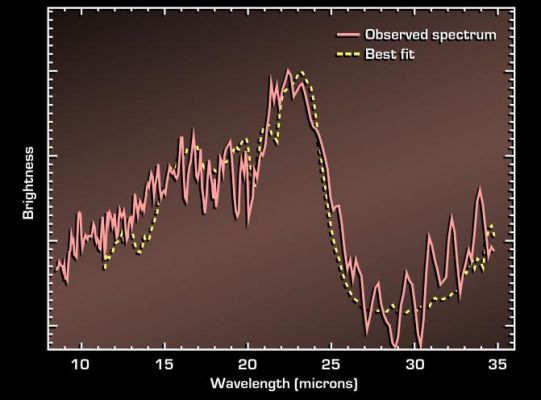
This graph, or spectrum, shows the light from a dusty, distant galaxy (invisible to optical telescopes) that is located 11 BLY away. NASA's SST was able to capture the light from it by using heat-seeking infrared eyes. Spectra are created when a  spectrograph spreads light out into its basic parts, like a prism turning sunlight into a rainbow. The spectra contain the signatures of molecules that contribute to an object's light. In this case, the galaxy's spectrum reveals the fingerprint for silicate dust (large dip at right), a planetary building block like sand, only smaller. This particular fingerprint is important because it helps to determine how far away the galaxy lies as well as how much the galaxy's light had stretched ("redshifted") during its journey to SST's eyes. Because the universe is expanding, a galaxy's light will shift toward reddish wavelengths as it moves away from us. This galaxy has a redshift of 1,95, meaning that its light travelled for 11 BY before 'hitting" SST's eyes. The presence of the silicate fingerprint is also significant because it implies that galaxies were ripe for planetary formation 11 billion years ago - back to a time when the universe was 3 billion years old. The universe is currently believed to be 13.5 billion years old. This is the furthest back in time that silicate dust has been detected around a galaxy.
Parole chiave: Graphs and Spectra

Looking back...

This graph, or spectrum, shows the light from a dusty, distant galaxy (invisible to optical telescopes) that is located 11 BLY away. NASA's SST was able to capture the light from it by using heat-seeking infrared eyes. Spectra are created when a spectrograph spreads light out into its basic parts, like a prism turning sunlight into a rainbow. The spectra contain the signatures of molecules that contribute to an object's light. In this case, the galaxy's spectrum reveals the fingerprint for silicate dust (large dip at right), a planetary building block like sand, only smaller. This particular fingerprint is important because it helps to determine how far away the galaxy lies as well as how much the galaxy's light had stretched ("redshifted") during its journey to SST's eyes. Because the universe is expanding, a galaxy's light will shift toward reddish wavelengths as it moves away from us. This galaxy has a redshift of 1,95, meaning that its light travelled for 11 BY before 'hitting" SST's eyes. The presence of the silicate fingerprint is also significant because it implies that galaxies were ripe for planetary formation 11 billion years ago - back to a time when the universe was 3 billion years old. The universe is currently believed to be 13.5 billion years old. This is the furthest back in time that silicate dust has been detected around a galaxy.

IC-2118-2-WITCHHEAD.jpg NGC-3310.jpg DR21-SST-PIA05733_modest.jpg Exo-Planet-PIA13054.jpg HD 100546_ctio.jpg
Informazioni sul file
Nome del file:Graph-PIA07395.jpg
Nome album:Deep Sky Objects
Valutazione (10 voti):55555(Mostra dettagli)
Parole chiave:Graphs / and / Spectra
Copyright:Spitzer Space Telescope - NASA/JPL - Caltech
Dimensione del file:36 KiB
Data di inserimento:Mar 07, 2005
Dimensioni:671 x 496 pixels
Visualizzato:116 volte
URL:https://www.lunexit.it/gallery/displayimage.php?pid=4659
Preferiti:Aggiungi ai preferiti


Powered by Coppermine Photo Gallery