Inizio Registrati Login

Elenco album Ultimi arrivi Ultimi commenti Più viste Più votate Preferiti Cerca

Inizio > MARS > Mars in JPEG2000
Ritorna alla pagina delle miniature FILE 57/198 Torna all'inizio Guarda foto precedente Guarda foto successiva Salta alla fine
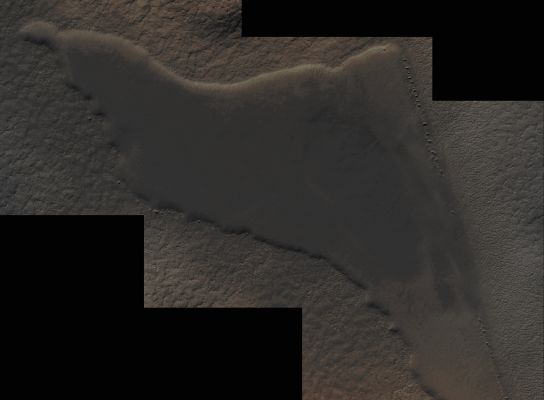
Possible Paleo-Lake near the South Pole of Mars (an Image-Mosaic in Absolute Natural Colors; credits for the Research, additional process. and color.: Drr Gianluigi Barca and Paolo C. Fienga/Lunar Explorer Italia/Italian Planetary Foundation)
In this image-mosaic showing the "Smooth South Polar Region", as NASA defined this Surface Feature, we wish to draw to your attention the extremely linear and, in a way, unusually-looking Chain of "oblong-shaped" Impact Craters that can easily be seen on the East Side (better yet: East Wall) of the Feature, from its upper right (Dx) corner and then down, for about 1/4 (one fourth) of its full length. This Chain of Craters litterally "follows" the Eastern Margin of the Lake-like Feature, then it suddenly stops (or, perhaps, quite a few of the Craters forming the Chain were simply "erased" by the occurrence of some Geological and/or Atmospherical - or both, probably - Events, still unknown at this point), and then it starts again, still remaining sharp and linear, but with a lesser Craters' Density. 
Furthermore, on the left (Sx) side of the Craters forming the Chain, the Surface appears to be characterized by the presence of Gullies (---> remember that a so-called "Gully" is a landform created by running water, eroding sharply into the Soil. Gullies may resemble to large ditches or small valleys, but they can be a few meters, to tens of meters, deep and wide. When the Gully Formation is in process, the Water Flow Rate can be substantial, and this fact causes a significant deep cutting action into the Soil). So, one - perhaps remote, but, in any case, extremely intriguing - possibility, is that the Chain of Craters (or whatever those "oblong-shaped holes in the ground" may be) was the actual "passageway" through which a more than significant amount of running water once flew and, in the end (an end that occurred, very likely, in a distant past), filled up the whole Surface Depression and formed a true South Polar Lake. Then the water froze, and the Surface of this Martian Lake got slowly covered by Dust and Ashes but, in any case, it remained very smooth, like the still waters that once must have been there and that, in our opinion, froze very quickly. 
All that said, we humbly believe, as IPF, that this whole Surface Feature has too quickly (and superficially) been called "Smooth South Polar Region", and then (at least as far as we know) forgotten by the many Spacecrafts that we still have orbiting around the Red Planet. In other words, if we had the chance, we would strongly suggest NASA (and ESA) to send the Mars Reconnaissance Orbiter and the Mars Express Spacecraft over this Region, and then take a new and better look at was lies down below, on the Surface. And this because, as they should know very well, "Science is always full of surprises"!...

Your opinions and insights about this topic are and shall always be appreciated.

Mars Local Time: 14:56 (Early Afternoon)
Coord. (centered): 78,638° South Lat. and 68,111° East Long.
Spacecraft altitude: 248,0 Km (such as about 154,008 miles) 
Original image scale range: 49,6 cm/pixel (with 2 x 2 binning) so objects ~ 1 mt and 49 cm across are resolved
Map projected scale: 50 cm/pixel
Map projection: POLAR STEREOGRAPHIC
Emission Angle: 4,5° 
Sun-Martian Surface-MRO Spacecraft (or Phase) Angle: 67,9°
Solar Incidence Angle: 65° (meaning that the Sun was about 25° above the Local Horizon at the time the picture was taken)
Solar Longitude: 317,2° (Northern Winter - Southern Summer)
Credits: NASA/JPL/University of Arizona
Additional process. and coloring: Lunar Explorer Italia

This picture (which is a cropped and NON-Map Projected NASA - Original Mars Reconnaissance Orbiter CTX b/w frame, identified by the serial n. ESP_023024_1010) has been additionally processed and then colorized in Absolute Natural Colors (such as the colors that a human eye would actually perceive if someone were onboard the NASA - Mars Reconnaissance Orbiter and then looked down, towards the Surface of Mars), by using an original technique created - and, in time, dramatically improved - by the Lunar Explorer Italia Team.
Parole chiave: Mars from orbit - South Polar Features - Possible Paleo-Lake - Controversial

Possible Paleo-Lake near the South Pole of Mars (an Image-Mosaic in Absolute Natural Colors; credits for the Research, additional process. and color.: Drr Gianluigi Barca and Paolo C. Fienga/Lunar Explorer Italia/Italian Planetary Foundation)

In this image-mosaic showing the "Smooth South Polar Region", as NASA defined this Surface Feature, we wish to draw to your attention the extremely linear and, in a way, unusually-looking Chain of "oblong-shaped" Impact Craters that can easily be seen on the East Side (better yet: East Wall) of the Feature, from its upper right (Dx) corner and then down, for about 1/4 (one fourth) of its full length. This Chain of Craters litterally "follows" the Eastern Margin of the Lake-like Feature, then it suddenly stops (or, perhaps, quite a few of the Craters forming the Chain were simply "erased" by the occurrence of some Geological and/or Atmospherical - or both, probably - Events, still unknown at this point), and then it starts again, still remaining sharp and linear, but with a lesser Craters' Density.
Furthermore, on the left (Sx) side of the Craters forming the Chain, the Surface appears to be characterized by the presence of Gullies (---> remember that a so-called "Gully" is a landform created by running water, eroding sharply into the Soil. Gullies may resemble to large ditches or small valleys, but they can be a few meters, to tens of meters, deep and wide. When the Gully Formation is in process, the Water Flow Rate can be substantial, and this fact causes a significant deep cutting action into the Soil). So, one - perhaps remote, but, in any case, extremely intriguing - possibility, is that the Chain of Craters (or whatever those "oblong-shaped holes in the ground" may be) was the actual "passageway" through which a more than significant amount of running water once flew and, in the end (an end that occurred, very likely, in a distant past), filled up the whole Surface Depression and formed a true South Polar Lake. Then the water froze, and the Surface of this Martian Lake got slowly covered by Dust and Ashes but, in any case, it remained very smooth, like the still waters that once must have been there and that, in our opinion, froze very quickly.
All that said, we humbly believe, as IPF, that this whole Surface Feature has too quickly (and superficially) been called "Smooth South Polar Region", and then (at least as far as we know) forgotten by the many Spacecrafts that we still have orbiting around the Red Planet. In other words, if we had the chance, we would strongly suggest NASA (and ESA) to send the Mars Reconnaissance Orbiter and the Mars Express Spacecraft over this Region, and then take a new and better look at was lies down below, on the Surface. And this because, as they should know very well, "Science is always full of surprises"!...

Your opinions and insights about this topic are and shall always be appreciated.

Mars Local Time: 14:56 (Early Afternoon)
Coord. (centered): 78,638° South Lat. and 68,111° East Long.
Spacecraft altitude: 248,0 Km (such as about 154,008 miles)
Original image scale range: 49,6 cm/pixel (with 2 x 2 binning) so objects ~ 1 mt and 49 cm across are resolved
Map projected scale: 50 cm/pixel
Map projection: POLAR STEREOGRAPHIC
Emission Angle: 4,5°
Sun-Martian Surface-MRO Spacecraft (or Phase) Angle: 67,9°
Solar Incidence Angle: 65° (meaning that the Sun was about 25° above the Local Horizon at the time the picture was taken)
Solar Longitude: 317,2° (Northern Winter - Southern Summer)
Credits: NASA/JPL/University of Arizona
Additional process. and coloring: Lunar Explorer Italia

This picture (which is a cropped and NON-Map Projected NASA - Original Mars Reconnaissance Orbiter CTX b/w frame, identified by the serial n. ESP_023024_1010) has been additionally processed and then colorized in Absolute Natural Colors (such as the colors that a human eye would actually perceive if someone were onboard the NASA - Mars Reconnaissance Orbiter and then looked down, towards the Surface of Mars), by using an original technique created - and, in time, dramatically improved - by the Lunar Explorer Italia Team.

ESP_019997_1975_RED_abrowse-01.jpg PSP_005370_1845_RED_abrowse-05.jpg ESP_023024_1010-GB-PCF-LXTT-IPF-Possible_Paleo-Lake-02.jpg PSP_007820_1505_RED_abrowse-44.JPG ESP_019011_2245-EB-LXTT.jpg
Informazioni sul file
Nome del file:ESP_023024_1010-GB-PCF-LXTT-IPF-Possible_Paleo-Lake-02.jpg
Nome album:MareKromium / Mars in JPEG2000
Valutazione (6 voti):55555(Mostra dettagli)
Parole chiave:Mars / from / orbit / - / South / Polar / Features / - / Possible / Paleo-Lake / - / Controversial
Copyright:NASA/JPL/University of Arizona and Drr Gianluigi Barca and Paolo C. Fienga for the research and the additional processing and color.
Dimensione del file:644 KiB
Data di inserimento:Feb 24, 2013
Dimensioni:2947 x 2166 pixels
Visualizzato:110 volte
URL:https://www.lunexit.it/gallery/displayimage.php?pid=31033
Preferiti:Aggiungi ai preferiti

Commento 1 a 8 di 8
Pagina: 1

MareKromium   [Feb 12, 2020 at 10:11 AM]
Questa é CO2 ghiacciata e senza crateri da impatto sulla superficie, per cui... DEVE essere recente. E NON parlo di miliardi o milioni di anni...
walthari   [Feb 19, 2020 at 11:38 AM]
essi
Anakin   [Feb 19, 2020 at 12:37 PM]
ma anche tanto recente, perchè suppongo che su Marte di meteoriti e asteroidi ne cadano un bel pò vista la mancanza di un atmosfera efficacie che possa fare da scudo
MareKromium   [Feb 24, 2020 at 03:47 PM]
Quoto Anakin. Per Walt: non ho capito... ehmmm.... "essi" chi o cosa?!?.... ;-)
walthari   [Feb 27, 2020 at 09:54 AM]
il fatto che sia recente...
MareKromium   [Feb 27, 2020 at 07:01 PM]
Ok. Ma Tu che ne pensi? Abbraccio!
walthari   [Mar 01, 2020 at 12:26 PM]
la logica ci impone di pensare questo lago in forma liquida non molto tempo fa, probabilmente diversi milioni di anni fa o meno e quindi che le condizioni ambientali di questa regione di MArte fossero ben diverse dalle attuali...
MareKromium   [Mar 02, 2020 at 06:04 PM]
Concordo.

Commento 1 a 8 di 8
Pagina: 1


Powered by Coppermine Photo Gallery