Inizio Registrati Login

Elenco album Ultimi arrivi Ultimi commenti Più viste Più votate Preferiti Cerca

Inizio > MARS > Mars in JPEG2000
Ritorna alla pagina delle miniature FILE 49/198 Torna all'inizio Guarda foto precedente Guarda foto successiva Salta alla fine
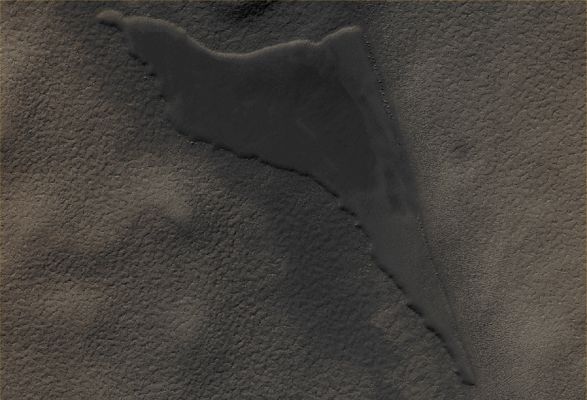
Possible Paleo-Lake near the South Pole of Mars (EDM; Absolute Natural Colors - credits for the Research, additional process. and color.: Drr Gianluigi Barca and Paolo C. Fienga/Lunar Explorer Italia/Italian Planetary Foundation)
This Surface Feature, now pictured by the NASA - Mars Reconnaissance Orbiter, but already known to Planetary Researchers (since it had already been photographed by the NASA - Mars Global Surveyor Orbiter a few years ago - see the MGS-MOC Image identified by the serial n. M09-01354), it is certainly very intriguing and highly suggestive. The NASA People, however, called this Surface Feature (that, in our humble opinion, as IPF, looks like a frozen Lake and it is also well characterized by the presence, on its Eastern Side, of a long line of almost perfectly lined-up and unusually-looking - "oblong" - Impact Craters) "Smooth South Polar Region". 
This Surface Feature (as you will better see in the next few days, when we shall show you its smallest details) is (or "looks", if you prefer) very peculiar, and that is a fact that can hardly be disputed. Said that, we, as IPF, expected that NASA told us something more about this Smooth South Polar Region. We honestly thought that NASA would (and should) have showed us soon enough this intriguing Surface Feature from other visual angles, maybe (if possible) from a lower altitude, certainly during other seasons/periods of the Martian Year and, last but not least, under different Illumination Geometries, but...Nothing happened. Not a word of explanation was ever said or written (as far as we know) and not an "official" comment whatsoever was ever released. 
Now, in the light of the aformentioned considerations, we decided to draw to your attention - through our Daily APOD - this "Smooth South Polar Region" and ask you a couple of simple questions: what do you really think or believe that this Surface Feature could be representing? Do you think that it could actually be the frozen remnant of an ancient (and once much bigger) Martian Lake or it is just a flat area surrounded by the typical Polar Terrain? If you wish to express your opinion, please write us at Alphacentauri@intercom.it . The most interesting and well substantiated ideas and theories that we hope to receive, shall be published here (giving to the Writer/s all the due credits), as additional comments to other (VERY detailed) orbital views of this very same Smooth South Polar Region. Thanks, as usual, for you interest and support! 

Dr Paolo C. Fienga/LXTT/IPF

Mars Local Time: 14:56 (Early Afternoon)
Coord. (centered): 78,638° South Lat. and 68,111° East Long.
Spacecraft altitude: 248,0 Km (such as about 154,008 miles) 
Original image scale range: 49,6 cm/pixel (with 2 x 2 binning) so objects ~ 1 mt and 49 cm across are resolved
Map projected scale: 50 cm/pixel
Map projection: POLAR STEREOGRAPHIC
Emission Angle: 4,5° 
Sun-Martian Surface-MRO Spacecraft (or Phase) Angle: 67,9°
Solar Incidence Angle: 65° (meaning that the Sun was about 25° above the Local Horizon at the time the picture was taken)
Solar Longitude: 317,2° (Northern Winter - Southern Summer)
Credits: NASA/JPL/University of Arizona
Additional process. and coloring: Lunar Explorer Italia

This picture (which is a cropped and NON-Map Projected NASA - Original Mars Reconnaissance Orbiter CTX b/w frame, identified by the serial n. ESP_023024_1010) has been additionally processed and then colorized in Absolute Natural Colors (such as the colors that a human eye would actually perceive if someone were onboard the NASA - Mars Reconnaissance Orbiter and then looked down, towards the Surface of Mars), by using an original technique created - and, in time, dramatically improved - by the Lunar Explorer Italia Team.
Parole chiave: Mars from orbit - South Polar Features - Possible Paleo-Lake - Controversial

Possible Paleo-Lake near the South Pole of Mars (EDM; Absolute Natural Colors - credits for the Research, additional process. and color.: Drr Gianluigi Barca and Paolo C. Fienga/Lunar Explorer Italia/Italian Planetary Foundation)

This Surface Feature, now pictured by the NASA - Mars Reconnaissance Orbiter, but already known to Planetary Researchers (since it had already been photographed by the NASA - Mars Global Surveyor Orbiter a few years ago - see the MGS-MOC Image identified by the serial n. M09-01354), it is certainly very intriguing and highly suggestive. The NASA People, however, called this Surface Feature (that, in our humble opinion, as IPF, looks like a frozen Lake and it is also well characterized by the presence, on its Eastern Side, of a long line of almost perfectly lined-up and unusually-looking - "oblong" - Impact Craters) "Smooth South Polar Region".
This Surface Feature (as you will better see in the next few days, when we shall show you its smallest details) is (or "looks", if you prefer) very peculiar, and that is a fact that can hardly be disputed. Said that, we, as IPF, expected that NASA told us something more about this Smooth South Polar Region. We honestly thought that NASA would (and should) have showed us soon enough this intriguing Surface Feature from other visual angles, maybe (if possible) from a lower altitude, certainly during other seasons/periods of the Martian Year and, last but not least, under different Illumination Geometries, but...Nothing happened. Not a word of explanation was ever said or written (as far as we know) and not an "official" comment whatsoever was ever released.
Now, in the light of the aformentioned considerations, we decided to draw to your attention - through our Daily APOD - this "Smooth South Polar Region" and ask you a couple of simple questions: what do you really think or believe that this Surface Feature could be representing? Do you think that it could actually be the frozen remnant of an ancient (and once much bigger) Martian Lake or it is just a flat area surrounded by the typical Polar Terrain? If you wish to express your opinion, please write us at Alphacentauri@intercom.it . The most interesting and well substantiated ideas and theories that we hope to receive, shall be published here (giving to the Writer/s all the due credits), as additional comments to other (VERY detailed) orbital views of this very same Smooth South Polar Region. Thanks, as usual, for you interest and support!

Dr Paolo C. Fienga/LXTT/IPF

Mars Local Time: 14:56 (Early Afternoon)
Coord. (centered): 78,638° South Lat. and 68,111° East Long.
Spacecraft altitude: 248,0 Km (such as about 154,008 miles)
Original image scale range: 49,6 cm/pixel (with 2 x 2 binning) so objects ~ 1 mt and 49 cm across are resolved
Map projected scale: 50 cm/pixel
Map projection: POLAR STEREOGRAPHIC
Emission Angle: 4,5°
Sun-Martian Surface-MRO Spacecraft (or Phase) Angle: 67,9°
Solar Incidence Angle: 65° (meaning that the Sun was about 25° above the Local Horizon at the time the picture was taken)
Solar Longitude: 317,2° (Northern Winter - Southern Summer)
Credits: NASA/JPL/University of Arizona
Additional process. and coloring: Lunar Explorer Italia

This picture (which is a cropped and NON-Map Projected NASA - Original Mars Reconnaissance Orbiter CTX b/w frame, identified by the serial n. ESP_023024_1010) has been additionally processed and then colorized in Absolute Natural Colors (such as the colors that a human eye would actually perceive if someone were onboard the NASA - Mars Reconnaissance Orbiter and then looked down, towards the Surface of Mars), by using an original technique created - and, in time, dramatically improved - by the Lunar Explorer Italia Team.

PSP_004006_1900-Cerberus_Fossae-MF-PCF-LXTT.jpg ESP_019589_2340-03.jpg ESP_023024_1010-GB-PCF-LXTT-IPF-Possible_Paleo-Lake-01.jpg PSP_004026_1765-2-GB-PCF-LXTT.jpg PSP_002047_1890-09d.jpg
Informazioni sul file
Nome del file:ESP_023024_1010-GB-PCF-LXTT-IPF-Possible_Paleo-Lake-01.jpg
Nome album:MareKromium / Mars in JPEG2000
Valutazione (5 voti):55555(Mostra dettagli)
Parole chiave:Mars / from / orbit / - / South / Polar / Features / - / Possible / Paleo-Lake / - / Controversial
Copyright:NASA/JPL/University of Arizona and Drr Gianluigi Barca and Paolo C. Fienga for the research and the additional processing and color.
Dimensione del file:766 KiB
Data di inserimento:Feb 24, 2013
Dimensioni:3000 x 2041 pixels
Visualizzato:116 volte
URL:https://www.lunexit.it/gallery/displayimage.php?pid=31032
Preferiti:Aggiungi ai preferiti

Commento 2 a 21 di 21
Pagina: 1 - 2

AndreaGG   [Feb 24, 2013 at 11:43 AM]
quando l'ho vista mi ha dato l'impressione di una fuoriuscita di liquido a seguito di una frattura, sul lato destro dove il margine pare dritto.
MareKromium   [Feb 24, 2013 at 12:09 PM]
Ci stà, Andrea, ci stà: sul lato Dx, infatti, c'è un altro bacino che, un tempo, poteva essere pieno d'acqua.... Vedi, il punto è solo uno: perchè non "guardare meglio"? Dio solo sa cosa la NASA "teme" di vedere e di FAR vedere.... Abbraccio! paolo
Omomoto   [Feb 25, 2013 at 05:16 PM]
io ho il solito problema...concavo o convesso?
paolocf1963   [Feb 25, 2013 at 06:06 PM]
Concavissimo Omo! Guarda le ombre: la luce viene dal basso (Sud). Abbraccione! paolo
Omomoto   [Feb 25, 2013 at 08:30 PM]
GNiente, convesso anche a mettermi a testa in giù.....
AndreaGG   [Feb 25, 2013 at 09:12 PM]
Prova coi superalcolici, dopo lo vedrai proprio liquido! eheheh Anch'io in vero mi devo sforzare per decifrare se "vanno su" o "vanno giù"
Anakin   [Feb 26, 2013 at 07:28 AM]
Per me convesso. Cioè il "liquido" è sopra al restante paesaggio
paolocf1963   [Feb 26, 2013 at 10:16 AM]
...il rilievo è concavo, Amici. L'immagine, effettivamente, è ingannevole (come lo sono quasi tutte le immagini che mostrano rilievi Polari o Presso-Polari), ma Vi garantisco che è concavo. - paolo
Anakin   [Feb 26, 2013 at 10:42 AM]
allora non ci dovrebbe essere quella fascia luminosa nella zona "nord" dell'anomalia (secondo me)
paolocf1963   [Feb 26, 2013 at 03:15 PM]
Ma c'è proprio perchè il Sole è (relativamente) basso in direzione Sud-Ovest... Guarda l'APOD di oggi: c'è una foto scattata più o meno alla stessa ora, ma con un Angolo di Incidenza Solare diverso (Sole più alto).
AndreaGG   [Feb 26, 2013 at 06:05 PM]
Certo che nell'apod è più facile percepire la concavità... penso sia pure legato all'angolo con cui è stata scattata la foto, che qui su è quasi sulla verticale (almeno mi sembra)
paolocf1963   [Feb 26, 2013 at 06:51 PM]
BRAVISSIMO Andrea, ottimo ragionamento! Tuttavia, in questo caso, l'Angolo di Emissione - e cioè quello che esprime la differenza tra la "verticale" della fotocamera presente sull'Orbiter ed il centro dell'immagine ripresa -, è di 4,5°, mentre nel frame MGS, è di 0,23°. Dunque in questo frame MRO, in teoria, la concavità si dovrebbe vedere meglio, perchè lo shift esistente tra "verticale" e centro frame DOVREBBE esaltare le "profondità" dei rilievi ripresi (magari anche deformandole un pò)!

Ma la verità, secondo me, è nel fatto che l'immagine MGS è stata ottenuta da un'altezza assai maggiore e con un contrasto più elevato. Poi, lo sai, ognuno ha i "suoi propri occhi" ed il "suo proprio modo di guardare e vedere". Ma questo rilievo, comunque, è concavo.

Abbraccio Circolare - paolo
Anakin   [Feb 27, 2013 at 07:39 AM]
NOn sono riuscito a vedrel'APOD di ieri. é possibile dargli un occhio?
paolocf1963   [Feb 27, 2013 at 08:55 AM]
Basta che vai sulla colonnina di destra e premi "Archives": lì ci sono tutti gli APOD pubblicati, dal primo all'ultimo (è l'Archivio Storico).
AndreaGG   [Feb 27, 2013 at 09:50 AM]
Certo Paolo, al centro hanno un'inclinazione, ma dipende dalla distanza del soggetto dal centro e dalla sua posizione sulla superficie del pianeta. Mi spiego meglio: la sonda fotografa subito sotto di lei, ma il pianeta è una sfera (per semplificare) e la sua superficie presenta delle depressioni e degli altopiani...
paolocf1963   [Feb 27, 2013 at 02:33 PM]
Certo Andrea, ma i dislivelli, in fotografia orbitale, si notano "istantaneamente" solo in due casi:

1) Angolo di Emissione Alto e
2) Angolo di Incidenza Solare Alto (ergo Sole basso ed ombre lunghe, nere e nette). Abbraccio! paolo
Anakin   [Feb 27, 2013 at 03:26 PM]
Allora, sull'Apod si vede chiaramente che si tratta di "buco". Pertanto parliamo di concavità. Per quanto riguarda questa immagine l'ho fatta vedere a 20 persone: 3 hanno visto una zona concava, le restanti 17 una zona convessa
paolocf1963   [Feb 27, 2013 at 03:49 PM]
...e la cosa, onestamente, non mi sorprende affatto... :-)
AndreaGG   [Feb 27, 2013 at 04:35 PM]
Per spiegare cosa intendevo ho fatto un disegnino:
http: // img59. imageshack. us/img59 /7245 /fotosatellitare.jpg
L'immagine fotografata è quella all'interno del cono, ma se al centro abbiamo una certa inclinazione, ai bordi questa è differente (nel mio esempio ho esagerato volutamente). Sarà chiaro che la parte a sud della foto risulterà molto inclinata ;)
paolocf1963   [Feb 27, 2013 at 05:29 PM]
Bravissimo ancora una volta Andrea, ed ovviamente hai ragione: ma l'effetto distorsivo determinato dal fatto che la Superficie ripresa da una verticale (o da una "quasi verticale" - si dice "slant") sia "parte" di una sfera, diviene percepibile da distanze che dipendono, in buona sostanza e fondamentalmente, dalle dimensioni (diametro) della sfera stessa. Nel caso di Marte, per "avvertire" la distorsione, devi fotografare da altezze superiori ai (circa) 2800 Km.... Ora, MRO ha scattato da 248 e MGS da 370 (e per giunta con un potente teleobbiettivo: il che "accorcia", di fatto, ancora di più la distanza tra Orbiter e Superficie!).
L'effetto di distorsione, da altezze così modeste (e "mascherato" altresì dall'esistenza di un forte fattore di magnificazione dovuto, come ti dicevo, al teleoobiettivo), si definisce "trascurabile".

Per cui: il tuo ragionamento è esatto, ma nel caso di specie (come nel quasi 99% dei frames orbitali), la "curvatura" della Superficie ripresa crea un effetto distorsivo "trascurabile". Concludo quindi dicendoti che, a mio parere, il motivo della solita svista tra rilievi concavi o convessi va cercato negli occhi - o meglio: nei processi visivi (e quindi nel cervello) - di chi guarda, e non nell'immagine in sè...

Abbraccio! paolo

Commento 2 a 21 di 21
Pagina: 1 - 2


Powered by Coppermine Photo Gallery