|
|
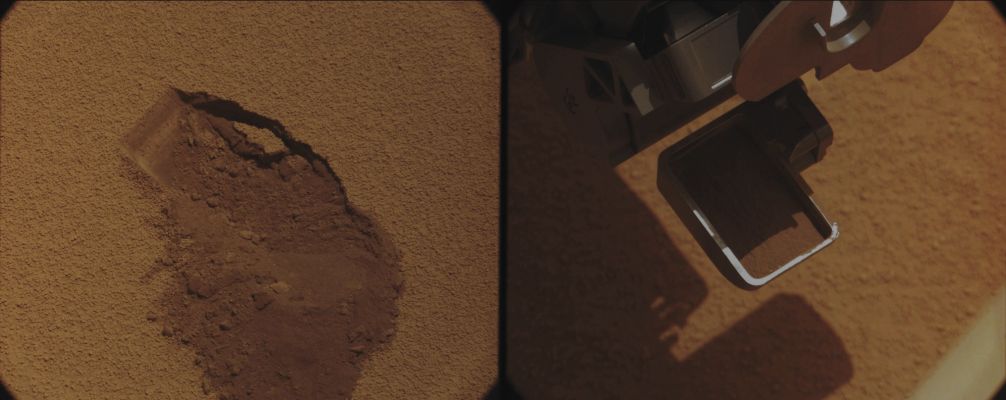
First "Scoop" at Gale - Sol 61 (Absolute Natural Colors; credits for the additional process. and color.: Dr Paolo C. Fienga/Lunar Explorer Italia/Italian Planetary Foundation)
|
Caption NASA:"This pairing illustrates the first time that the NASA's Mars Exploration Rover Curiosity collected a scoop of Soil on Mars. It combines two raw images taken on the mission's 61st Martian Day, or Sol (such as October, 7, 2012) by the right camera of the Rover's two-camera Mast Camera (Mastcam) instrument. The right Mastcam, or Mastcam-100, has a telephoto, 100-millimeter-focal-length lens.
The image on the left shows the Ground at the location "Rocknest" after the scoop of Sand and Dust had been removed. The image on the right shows the Sandy and Dusty Material inside the Rover's Scoop, which is 1,8" (inches - such as approx. 4,5 centimeters) wide, and 2.8" (about 7 centimeters) long".
|
|









"This data is gonna be one for the history books. It's looking really good," Curiosity project scientist John Grotzinger of Caltech said in the report. Grotzinger was describing initial results from the rover's Sample Analysis at Mars - or SAM - suite of instruments, but offered no other details because scientists had yet to confirm the findings.
Curiosity's holy grail is organic compounds, such as methane gas, which would provide a major clue that life might have once existed on Mars.
That's what SAM tests for, fueling speculation about Curiosity's discovery. Organic compounds contain carbon, the element that's considered the basic building block of life.
However, JPL spokesman pointed out Wednesday that the reported "earthshaking" news wasn't Grotzinger's description. Curiosity's official Twitter account also struck a less dramatic chord on Wednesday: "What did I discover on Mars? That rumors spread fast online. My team considers this whole mission `one for the history books."'
JPL said the findings will be revealed Dec. 3 at the American Geophysical Union conference in San Francisco. Curiosity is no stranger to what could be described as big news.
Since its celebrated landing in Mars' Gale Crater in August for a two-year mission, the rover has already found that an ancient streambed once rushed through the area, and found that properly equipped astronauts could withstand the planet's radiation.
The soil sample it collected for its first SAM test wasn't expected to come up with organic compounds, however.
The sample came from Rocknest, a sandy, windblown spot where previous tests had already shown much of the material had been transported from elsewhere.
"We received good data from this first solid sample," SAM principal investigator Paul Mahaffy said in a Nov. 13 status report.
The rover's ultimate destination is Mt. Sharp, in the center of the crater, where layered rock provides a good chance to find organics. SAM has three instruments that test for chemistry relevant to life: a mass spectrometer, a tunable laser spectrometer and a gas chromatograph.
They can identify and measure gases, and provide plenty of ways for scientists to make findings important to the scientific community. The laser spectrometer is capable of measuring isotopes, which could help determine how Mars lost much of its atmosphere, according to the Curiosity press kit.
JPL and Grotzinger's cautiousness has already prevented a mistaken announcement once during the Curiosity mission, when a methane finding wasn't supported by subsequent tests, according to NPR.