Inizio Registrati Login

Elenco album Ultimi arrivi Ultimi commenti Più viste Più votate Preferiti Cerca

Inizio > SOLAR SYSTEM > 1-Ceres and 4-Vesta
Ritorna alla pagina delle miniature FILE 48/55 Torna all'inizio Guarda foto precedente Guarda foto successiva Salta alla fine
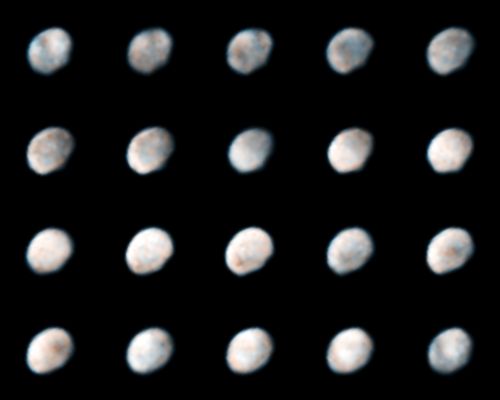
Moments of 4-Vesta
To prepare for the Dawn spacecraft's visit to Vesta, astronomers used Hubble's Wide Field Planetary Camera 2 to snap new images of the asteroid. These images were taken on May 14 and 16, 2007. Each frame shows time in hours and minutes based on Vesta's 5,34-hour rotation period. Using Hubble, astronomers mapped Vesta's Southern Hemisphere, a Region dominated by a giant impact crater formed by a collision billions of years ago. The crater is 285 miles (456 Km) across, which is nearly equal to Vesta's 330-mile (530-Km) diameter.
Hubble's sharp "eye" can see features as small as about 37 miles (60 Km) across. The images show the difference in brightness and color on the asteroid's surface. These characteristics hint at the large-scale features that the Dawn spacecraft will see when it arrives at Vesta in 2011.

Hubble's view reveals extensive global features stretching longitudinally from the Northern Hemisphere to the Southern Hemisphere. 
The images also show widespread differences in brightness in the east and west, which probably reflects compositional changes. Both of these characteristics could reveal volcanic activity throughout Vesta. The size of these different regions varies. Some are hundreds of miles across. 

The brightness differences could be similar to the effect seen on the Moon, where smooth, dark regions are more iron-rich than the brighter highlands that contain minerals richer in calcium and aluminum. When Vesta was forming 4.5 billion years ago, it was heated to the melting temperatures of rock. This heating allowed heavier material to sink to Vesta's center and lighter minerals to rise to the surface. 

Astronomers combined images of Vesta in two colors to study the variations in iron-bearing minerals. From these minerals, they hope to learn more about Vesta's surface structure and composition. Astronomers expect that Dawn will provide rich details about the asteroid's surface and interior structure.


Parole chiave: From Space Images - Hubble Space Telescope - Vesta

Moments of 4-Vesta

To prepare for the Dawn spacecraft's visit to Vesta, astronomers used Hubble's Wide Field Planetary Camera 2 to snap new images of the asteroid. These images were taken on May 14 and 16, 2007. Each frame shows time in hours and minutes based on Vesta's 5,34-hour rotation period. Using Hubble, astronomers mapped Vesta's Southern Hemisphere, a Region dominated by a giant impact crater formed by a collision billions of years ago. The crater is 285 miles (456 Km) across, which is nearly equal to Vesta's 330-mile (530-Km) diameter.
Hubble's sharp "eye" can see features as small as about 37 miles (60 Km) across. The images show the difference in brightness and color on the asteroid's surface. These characteristics hint at the large-scale features that the Dawn spacecraft will see when it arrives at Vesta in 2011.

Hubble's view reveals extensive global features stretching longitudinally from the Northern Hemisphere to the Southern Hemisphere.
The images also show widespread differences in brightness in the east and west, which probably reflects compositional changes. Both of these characteristics could reveal volcanic activity throughout Vesta. The size of these different regions varies. Some are hundreds of miles across.

The brightness differences could be similar to the effect seen on the Moon, where smooth, dark regions are more iron-rich than the brighter highlands that contain minerals richer in calcium and aluminum. When Vesta was forming 4.5 billion years ago, it was heated to the melting temperatures of rock. This heating allowed heavier material to sink to Vesta's center and lighter minerals to rise to the surface.

Astronomers combined images of Vesta in two colors to study the variations in iron-bearing minerals. From these minerals, they hope to learn more about Vesta's surface structure and composition. Astronomers expect that Dawn will provide rich details about the asteroid's surface and interior structure.

006-Ceres.jpg 021-Vesta-2.jpg 021-Vesta-3.jpg 015-Ceres_and_Vesta.jpg 099-DawnTrajectory.jpg
Informazioni sul file
Nome del file:021-Vesta-3.jpg
Nome album:MareKromium / 1-Ceres and 4-Vesta
Valutazione (8 voti):55555(Mostra dettagli)
Parole chiave:From / Space / Images / - / Hubble / Space / Telescope / - / Vesta
Copyright:NASA, ESA and L. McFadden (University of Maryland)
Dimensione del file:314 KiB
Data di inserimento:Giu 29, 2007
Dimensioni:1500 x 1200 pixels
Visualizzato:57 volte
URL:https://www.lunexit.it/gallery/displayimage.php?pid=17298
Preferiti:Aggiungi ai preferiti


Powered by Coppermine Photo Gallery