|
|
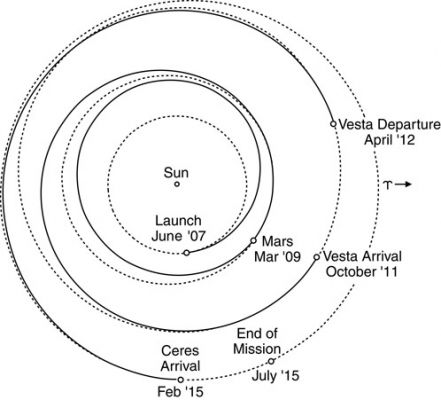
The "Dawn" Mission to 4-Vesta and 1-Ceres
|
German mathematician Karl F. Gauss calculated from Piazzi's few observations that 1-Ceres circled around the Sun once every 4,6 years or about 4 years, 220 days. The asteroid has a very primitive surface, say scientists on NASA's Dawn mission, which will launch in 2007 and examine 1-Ceres in 2015. The asteroid, like a young planet, contains water-bearing minerals, and possibly a very weak atmosphere and frost. Infrared observations show that the surface is warm.
NASA's HST observed that 1-Ceres' surface has a large spot, which could be a crater formed when another asteroid struck Ceres.
A second explanation may be that the spot is a brighter substance in the asteroid's soil. In July 2001, an object larger than 1-Ceres was found in the vast Kuiper Belt of asteroids, stretching from 30 to 100 AU (2,8 to 9,3 BMs away from the Sun.) This brightest and therefore biggest non-planet space rock, 2001 KX76, could be as big as 1300 Km across.
Per maggiori informazioni sulla Missione "Dawn", visitate il Sito:
http://dawn.jpl.nasa.gov/mission/index.asp
|
|