|
|
The Colors of Mars (4)
|
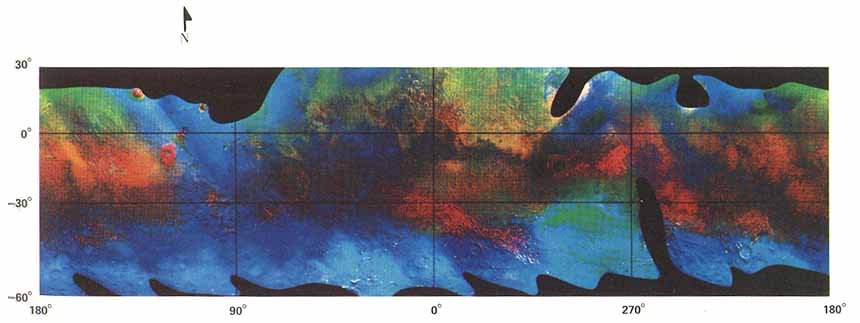
Atmospheric phenomena and surface frost affect the Planet's appearance. South of approximately 40° Lat., the scene is dominated by the annual South Polar CO2 fee cap. Near-surface condensate clouds arc abundant in this Region, especially in Hellas. Because some of the data in the bright areas were saturated, the color balance is distorted; no attempt was made to correct this problem. North of about 20° Lat., condensate clouds are especially noticeable along the northernmost edge where emission angles were extreme. Other clouds are scattered locally throughout the Equatorial Region South and South-West of Valles Marineris.
This image dramatically enhances subtle color variations The violet/green ratio is used as the blue component of the final image, the albedo at the are en wavelength as the green component, and the red/green n ratio as the red component. Hence, the amount of red or blue is controlled primarily by the slope of the spectral reflectance curve: areas with high albedo are also green. Thus, high albedo blue areas (ice, fog, clouds) are blue-green in color, and high albedo red areas are orange and yellow; bright areas of average color are green. Green is absent in dark areas, so the colors represent the slope from violet to red; red areas have a steeper slope, increasing from violet to blue; blue areas have a shallower slope.
|
|