Inizio Registrati Login

Elenco album Ultimi arrivi Ultimi commenti Più viste Più votate Preferiti Cerca

Inizio > MARS > Mars Reconnaissance Orbiter (MRO)
Ritorna alla pagina delle miniature FILE 31/2237 Torna all'inizio Guarda foto precedente Guarda foto successiva Salta alla fine
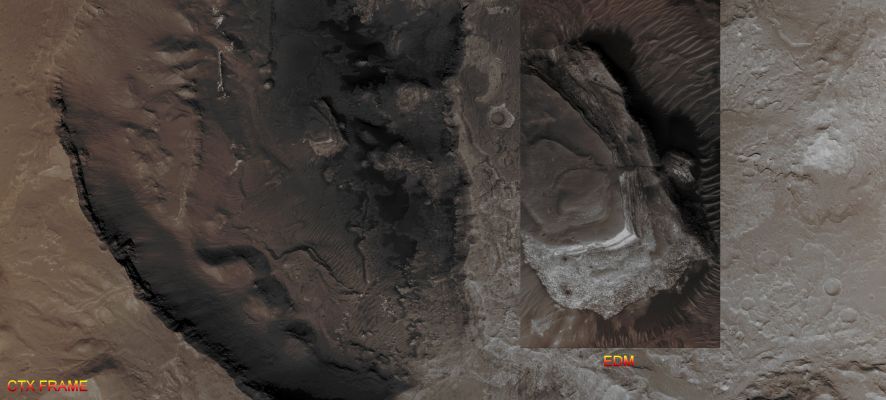
Features of Hydrae Chasma (Absolute Natural Colors; credits for the additional process. and color.: Dr Paolo C. Fienga/Lunar Explorer Italia/Italian Planetary Foundation)
Hydrae Chasma is a deep, almost Circular Depression approximately 50 Km across, situated between Juventae Chasma (to the North) and the large Canyon System known as Valles Marineris (to the South). This Chasma (---> Abyss) has steep Walls, flanked by numerous Landslides and a massive Scarp along its Southern Boundary, just where the Surface has collapsed into the Depression.
The EDM shows us an isolated flat-topped and small Mountain (known as a "Mesa") rising out of a Sea of Dunes located in the center of Hydrae Chasma. Darker-toned Dunes, likely composed of Basaltic Sands, form an Apron along the base of the Mesa's Northern Margin. The Western Side of the Mesa is gently sloping and is composed of a highly fractured light-toned Rubbly Base. It is overlaid by alternating light and dark Layered Cliff-forming Units and is covered by a Sediment Cap containing still more Dunes. 
The Layered Sequences are present only in the Interior Deposits and not in the Walls of the Chasma. Similar Deposits can also be found on the Floor of the Valles Marineris Canyon System, as well as in other Chasmata (like Juventae, for instance), and may represent the Sedimentary Remnants of ancient (relatively) deep and quiet (---> with probably minimal Internal Streams) Martian Lakes that formed, eons ago, within all these Canyon and Depression Systems and which, in (a, likely, extremely long) time, slowly disappeared (---> evaporated, sublimed or just froze).

Mars Local Time: 15:39 (Middle Afternoon)
Coord. (centered): 6,825° South Lat. and 297,987° East Long.
Spacecraft altitude: 268,4 Km (such as about 167,8 miles) 
Original image scale range: 26,9 cm/pixel (with 1 x 1 binning) so objects ~ 81 cm across are resolved
Map projected scale: 25 cm/pixel
Map projection: EQUIRECTANGULAR
Emission Angle: 8,5° 
Phase Angle: 45,9°
Solar Incidence Angle: 54° (meaning that the Sun was about 36° above the Local Horizon at the time the picture was taken)
Solar Longitude: 205,5° (Northern Autumn - Southern Spring)
Credits: NASA/JPL/University of Arizona
Additional process. and coloring: Lunar Explorer Italia

These two pictures (which are a NASA - Original Mars Reconnaissance Orbiter CTX b/w frame and an EDM color frame, both identified by the serial n. ESP_029516_1730) have been additionally processed and then colorized and re-colorized (as far as the EDM is concerned), respectively, in Absolute Natural Colors (such as the colors that a human eye would actually perceive if someone were onboard the NASA - Mars Reconnaissance Orbiter and then looked down, towards the Surface of Mars), by using an original technique created - and, in time, dramatically improved - by the Lunar Explorer Italia Team.
Parole chiave: Mars from orbit - Chasmas - Hydrae Chasma

Features of Hydrae Chasma (Absolute Natural Colors; credits for the additional process. and color.: Dr Paolo C. Fienga/Lunar Explorer Italia/Italian Planetary Foundation)

Hydrae Chasma is a deep, almost Circular Depression approximately 50 Km across, situated between Juventae Chasma (to the North) and the large Canyon System known as Valles Marineris (to the South). This Chasma (---> Abyss) has steep Walls, flanked by numerous Landslides and a massive Scarp along its Southern Boundary, just where the Surface has collapsed into the Depression.
The EDM shows us an isolated flat-topped and small Mountain (known as a "Mesa") rising out of a Sea of Dunes located in the center of Hydrae Chasma. Darker-toned Dunes, likely composed of Basaltic Sands, form an Apron along the base of the Mesa's Northern Margin. The Western Side of the Mesa is gently sloping and is composed of a highly fractured light-toned Rubbly Base. It is overlaid by alternating light and dark Layered Cliff-forming Units and is covered by a Sediment Cap containing still more Dunes.
The Layered Sequences are present only in the Interior Deposits and not in the Walls of the Chasma. Similar Deposits can also be found on the Floor of the Valles Marineris Canyon System, as well as in other Chasmata (like Juventae, for instance), and may represent the Sedimentary Remnants of ancient (relatively) deep and quiet (---> with probably minimal Internal Streams) Martian Lakes that formed, eons ago, within all these Canyon and Depression Systems and which, in (a, likely, extremely long) time, slowly disappeared (---> evaporated, sublimed or just froze).

Mars Local Time: 15:39 (Middle Afternoon)
Coord. (centered): 6,825° South Lat. and 297,987° East Long.
Spacecraft altitude: 268,4 Km (such as about 167,8 miles)
Original image scale range: 26,9 cm/pixel (with 1 x 1 binning) so objects ~ 81 cm across are resolved
Map projected scale: 25 cm/pixel
Map projection: EQUIRECTANGULAR
Emission Angle: 8,5°
Phase Angle: 45,9°
Solar Incidence Angle: 54° (meaning that the Sun was about 36° above the Local Horizon at the time the picture was taken)
Solar Longitude: 205,5° (Northern Autumn - Southern Spring)
Credits: NASA/JPL/University of Arizona
Additional process. and coloring: Lunar Explorer Italia

These two pictures (which are a NASA - Original Mars Reconnaissance Orbiter CTX b/w frame and an EDM color frame, both identified by the serial n. ESP_029516_1730) have been additionally processed and then colorized and re-colorized (as far as the EDM is concerned), respectively, in Absolute Natural Colors (such as the colors that a human eye would actually perceive if someone were onboard the NASA - Mars Reconnaissance Orbiter and then looked down, towards the Surface of Mars), by using an original technique created - and, in time, dramatically improved - by the Lunar Explorer Italia Team.

Nereidum_Montes-Dunefield-ESP_029608_1390-PCF-LXTT-IPF-1.jpg Nereidum_Montes-Dunefield-ESP_029608_1390-PCF-LXTT-IPF-2.jpg ESP_029516_1730-PCF-LXTT-IPF-2.jpg ESP_029660_1350-PCF-LXTT-IPF-2.jpg ESP_028321_1785_RED_NOMAP_browse-PCF-LXTT-IPF.jpg
Informazioni sul file
Nome del file:ESP_029516_1730-PCF-LXTT-IPF-2.jpg
Nome album:MareKromium / Mars Reconnaissance Orbiter (MRO)
Valutazione (3 voti):55555(Mostra dettagli)
Parole chiave:Mars / from / orbit / - / Chasmas / - / Hydrae / Chasma
Copyright:NASA/JPL/Univ. of Arizona e Dr Paolo C. Fienga - Lunar Explorer/IPF Italia per l'additional process. e la colorizzazione
Dimensione del file:630 KiB
Data di inserimento:Dic 19, 2012
Dimensioni:3000 x 1354 pixels
Visualizzato:82 volte
URL:https://www.lunexit.it/gallery/displayimage.php?pid=30940
Preferiti:Aggiungi ai preferiti


Powered by Coppermine Photo Gallery