Inizio Registrati Login

Elenco album Ultimi arrivi Ultimi commenti Più viste Più votate Preferiti Cerca

Inizio > MARS > Mars Reconnaissance Orbiter (MRO)
Ritorna alla pagina delle miniature FILE 319/2237 Torna all'inizio Guarda foto precedente Guarda foto successiva Salta alla fine
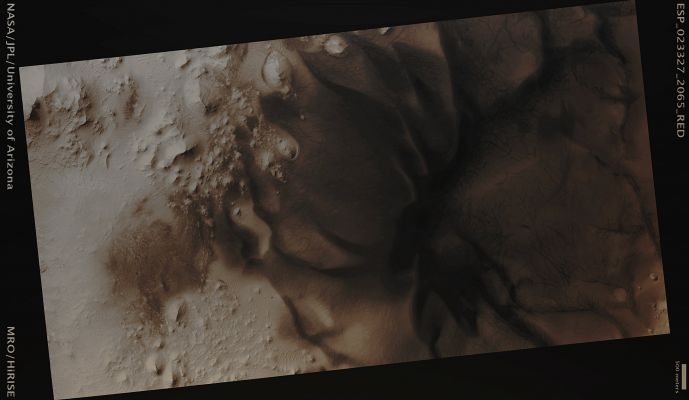
Dark Dust Devil Tracks on colourful Dunes (CTX Frame - Absolute Natural Colors; credits for the additional process. and color.: Dr Paolo C. Fienga - Lunexit Team)
Mars Local Time: 14:09 (Early Afternoon)
Coord. (centered): 26,1° North Lat. and 57,0° East Long.
Spacecraft altitude: 304,8 Km (such as about 190,5 miles) 
Original image scale range: 30,5 cm/pixel (with 1 x 1 binning) so objects ~ 91 cm across are resolved 
Map projected scale: 25 cm/pixel
Map projection: EQUIRECTANGULAR
Emission Angle: 20,6° 
Phase Angle: 36,0°
Solar Incidence Angle: 49° (meaning that the Sun is about 41° above the Local Horizon)
Solar Longitude: 330,5° (Northern Winter)
Credits: NASA/JPL/University of Arizona
Additional process. and coloring: Dr Paolo C. Fienga - Lunar Explorer Italia

Caption NASA:"Dust Devils leave Tracks behind them that create the beautiful swirling patterns visible in the EDM n.2 (approximately 0,5 Km, or about 0,3 miles across) and in many other images of Dust-covered Terrain. Suction created by the air rotating in a whirlwind removes a thin layer of light-colored Dust from the Martian Surface, leaving behind dark lines in the Dust Devil's path. That's what usually happens. In this case, however, there is an unusual Streak that appears brighter at one end (see EDM n.1 - approximately 0,6 Km or just about 0,4 miles across, with North is roughly upwards).
The bright Streak could be a deposit of light-colored Material that the Dust Devil dropped for some reason: maybe the Dust Devil died out right at this spot. Or it could be that at this particular location, the underlying dune is brighter than the dust on top of it, so when the dust devil removed the surface layer, a brighter layer below was revealed. Or there could be some other explanation we haven't even thought of yet!
Numerous small Slope Streaks are also visible in this image; for example, on the left side of the EDM n.2, indicated by the white arrow. These are thought to occur when a thin layer of Dust Avalanches downhill, revealing darker material beneath. Over time, these Streaks, like the DDTs, slowly brighten to match their surroundings, as Dust is deposited from the Atmosphere to cover them".
Parole chiave: Mars from orbit - Aeolian Features - Dust Devil Tracks (DD Tracks)

Dark Dust Devil Tracks on colourful Dunes (CTX Frame - Absolute Natural Colors; credits for the additional process. and color.: Dr Paolo C. Fienga - Lunexit Team)

Mars Local Time: 14:09 (Early Afternoon)
Coord. (centered): 26,1° North Lat. and 57,0° East Long.
Spacecraft altitude: 304,8 Km (such as about 190,5 miles)
Original image scale range: 30,5 cm/pixel (with 1 x 1 binning) so objects ~ 91 cm across are resolved
Map projected scale: 25 cm/pixel
Map projection: EQUIRECTANGULAR
Emission Angle: 20,6°
Phase Angle: 36,0°
Solar Incidence Angle: 49° (meaning that the Sun is about 41° above the Local Horizon)
Solar Longitude: 330,5° (Northern Winter)
Credits: NASA/JPL/University of Arizona
Additional process. and coloring: Dr Paolo C. Fienga - Lunar Explorer Italia

Caption NASA:"Dust Devils leave Tracks behind them that create the beautiful swirling patterns visible in the EDM n.2 (approximately 0,5 Km, or about 0,3 miles across) and in many other images of Dust-covered Terrain. Suction created by the air rotating in a whirlwind removes a thin layer of light-colored Dust from the Martian Surface, leaving behind dark lines in the Dust Devil's path. That's what usually happens. In this case, however, there is an unusual Streak that appears brighter at one end (see EDM n.1 - approximately 0,6 Km or just about 0,4 miles across, with North is roughly upwards).
The bright Streak could be a deposit of light-colored Material that the Dust Devil dropped for some reason: maybe the Dust Devil died out right at this spot. Or it could be that at this particular location, the underlying dune is brighter than the dust on top of it, so when the dust devil removed the surface layer, a brighter layer below was revealed. Or there could be some other explanation we haven't even thought of yet!
Numerous small Slope Streaks are also visible in this image; for example, on the left side of the EDM n.2, indicated by the white arrow. These are thought to occur when a thin layer of Dust Avalanches downhill, revealing darker material beneath. Over time, these Streaks, like the DDTs, slowly brighten to match their surroundings, as Dust is deposited from the Atmosphere to cover them".

ESP_023829_1350_RED_abrowse-PCF-LXTT-01.jpg ESP_024000_1425_RED_abrowse-PCF-LXTT.jpg ESP_023327_2065_RED_abrowse-PCF-LXTT-00.jpg ESP_023327_2065_RED_abrowse-PCF-LXTT-02.jpg ESP_023327_2065_RED_abrowse-PCF-LXTT-01.jpg
Informazioni sul file
Nome del file:ESP_023327_2065_RED_abrowse-PCF-LXTT-00.jpg
Nome album:MareKromium / Mars Reconnaissance Orbiter (MRO)
Valutazione (2 voti):55555(Mostra dettagli)
Parole chiave:Mars / from / orbit / - / Aeolian / Features / - / Dust / Devil / Tracks / (DD / Tracks)
Copyright:NASA/JPL/University of Arizona and Dr Paolo C. Fienga for the additional process. and color.
Dimensione del file:565 KiB
Data di inserimento:Ott 25, 2011
Dimensioni:3529 x 2048 pixels
Visualizzato:162 volte
URL:https://www.lunexit.it/gallery/displayimage.php?pid=30048
Preferiti:Aggiungi ai preferiti


Powered by Coppermine Photo Gallery