Inizio Registrati Login

Elenco album Ultimi arrivi Ultimi commenti Più viste Più votate Preferiti Cerca

Inizio > MARS > Mars Reconnaissance Orbiter (MRO)
Ritorna alla pagina delle miniature FILE 1715/2237 Torna all'inizio Guarda foto precedente Guarda foto successiva Salta alla fine
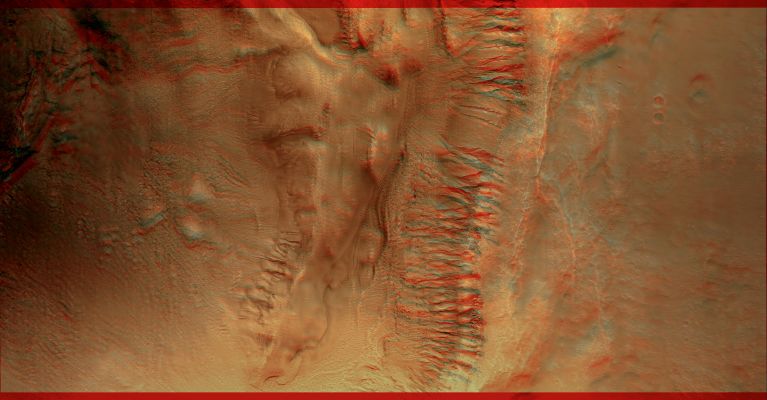
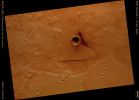
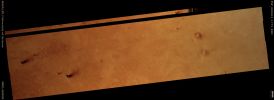
Multiple Levels of Gullies (3D and possible True Colors; credits: NASA and Lunar Explorer Italia)
This image shows groups of gullies at different elevations on the same crater wall. Although gullies are common in the mid-latitudes of Mars, they are rarely found to exist at such distinct elevations as visible here.
The mounds on the floor, one of which contains gullies, probably formed during a late stage of crater formation. Both levels of gullies appear to originate at layers. These layers might be ice-rich, or they might be capable of conducting water to the surface. The anaglyph image, providing a three-dimensional perspective, reveals the relative depth of the gullies in the crater walls and amount of alluvial material deposited at the bottom of the gullies. 
The gullies visible here are good candidates for formation by subsurface water, as opposed to melting ice or snow originating on the surface. The rounded, theater-shaped alcove and tributary heads are typical of features formed by groundwater sapping on Earth. Surface runoff does not form this morphology. 

This image contains possible evidence of subsurface piping, when soil pores connect to form a "pipe" that transports water. When piping occurs, water carries soil with it, leaving empty space beneath the surface. As this process continues, the overlying surface can no longer support itself, and it collapses to form a depression. Several depressions that could have formed this way are seen in this image. The depressions are also directly upslope of more developed alcoves. They also originate at upslope layers, and might be examples of developing alcoves.

Mars Local Time: 15:21 (early afternoon)
Coord. (centered): 37,9° South Lat. and 169,6° East Long.
Spacecraft altitude: 268,5 Km (such as about 167,8 miles) 
Original image scale range: 26,9 cm/pixel (with 1 x 1 binning) so objects ~81 cm across are resolved 
Map projected scale: 25 cm/pixel 
Map projection: EQUIRECTANGULAR 
Emission Angle: 20,6° 
Phase Angle: 24,7°
Solar Incidence Angle: 45° (meaning that the Sun is about 45° above the Local Horizon)
Solar Longitude: 255,0° (Northern Autumn)
Credits: NASA/JPL/University of Arizona
Additional process. and coloring: Lunar Explorer Italia
Parole chiave: Mars from orbit - Gullies - Southern Mid-Latitudes

Multiple Levels of Gullies (3D and possible True Colors; credits: NASA and Lunar Explorer Italia)

This image shows groups of gullies at different elevations on the same crater wall. Although gullies are common in the mid-latitudes of Mars, they are rarely found to exist at such distinct elevations as visible here.
The mounds on the floor, one of which contains gullies, probably formed during a late stage of crater formation. Both levels of gullies appear to originate at layers. These layers might be ice-rich, or they might be capable of conducting water to the surface. The anaglyph image, providing a three-dimensional perspective, reveals the relative depth of the gullies in the crater walls and amount of alluvial material deposited at the bottom of the gullies.
The gullies visible here are good candidates for formation by subsurface water, as opposed to melting ice or snow originating on the surface. The rounded, theater-shaped alcove and tributary heads are typical of features formed by groundwater sapping on Earth. Surface runoff does not form this morphology.

This image contains possible evidence of subsurface piping, when soil pores connect to form a "pipe" that transports water. When piping occurs, water carries soil with it, leaving empty space beneath the surface. As this process continues, the overlying surface can no longer support itself, and it collapses to form a depression. Several depressions that could have formed this way are seen in this image. The depressions are also directly upslope of more developed alcoves. They also originate at upslope layers, and might be examples of developing alcoves.

Mars Local Time: 15:21 (early afternoon)
Coord. (centered): 37,9° South Lat. and 169,6° East Long.
Spacecraft altitude: 268,5 Km (such as about 167,8 miles)
Original image scale range: 26,9 cm/pixel (with 1 x 1 binning) so objects ~81 cm across are resolved
Map projected scale: 25 cm/pixel
Map projection: EQUIRECTANGULAR
Emission Angle: 20,6°
Phase Angle: 24,7°
Solar Incidence Angle: 45° (meaning that the Sun is about 45° above the Local Horizon)
Solar Longitude: 255,0° (Northern Autumn)
Credits: NASA/JPL/University of Arizona
Additional process. and coloring: Lunar Explorer Italia

Psp_009418_2230_red.jpg Psp_009422_1555_red.jpg PSP_004085_1420_PSP_004019_1420_RED_browse.jpg Psp_009427_2190_red.jpg Psp_009431_1775_red.jpg
Informazioni sul file
Nome del file:PSP_004085_1420_PSP_004019_1420_RED_browse.jpg
Nome album:MareKromium / Mars Reconnaissance Orbiter (MRO)
Valutazione (2 voti):55555(Mostra dettagli)
Parole chiave:Mars / from / orbit / - / Gullies / - / Southern / Mid-Latitudes
Copyright:NASA/JPL/Univ. of Arizona e Lunar Explorer Italia per il processing addizionale e la colorizzazione
Dimensione del file:1404 KiB
Data di inserimento:Dic 13, 2008
Dimensioni:3928 x 2048 pixels
Visualizzato:62 volte
URL:https://www.lunexit.it/gallery/displayimage.php?pid=22839
Preferiti:Aggiungi ai preferiti


Powered by Coppermine Photo Gallery