|
|
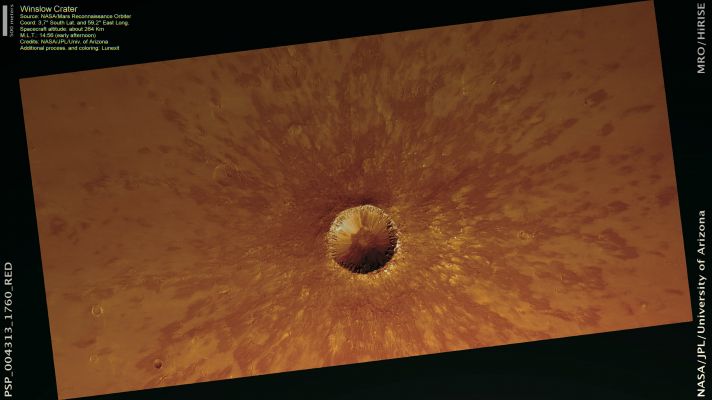
Winslow Crater - context frame n. 1 (MULTISPECTRUM; credits: Lunexit)
|
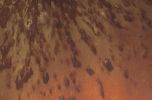
In this first HiRISE image of Winslow Crater (PSP_004313_1760), distinct dark rays surrounding the crater and are consistent with the THEMIS data’s suggestion of rockier materials. V-shaped patterns in the rays — referred to as a “herringbone” pattern — are identical to those around fresh Lunar Craters.
These form when materials are ejected from the crater at a very low angle, which form clusters of secondary craters that preferentially eject materials down-range in a V-shaped pattern. (It‘s the same pattern that you would get when shooting a water pistol nearly parallel to a sidewalk.)
Also noteworthy are the large meter-to-decimeter-sized boulders on the steep rim that have not been buried or physically weathered to smaller sizes in this windy region, indicating that they have not been exposed long.
This is also reminiscent of Meteor Crater and examples of fresh simple craters on the Moon.
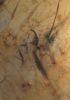
The ring of rocky, cliff-forming materials in the inner wall of the Crater represents original bedrock that was uplifted and exposed by the impact. The characteristic morphology is called “spur and gully” consisting of both the protruding bedrock inter-fingered with debris shoots feeding fans of sandy materials that extend down to the crater floor.
Throughout this Region, the present-day surface consists of a mix of global dust and volcanic sands from the Syrtis Major complex that typically cover the local bedrock. Winslow Crater is an excellent example of how craters can provide a window into the subsurface by exposing the local bedrock within the ejecta and crater wall.
|
|