Inizio Registrati Login

Elenco album Ultimi arrivi Ultimi commenti Più viste Più votate Preferiti Cerca

Inizio > SOLAR SYSTEM > Neptune and His Moons
Ritorna alla pagina delle miniature FILE 2/93 Torna all'inizio Guarda foto precedente Guarda foto successiva Salta alla fine
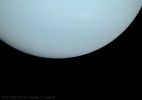
Neptune from the Saturnian Sky (Natural Colors; credits: NASA/JPL-Caltech/Space Science Institute)
Caption NASA:"On August 25, 1989, NASA's Voyager 2 made its historic Fly-By of Neptune and its largest moon, Triton. The Cassini Spacecraft took this image to celebrate the anniversary of that event.

Neptune appears in this Natural Color composite as a pale blue disk (similar to Cassini's image of Uranus from 2014), just below and to the right of image center. Most of the faint specks in the image are background stars, although some are likely Cosmic Rays (charged particles that strike the camera detector).
By imaging Neptune, Cassini's Solar System family portrait-taking is complete. The Mission's Planetary Photojournal includes all of the major Planets except Mercury, which is too close to the Sun to be imaged, as well as dwarf planet Pluto.

This view was acquired by the Cassini narrow-angle camera on Aug. 10, 2017, at a distance of approximately 2,72 Billion Miles (such as approx. 4,38 BKM) from Neptune. Red, blue and green filter images were combined to create this Natural Color image".
Parole chiave: Neptune

Neptune from the Saturnian Sky (Natural Colors; credits: NASA/JPL-Caltech/Space Science Institute)

Caption NASA:"On August 25, 1989, NASA's Voyager 2 made its historic Fly-By of Neptune and its largest moon, Triton. The Cassini Spacecraft took this image to celebrate the anniversary of that event.

Neptune appears in this Natural Color composite as a pale blue disk (similar to Cassini's image of Uranus from 2014), just below and to the right of image center. Most of the faint specks in the image are background stars, although some are likely Cosmic Rays (charged particles that strike the camera detector).
By imaging Neptune, Cassini's Solar System family portrait-taking is complete. The Mission's Planetary Photojournal includes all of the major Planets except Mercury, which is too close to the Sun to be imaged, as well as dwarf planet Pluto.

This view was acquired by the Cassini narrow-angle camera on Aug. 10, 2017, at a distance of approximately 2,72 Billion Miles (such as approx. 4,38 BKM) from Neptune. Red, blue and green filter images were combined to create this Natural Color image".

Neptune-V2.png Neptune-PIA21629.jpg Triton-PIA02246-PCF-LXTT-IPF.jpg Triton-PIA00317-PCF-LXTT-IPF.jpg Neptune-June2011-HST.jpg
Informazioni sul file
Nome del file:Neptune-PIA21629.jpg
Nome album:MareKromium / Neptune and His Moons
Valutazione (2 voti):55555(Mostra dettagli)
Parole chiave:Neptune
Copyright:NASA/JPL-Caltech/Space Science Institute
Dimensione del file:42 KiB
Data di inserimento:Gen 20, 2020
Dimensioni:1024 x 1024 pixels
Visualizzato:118 volte
URL:https://www.lunexit.it/gallery/displayimage.php?pid=31350
Preferiti:Aggiungi ai preferiti

Commento 1 a 3 di 3
Pagina: 1

MareKromium   [Gen 20, 2020 at 05:17 PM]
Sembra un'immagine insignificante ma, a mio modestissimo avviso, non lo é. Perché? Perché, per noi "terrestri", vedere Nettuno - ancorché appaia come una tenue "stellina blu" nel Cielo, é - semplicemente - un Sogno....
Anakin   [Gen 23, 2020 at 03:15 PM]
Sicuramente lascia all'imaginazione, lo spazio per pensare di trovarsi su un'astronave e di stare per arrivare alla meta.
MareKromium   [Gen 23, 2020 at 06:39 PM]
Già... E sarebbe meraviglioso!!!

Commento 1 a 3 di 3
Pagina: 1


Powered by Coppermine Photo Gallery