Inizio Registrati Login

Elenco album Ultimi arrivi Ultimi commenti Più viste Più votate Preferiti Cerca

Inizio > SOLAR SYSTEM > Uranus and His Moons
Ritorna alla pagina delle miniature FILE 59/109 Torna all'inizio Guarda foto precedente Guarda foto successiva Salta alla fine
Uranus from Hubble Space Telescope
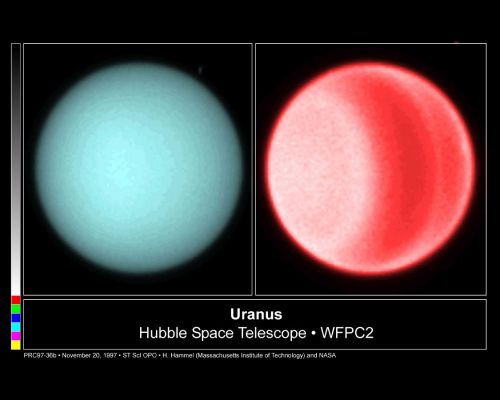
Caption NASA originale:"Uranus is sometimes called the sideways planet, because its rotation axis tipped more than 90° from the planet's orbit around the Sun. The year on Uranus lasts 84 Earth years, which creates extremely long seasons - winter in the Northern Hemisphere has lasted for nearly 20 years. Uranus has also been called bland and boring, because no clouds have been detectable in ground-based images of the planet. Even to the cameras of the Voyager spacecraft in 1986, Uranus presented a nearly uniform blank disk and discrete clouds were detectable only in the Southern Hemisphere. Voyager flew over the Planet's cloud tops near the dead of northern winter (when the northern hemisphere was completely shrouded in darkness). 
Two images are shown here. The "aqua" image (on the left) is taken at 5,470 Angstroms, which is near the human eye's peak response to wavelength. Color has been added to the image to show what a person on a spacecraft near Uranus might see. Little structure is evident at this wavelength, though with image-processing techniques, a small cloud can be seen near the planet's northern limb (rightmost edge). The "red" image (on the right) is taken at 6,190 Angstroms, and is sensitive to absorption by methane molecules in the planet's atmosphere. The banded structure of Uranus is evident, and the small cloud near the northern limb is now visible".
Parole chiave: Hubble Images - Uranus

Uranus from Hubble Space Telescope

Caption NASA originale:"Uranus is sometimes called the sideways planet, because its rotation axis tipped more than 90° from the planet's orbit around the Sun. The year on Uranus lasts 84 Earth years, which creates extremely long seasons - winter in the Northern Hemisphere has lasted for nearly 20 years. Uranus has also been called bland and boring, because no clouds have been detectable in ground-based images of the planet. Even to the cameras of the Voyager spacecraft in 1986, Uranus presented a nearly uniform blank disk and discrete clouds were detectable only in the Southern Hemisphere. Voyager flew over the Planet's cloud tops near the dead of northern winter (when the northern hemisphere was completely shrouded in darkness).
Two images are shown here. The "aqua" image (on the left) is taken at 5,470 Angstroms, which is near the human eye's peak response to wavelength. Color has been added to the image to show what a person on a spacecraft near Uranus might see. Little structure is evident at this wavelength, though with image-processing techniques, a small cloud can be seen near the planet's northern limb (rightmost edge). The "red" image (on the right) is taken at 6,190 Angstroms, and is sensitive to absorption by methane molecules in the planet's atmosphere. The banded structure of Uranus is evident, and the small cloud near the northern limb is now visible".

AAA-vg2_2684726.gif AAA-Uranus&Co..jpg Uranus-HST-PIA01279.jpg Uranus-uppatm-PIA01488.jpg AB-Ariel-V2-PIA01351.jpg
Informazioni sul file
Nome del file:Uranus-HST-PIA01279.jpg
Nome album:Uranus and His Moons
Valutazione (8 voti):55555(Mostra dettagli)
Parole chiave:Hubble / Images / - / Uranus
Copyright:Dr Heidi Hammel - NASA - Hubble Space Telescope
Dimensione del file:70 KiB
Data di inserimento:Mar 15, 2005
Dimensioni:1125 x 900 pixels
Visualizzato:59 volte
URL:https://www.lunexit.it/gallery/displayimage.php?pid=4798
Preferiti:Aggiungi ai preferiti


Powered by Coppermine Photo Gallery