Inizio Registrati Login

Elenco album Ultimi arrivi Ultimi commenti Più viste Più votate Preferiti Cerca

Inizio > SOLAR SYSTEM > Uranus and His Moons
Ritorna alla pagina delle miniature FILE 3/109 Torna all'inizio Guarda foto precedente Guarda foto successiva Salta alla fine
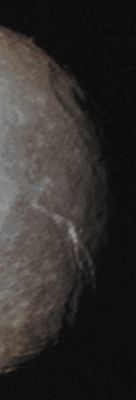
On the Limb of Titania (Possible Absolute Natural Colors; credits for the additional process. and color. Dr Paolo C. Fienga/Lunar Explorer Italia/Italian Planetary Foundation)
Like their semi-divine namesakes, Dione's twin Impact Craters Romulus and Remus (just above-right of the center) stand together while Dido, the larger Impact Crater showing a magnificent and impressive Central Peak, lies to the South/East, on the lower left Limb of Dione and almost half-way on top of the Terminator. The lit Terrain seen here is on the Saturn-facing Hemisphere of Dione and North is up. 
The image was taken in Visible Light with the NASA - Cassini Spacecraft Narrow-Angle Camera on April 28, 2013. The view was obtained at a distance of approximately 870.000 miles (such as a little more than 1,4 Million KiloMeters) from Dione and at a Sun-Dione-Cassini Spacecraft, or Phase, Angle of 77°. Image scale is roughly 5 miles (a little more than 8 Km) per pixel.

This frame (which is an Original NASA - Cassini Spacecraft b/w frame published on the NASA - Planetary Photojournal with the ID n. PIA 17126) has been additionally processed, contrast enhanced, magnified to aid visibility of the Surface details and then colorized, according to an educated guess carried out by Dr Paolo C. Fienga/LXTT/IPF, in what they should be its Absolute Natural Colors (such as the colors that a human eye would actually perceive if someone were onboard the NASA - Cassini Spacecraft and then looked outside, towards the Saturnian moon Dione), by using an original technique created - and, in time, dramatically improved - by the Lunar Explorer Italia Team. Different colors, as well as different shades of the same color, mean, among others, the existence of different Elements present on the Surface of Dione, each having a different Albedo (---> Reflectivity) and Chemical Composition.

Note: it is possible (but we, as IPF, have no way to be one-hundred-percent sure of such a circumstance), that the actual luminosity of Dione - as it is in this frame - would appear, to an average human eye, a little bit lower than it has been shown (or, better yet: interpreted) here.
Parole chiave: Uranian Moons - Titania

On the Limb of Titania (Possible Absolute Natural Colors; credits for the additional process. and color. Dr Paolo C. Fienga/Lunar Explorer Italia/Italian Planetary Foundation)

Like their semi-divine namesakes, Dione's twin Impact Craters Romulus and Remus (just above-right of the center) stand together while Dido, the larger Impact Crater showing a magnificent and impressive Central Peak, lies to the South/East, on the lower left Limb of Dione and almost half-way on top of the Terminator. The lit Terrain seen here is on the Saturn-facing Hemisphere of Dione and North is up.
The image was taken in Visible Light with the NASA - Cassini Spacecraft Narrow-Angle Camera on April 28, 2013. The view was obtained at a distance of approximately 870.000 miles (such as a little more than 1,4 Million KiloMeters) from Dione and at a Sun-Dione-Cassini Spacecraft, or Phase, Angle of 77°. Image scale is roughly 5 miles (a little more than 8 Km) per pixel.

This frame (which is an Original NASA - Cassini Spacecraft b/w frame published on the NASA - Planetary Photojournal with the ID n. PIA 17126) has been additionally processed, contrast enhanced, magnified to aid visibility of the Surface details and then colorized, according to an educated guess carried out by Dr Paolo C. Fienga/LXTT/IPF, in what they should be its Absolute Natural Colors (such as the colors that a human eye would actually perceive if someone were onboard the NASA - Cassini Spacecraft and then looked outside, towards the Saturnian moon Dione), by using an original technique created - and, in time, dramatically improved - by the Lunar Explorer Italia Team. Different colors, as well as different shades of the same color, mean, among others, the existence of different Elements present on the Surface of Dione, each having a different Albedo (---> Reflectivity) and Chemical Composition.

Note: it is possible (but we, as IPF, have no way to be one-hundred-percent sure of such a circumstance), that the actual luminosity of Dione - as it is in this frame - would appear, to an average human eye, a little bit lower than it has been shown (or, better yet: interpreted) here.

Miranda.jpg Miranda-Verona_Rupes.jpg Titania-PIA01978-PCF-LXTT-IPF.jpg Miranda-PIA00042-PCF-LXTT-IPF.jpg Oberon-PIA01352-PCF-LXTT-IPF.jpg
Informazioni sul file
Nome del file:Titania-PIA01978-PCF-LXTT-IPF.jpg
Nome album:MareKromium / Uranus and His Moons
Valutazione (4 voti):55555(Mostra dettagli)
Parole chiave:Uranian / Moons / - / Titania
Copyright:NASA/JPL - Voyager 2 Mission and Dr Paolo C. Fienga/Lunar Explorer Italia/IPF for the additional process. and color.
Dimensione del file:145 KiB
Data di inserimento:Set 08, 2013
Dimensioni:1018 x 2990 pixels
Visualizzato:81 volte
URL:https://www.lunexit.it/gallery/displayimage.php?pid=31137
Preferiti:Aggiungi ai preferiti


Powered by Coppermine Photo Gallery