Inizio Registrati Login

Elenco album Ultimi arrivi Ultimi commenti Più viste Più votate Preferiti Cerca

Inizio > SOLAR SYSTEM > Jupiter: the "King" and His Moons
Ritorna alla pagina delle miniature FILE 195/325 Torna all'inizio Guarda foto precedente Guarda foto successiva Salta alla fine
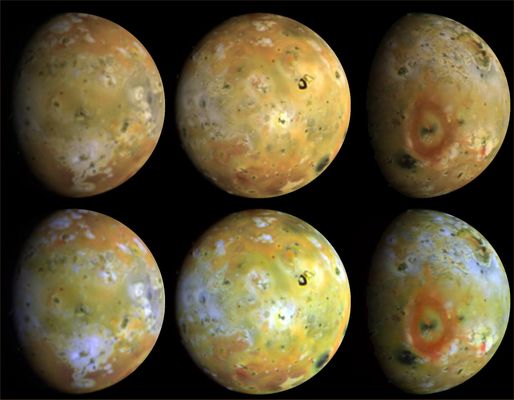
Io: three views of the one and the same
Three views of the full disk of Jupiter's volcanic moon, Io, each shown in natural and enhanced color. These three views, taken by Galileo in late June 1996, show about 75 percent of Io's surface. North is up. The top disks are intended to show the satellite in natural color (but colors will vary with display devices) while the bottom disks show enhanced color (near-infrared-, green-, and violet-filtered images) to highlight details of the surface. These images reveal that some areas on Io are truly red, whereas much of the surface is yellow or light greenish. (Accurate natural color renditions were not possible from the Voyager images taken during the 1979 flybys because there was no coverage in the red.) The reddish materials may be associated with very recent fragmental volcanic deposits (pyroclastics) erupted in the form of volcanic plumes. Dark materials appear in flows and on caldera floors. Bright white materials correspond to sulfur dioxide frost, and bright yellow materials appear to be in new flows such as those surrounding Ra Patera. The red material may be unstable since the color appears to fade over time. This fading appears to occur most rapidly in the equatorial region and more slowly over the polar regions; surface temperature may control the rate of transformation. Comparisons of these images to those taken by the Voyager spacecraft 17 years ago have revealed that many changes have occurred on Io. Since that time, about a dozen areas at least as large as the state of Connecticut have been resurfaced. Io's diameter is 3632 km. 
Parole chiave: Jupiter Moons - Io

Io: three views of the one and the same

Three views of the full disk of Jupiter's volcanic moon, Io, each shown in natural and enhanced color. These three views, taken by Galileo in late June 1996, show about 75 percent of Io's surface. North is up. The top disks are intended to show the satellite in natural color (but colors will vary with display devices) while the bottom disks show enhanced color (near-infrared-, green-, and violet-filtered images) to highlight details of the surface. These images reveal that some areas on Io are truly red, whereas much of the surface is yellow or light greenish. (Accurate natural color renditions were not possible from the Voyager images taken during the 1979 flybys because there was no coverage in the red.) The reddish materials may be associated with very recent fragmental volcanic deposits (pyroclastics) erupted in the form of volcanic plumes. Dark materials appear in flows and on caldera floors. Bright white materials correspond to sulfur dioxide frost, and bright yellow materials appear to be in new flows such as those surrounding Ra Patera. The red material may be unstable since the color appears to fade over time. This fading appears to occur most rapidly in the equatorial region and more slowly over the polar regions; surface temperature may control the rate of transformation. Comparisons of these images to those taken by the Voyager spacecraft 17 years ago have revealed that many changes have occurred on Io. Since that time, about a dozen areas at least as large as the state of Connecticut have been resurfaced. Io's diameter is 3632 km.

Europa-PIA02500.jpg Io-PIA02597.jpg Io-PIA00715.jpg Io-PIA00491.jpg Io-PIA00495.jpg
Informazioni sul file
Nome del file:Io-PIA00715.jpg
Nome album:Jupiter: the "King" and His Moons
Valutazione (9 voti):55555(Mostra dettagli)
Parole chiave:Jupiter / Moons / - / Io
Copyright:NASA - Galileo Project
Dimensione del file:255 KiB
Data di inserimento:Ott 20, 2005
Dimensioni:1965 x 1529 pixels
Visualizzato:59 volte
URL:https://www.lunexit.it/gallery/displayimage.php?pid=7903
Preferiti:Aggiungi ai preferiti


Powered by Coppermine Photo Gallery