Inizio Registrati Login

Elenco album Ultimi arrivi Ultimi commenti Più viste Più votate Preferiti Cerca

Inizio > SOLAR SYSTEM > Venus
Ritorna alla pagina delle miniature FILE 7/126 Torna all'inizio Guarda foto precedente Guarda foto successiva Salta alla fine
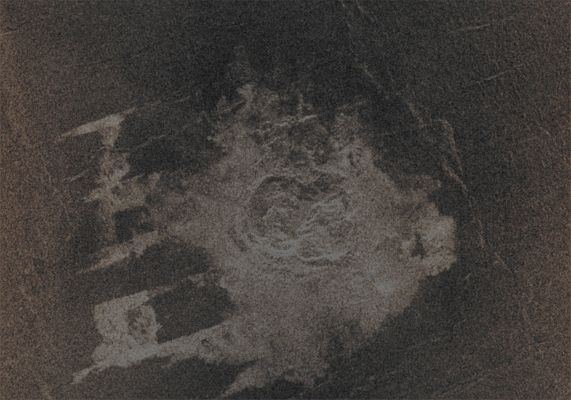
Unnamed Complex Crater (Possible Absolute Natural Colors; credits for the additional process. and color.: Dr Paolo C. Fienga/Lunar Explorer Italia/Italian Planetary Foundation)
The NASA - Magellan Spacecraft imaged this multiple-Floored, highly Irregular Impact Crater at Latitude 16,4° North and Longitude 352,1° East, during its 481st and 482nd orbits around the Planet Venus (on Earth, it was September, 27, 1990). This Impact Crater, about 9,2 Km (such as approx. 5,7 miles) in maximum diameter, was formed on what appears to be a slightly fractured, radar-dark (---> smooth) Venusian Plain. The abundant, low viscosity Flows associated with this Impact Event have, however, filled local Fault-controlled Troughs (---> Graben). These shallow Grabens are well portrayed on this Magellan image but they would have been unrecognizable if they had not (coincidentally) been infillled by the radar-bright Crater Flows. 
This fortuitous enhancement by the Crater Flows - of Fault Structures - that were below the resolution capacity of the Magellan Synthetic Aperture Radar provided the Magellan Science Team with valuable Geologic information. For instance, the Flow Deposits from this Impact Crater are now thought to consist - primarily - of "Shock Melted Rock" (---> such as a remarkable quantity of almost liquid rocky material that got pushed away and outwards by the powerful shock-wave/s that followed the original Impact Event/s) and Fragmented Debris resulting from the nearly simultaneous impacts of 2 (two) projectile fragments into the hot (---> approx. 426° Celsius - or about 800 degrees Farheneit) Surface Rocks of Venus. On the other hand, the presence of various Floors in this highly Irregular Impact Crater is interpreted to be the result of Crushing, Fragmentation, and eventual Aerodynamic Dispersion of a single entry projectile (---> meteor) during its passage through the dense Venusian Atmosphere.

This frame (which is an Original NASA - Magellan Spacecraft Radio-Image published on the NASA - Planetary Photojournal with the n. PIA 00462), since it is just a Radio-Image of the Venusian Surface and NOT a real view of it, has been colorized, according to an educated guess carried out by Dr Paolo C. Fienga (LXTT-IPF), in what they could reasonably be its possible Absolute Natural Colors (such as the colors that a human eye would perceive if someone were onboard the NASA - Magellan Spacecraft and, once the thick layer of Venusian Clouds and Fogs is completely overcome, looked down, towards the Surface of Venus itself), by using an original technique created - and, in time, dramatically improved - by the Lunar Explorer Italia Team.
Parole chiave: Venus - Craters - Unnamed Complex Crater

Unnamed Complex Crater (Possible Absolute Natural Colors; credits for the additional process. and color.: Dr Paolo C. Fienga/Lunar Explorer Italia/Italian Planetary Foundation)

The NASA - Magellan Spacecraft imaged this multiple-Floored, highly Irregular Impact Crater at Latitude 16,4° North and Longitude 352,1° East, during its 481st and 482nd orbits around the Planet Venus (on Earth, it was September, 27, 1990). This Impact Crater, about 9,2 Km (such as approx. 5,7 miles) in maximum diameter, was formed on what appears to be a slightly fractured, radar-dark (---> smooth) Venusian Plain. The abundant, low viscosity Flows associated with this Impact Event have, however, filled local Fault-controlled Troughs (---> Graben). These shallow Grabens are well portrayed on this Magellan image but they would have been unrecognizable if they had not (coincidentally) been infillled by the radar-bright Crater Flows.
This fortuitous enhancement by the Crater Flows - of Fault Structures - that were below the resolution capacity of the Magellan Synthetic Aperture Radar provided the Magellan Science Team with valuable Geologic information. For instance, the Flow Deposits from this Impact Crater are now thought to consist - primarily - of "Shock Melted Rock" (---> such as a remarkable quantity of almost liquid rocky material that got pushed away and outwards by the powerful shock-wave/s that followed the original Impact Event/s) and Fragmented Debris resulting from the nearly simultaneous impacts of 2 (two) projectile fragments into the hot (---> approx. 426° Celsius - or about 800 degrees Farheneit) Surface Rocks of Venus. On the other hand, the presence of various Floors in this highly Irregular Impact Crater is interpreted to be the result of Crushing, Fragmentation, and eventual Aerodynamic Dispersion of a single entry projectile (---> meteor) during its passage through the dense Venusian Atmosphere.

This frame (which is an Original NASA - Magellan Spacecraft Radio-Image published on the NASA - Planetary Photojournal with the n. PIA 00462), since it is just a Radio-Image of the Venusian Surface and NOT a real view of it, has been colorized, according to an educated guess carried out by Dr Paolo C. Fienga (LXTT-IPF), in what they could reasonably be its possible Absolute Natural Colors (such as the colors that a human eye would perceive if someone were onboard the NASA - Magellan Spacecraft and, once the thick layer of Venusian Clouds and Fogs is completely overcome, looked down, towards the Surface of Venus itself), by using an original technique created - and, in time, dramatically improved - by the Lunar Explorer Italia Team.

Venus-Mariner_10.jpg Craters-Ghost_Crater_in_Lakshmi_Region-PIA00477-PCF-LXTT-IPF.jpg Craters-Unnamed_Complex_Crater-PIA00462-PCF-LXTT-IPF.jpg Venus-PIA10124-PCF-LXTT-IPF.jpg Venusian_Surface-Venera_13-07-DPM.jpg
Informazioni sul file
Nome del file:Craters-Unnamed_Complex_Crater-PIA00462-PCF-LXTT-IPF.jpg
Nome album:MareKromium / Venus
Valutazione (3 voti):55555(Mostra dettagli)
Parole chiave:Venus / - / Craters / - / Unnamed / Complex / Crater
Copyright:NASA - Magellan Mission and Dr Paolo C. Fienga/Lunar Explorer Italia(Italian Planetary Foundation per l'additional processing e la colorizzazione del frame
Dimensione del file:692 KiB
Data di inserimento:Mar 22, 2013
Dimensioni:2857 x 2000 pixels
Visualizzato:82 volte
URL:https://www.lunexit.it/gallery/displayimage.php?pid=31063
Preferiti:Aggiungi ai preferiti

Commento 1 a 5 di 5
Pagina: 1

AndreaGG   [Mar 24, 2013 at 05:36 AM]
Ma è precipitata l'Enterprise? Eheheh
Ufologo   [Mar 24, 2013 at 07:49 AM]
Vero! Ne è rimasta la ... traccia! ^_^
paolocf1963   [Mar 24, 2013 at 10:24 AM]
Ci assomiglia davvero, bravi! paolo
Ufologo   [Mar 24, 2013 at 02:17 PM]
Ha subito un esplosione nucleare in quota mentre era a terra ed è riamsta ... l'impronta! (Come i cadaveri a Mohenjo-daro ...) ^_^
paolocf1963   [Mar 24, 2013 at 03:46 PM]
E' vero: se un oggetto si trova al suolo e, sopra di esso (abbastanza, ma non troppo) si verifica un'esplosione nucleare di media potenza (tipo Hiroshime), l'oggetto al suolo - di fatto - viene disintegrato dall'Onda d'Urto e dal calore, ma la sua ombra resta. Su alcuni muri rimasti in piedi dopo Hiroshima e Nagasaki, sono state trovate "ombre" di corpi che avevano subìto la shock-wave della bomba ed erano stati "vaporizzati" dal calore da essa emesso. Terribile, ma questa è Storia. - paolo

Commento 1 a 5 di 5
Pagina: 1


Powered by Coppermine Photo Gallery