Inizio Registrati Login

Elenco album Ultimi arrivi Ultimi commenti Più viste Più votate Preferiti Cerca

Inizio > SOLAR SYSTEM > Saturn: the "Ringed Beauty" and His Moons
Ritorna alla pagina delle miniature FILE 8/2245 Torna all'inizio Guarda foto precedente Guarda foto successiva Salta alla fine
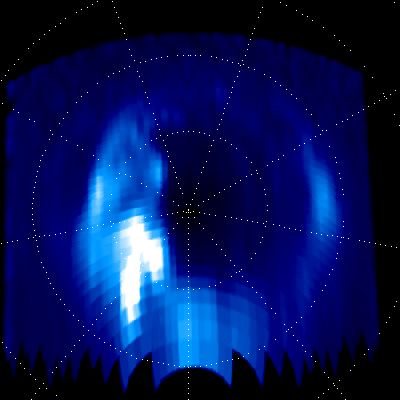
Polar Lights (Auroral Emissions from the North Pole of Saturn)
Caption NASA Originale:"On Sept. 14, 2017, one day before making its final plunge into Saturn's Atmosphere, NASA's Cassini Spacecraft used its Ultraviolet Imaging Spectrograph, or UVIS, instrument to capture this final view of Ultraviolet Auroral Emissions over the Planet's North Polar Regions. 

The view is centered on the North Pole of Saturn, with lines of Latitude visible for 80, 70 and 60°. Lines of Longitude are spaced 40° apart. The Planet's Day-Side is at the bottom of the picture, while the Night-Side is at the top. A sequence of images from this observation has also been assembled into a movie sequence. The last image in the movie was taken about an hour before the still image, which was the actual final UVIS auroral image.

Auroral Emissions are generated by charged particles traveling along the invisible lines of Saturn's Magnetic Field. These particles (then) precipitate into the Atmosphere, releasing light when they strike (the) Gas Molecules (that are present) there. 

Several individual auroral structures are visible here, despite that this UVIS view was acquired at a fairly large distance from the Planet (such as about 424.000 miles or approx. 682.361,856 Km). Each of these features is connected to a particular phenomenon (occurring) in the Saturnian Magnetosphere. For instance, it is possible to identify Auroral "signatures" here that are related to the injection of "Hot Plasma" from the Day-Side Magnetosphere, as well as Auroral Features associated with a change in the Magnetic Field's shape (existing) on the Magnetosphere's Night-Side. 

Several possible scenarios have been postulated over the years to explain Saturn's changing Auroral Emissions, but researchers are still far from a complete understanding of this complicated puzzle. Researchers will continue to analyze the hundreds of image sequences UVIS obtained of Saturn's auroras during Cassini's 13-year mission, with many new discoveries likely to be made.

This image and movie sequence were produced by the Laboratory for Planetary and Atmospheric Physics (LPAP) of the STAR Institute of the University of Liege in Belgium, in collaboration with the UVIS Team".
Parole chiave: Saturn - Polar Lights

Polar Lights (Auroral Emissions from the North Pole of Saturn)

Caption NASA Originale:"On Sept. 14, 2017, one day before making its final plunge into Saturn's Atmosphere, NASA's Cassini Spacecraft used its Ultraviolet Imaging Spectrograph, or UVIS, instrument to capture this final view of Ultraviolet Auroral Emissions over the Planet's North Polar Regions.

The view is centered on the North Pole of Saturn, with lines of Latitude visible for 80, 70 and 60°. Lines of Longitude are spaced 40° apart. The Planet's Day-Side is at the bottom of the picture, while the Night-Side is at the top. A sequence of images from this observation has also been assembled into a movie sequence. The last image in the movie was taken about an hour before the still image, which was the actual final UVIS auroral image.

Auroral Emissions are generated by charged particles traveling along the invisible lines of Saturn's Magnetic Field. These particles (then) precipitate into the Atmosphere, releasing light when they strike (the) Gas Molecules (that are present) there.

Several individual auroral structures are visible here, despite that this UVIS view was acquired at a fairly large distance from the Planet (such as about 424.000 miles or approx. 682.361,856 Km). Each of these features is connected to a particular phenomenon (occurring) in the Saturnian Magnetosphere. For instance, it is possible to identify Auroral "signatures" here that are related to the injection of "Hot Plasma" from the Day-Side Magnetosphere, as well as Auroral Features associated with a change in the Magnetic Field's shape (existing) on the Magnetosphere's Night-Side.

Several possible scenarios have been postulated over the years to explain Saturn's changing Auroral Emissions, but researchers are still far from a complete understanding of this complicated puzzle. Researchers will continue to analyze the hundreds of image sequences UVIS obtained of Saturn's auroras during Cassini's 13-year mission, with many new discoveries likely to be made.

This image and movie sequence were produced by the Laboratory for Planetary and Atmospheric Physics (LPAP) of the STAR Institute of the University of Liege in Belgium, in collaboration with the UVIS Team".

Atlas.jpg Pandora.png Saturn-PIA21899.gif Atlas,_Daphins_and_Pan-PIA21449.jpg Saturn-PIA21895.jpg
Informazioni sul file
Nome del file:Saturn-PIA21899.gif
Nome album:MareKromium / Saturn: the "Ringed Beauty" and His Moons
Valutazione (1 voti):55555(Mostra dettagli)
Parole chiave:Saturn / - / Polar / Lights
Copyright:NASA/JPL-Caltech/University of Colorado/ University of Liege-LPAP
Dimensione del file:573 KiB
Data di inserimento:Mar 12, 2020
Dimensioni:450 x 450 pixels
Visualizzato:112 volte
URL:https://www.lunexit.it/gallery/displayimage.php?pid=31392
Preferiti:Aggiungi ai preferiti


Powered by Coppermine Photo Gallery