|
|
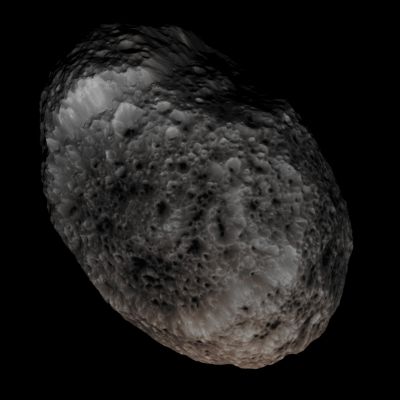
Farewell Hyperion! Part I (Absolute Natural Colors; credits for the additional process. and color.: Dr Paolo C. Fienga/Lunar Explorer Italia/Italian Planetary Foundation)
|
The NASA - Cassini Spacecraft's Imaging Scientists processed this view of Saturn's so-called "spongy" moon Hyperion, which was taken during a close Fly-By that occurred on May 31, 2015. This Fly-By marks the Mission's Final Close Approach to this Saturnian highly irregularly shaped moon. North on Hyperion is up and rotated 37° to the right (Dx).
The image was taken with the NASA - Cassini Spacecraft's Narrow-Angle Camera - as we wrote herebefore - on May 31, 2015, by using a Spectral Filter which preferentially admits Wavelengths of Near-InfraRed Light, centered at 862 nanometers. The view was acquired at a distance of approx. 37.000 miles (such as about 59.545,58 Km) from Hyperion, and at a Sun-Hyperion-Cassini Spacecraft, or Phase, Angle of 20°. The Image Scale is roughly 1180 feet (such as approx. 359,664 meters) per pixel.
This frame (which is an Original NASA - CASSINI Spacecraft's b/w and NON Map-Projected image published on the NASA - Planetary Photojournal with the ID n. PIA 17193) has been additionally processed, contrast enhanced, magnified to help the visibility of the Surface details, Gamma corrected and then re-colorized - according to an educated guess (or, if you wish, an informed speculation) carried out by Dr Paolo C. Fienga - in Absolute Natural Colors (such as the colors that a human eye would actually perceive if someone were onboard the NASA - Cassini Spacecraft and then looked outside, towards the Saturnian moon "Hyperion"), by using an original technique created - and, in time, dramatically improved - by the Lunar Explorer Italia Team. Different colors, as well as different shades of the same color, mean, among other things, the existence of different Elements (Minerals) present on the Surface of Hyperion, each having a different Albedo (---> Reflectivity) and Chemical Composition.
Note: it is possible (but we, as IPF, have no way to be one-hundred-percent sure of such a circumstance), that the actual luminosity of Hyperion - as it is in this frame - would appear, to an average human eye, a little bit lower than it has been shown (or, better yet: interpreted) here.
|
|








1.: Hyperion, a detta degli Scienziati, non è una "Luna Originaria" del Sistema di Saturno, ma fu catturata gravitazionalmente. Probabilmente era un Corpo Errante proveniente dalla Fascia di Kuiper. Ora, un Corpo Celeste così "spugnoso", che estrude Idrocarburi Affioranti praticamente da ogni suo pseudo-cratere (perché quelli che vediamo costellarne la Superficie NON sono Crateri da Impatto!), come avrebbe potuto mai superare il cosiddetto "Limite di Roche" - ossìa l'"Urto Gravitazionale vero e proprio proveniente da un Corpo Celeste Gigante (Gassoso o non Gassoso non fa differenza) - senza andare in pezzi? Pensate alla Cometa Shoemaker/Levy 9, e Giove, per esempio.
Evidentemente una plausibile risposta, paradossale, è insita nella domanda: è proprio la sua "spugnosità" (ergo la sua Elasticità Strutturale Intrinseca) che lo ha salvato dalla disintegrazione. Ovvio che questa è una mia Teoria, di fatto NON dimostrabile.
2.: Il Moto di Hyperion. Esso, sebbene la sua orbita intorno a Saturno sia quasi circolare, si muove in Risonanza (nel rapporto di 3:4) con Titano il quale lo "sfiora", letteralmente, periodicamente. Possibile che gli influssi Gravitazionali - Stabili - di Saturno e quelli "A Ondate" di Titano non lo scalfiscano minimamente. No, non lo scalfiscono. Lo hanno solo messo in condizione di orbitare "caoticamente" (cioè su tre assi) intorno a Saturno. E cosa lo ha salvato e lo salva dall'essere proiettato fuori orbita? Probabilmente la sua Velocità. Non viene distrutto dalle Onde Mareali di Titano per lo stesso motivo per il quale ha passato indenne il Limite di Roche: è un Corpo "Elastico". Il che potrebbe anche dipendere dal fatto che il suo "core" (nucleo) sia liquido, per lo meno in determinati momenti (rectius: periodi), a causa di un fenomeno che si chiama Frizionamento Mareale.
3.: Come mai non è stato disintegrato da qualche bolide? Quasi tutte le Lune di Saturno sono state - letteralmente - massacrate da impatti, tranne Titano, che ha un'Atmosfera spessa, ed Encelado, che "cancella" le tracce degli impatti rinnovando periodicamente la sua Superficie. Perché Hyperion l'ha fatta franca? Qui c'è una sola risposta possibile: esso è stato "catturato" da Saturno quando ormai il periodo dei grandi bombardamenti era finito. Quindi è anche un Corpo Celeste (relativamente) "giovane".
Struttura, Velocità, Composizione, Posizione, Tempo della "Cattura" e Fato: hanno giocato TUTTI a suo favore. Una marea di coincidenze che mi porta a credere che i casi come Hyperion non sono "Regola", bensì "Eccezione tra le Eccezioni".
Un Abbraccio Circolare - paolo
A pensarci bene forse sì. Però sappiamo che la fuori ci sono tante cose da scoprire.
Però richiedo una cosa:
questo periodo "dei grandi bombardamenti" quando ebbe luogo? Si riesce a quantficare la frequenze di questi bombardamenti?