Inizio Registrati Login

Elenco album Ultimi arrivi Ultimi commenti Più viste Più votate Preferiti Cerca

Inizio > SOLAR SYSTEM > Saturn: the "Ringed Beauty" and His Moons
Ritorna alla pagina delle miniature FILE 41/2245 Torna all'inizio Guarda foto precedente Guarda foto successiva Salta alla fine
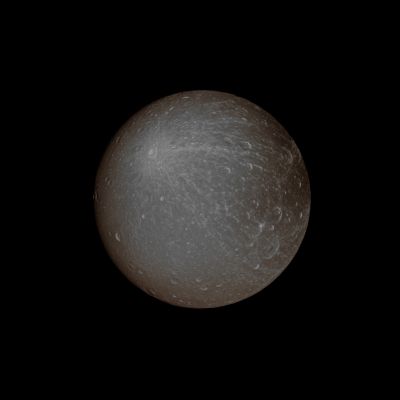
Large Rayed Crater on Dione (Absolute Natural Colors; credits for the additional process. and color.: Dr Paolo C. Fienga/Lunar Explorer Italia/Italian Planetary Foundation)
The NASA - Cassini Spacecraft looks at an example of a Rayed Crater located on the Leading Hemisphere of the Saturnian moon Dione. The Rayed Crater is in the upper-left of the image and its Rays (made by Ejecta ---> such as by Rocky Material, belonging to Dione, that was lifted up and thrown away in every direction at the time of the Impact) show up as brighter material ("brighter" if compared to the Albedo of the Surface that surrounds it) which emanates from the Crater itself. 
This view, as we said hereabove, looks toward the Leading Hemisphere of Dione (which is approx. 700 miles, such as about 1125 kilometers across). North on Dione is up and rotated 12 degrees to the left. The image was taken in Visible Light with the NASA - Cassini Spacecraft Narrow-Angle Camera on July 23, 2012. The view was acquired at a distance of approximately 260.000 miles (such as about 418.000 kilometers) from Dione and at a Sun-Dione-Spacecraft (or Phase) Angle of 5°. Image scale is about 2 miles (such as a little more than 3 kilometers) per pixel.
This frame (which is an Original NASA - Cassini Spacecraft image published on the NASA - Planetary Photojournal with the ID n. PIA 14628) has been additionally processed and then colorized in Absolute Natural Colors (such as the colors that a human eye would actually perceive if someone were onboard the NASA - Cassini Spacecraft and then looked outside, towards the Saturnian moon Dione), by using an original technique created - and, in time, dramatically improved - by the Lunar Explorer Italia Team. Different colors, as well as different shades of the same color, mean, among others, the existence of different Elements present on the Surface of Dione, each having a different Albedo (---> Reflectivity) and Chemical Composition.
Parole chiave: Saturnian Moons - Dione

Large Rayed Crater on Dione (Absolute Natural Colors; credits for the additional process. and color.: Dr Paolo C. Fienga/Lunar Explorer Italia/Italian Planetary Foundation)

The NASA - Cassini Spacecraft looks at an example of a Rayed Crater located on the Leading Hemisphere of the Saturnian moon Dione. The Rayed Crater is in the upper-left of the image and its Rays (made by Ejecta ---> such as by Rocky Material, belonging to Dione, that was lifted up and thrown away in every direction at the time of the Impact) show up as brighter material ("brighter" if compared to the Albedo of the Surface that surrounds it) which emanates from the Crater itself.
This view, as we said hereabove, looks toward the Leading Hemisphere of Dione (which is approx. 700 miles, such as about 1125 kilometers across). North on Dione is up and rotated 12 degrees to the left. The image was taken in Visible Light with the NASA - Cassini Spacecraft Narrow-Angle Camera on July 23, 2012. The view was acquired at a distance of approximately 260.000 miles (such as about 418.000 kilometers) from Dione and at a Sun-Dione-Spacecraft (or Phase) Angle of 5°. Image scale is about 2 miles (such as a little more than 3 kilometers) per pixel.
This frame (which is an Original NASA - Cassini Spacecraft image published on the NASA - Planetary Photojournal with the ID n. PIA 14628) has been additionally processed and then colorized in Absolute Natural Colors (such as the colors that a human eye would actually perceive if someone were onboard the NASA - Cassini Spacecraft and then looked outside, towards the Saturnian moon Dione), by using an original technique created - and, in time, dramatically improved - by the Lunar Explorer Italia Team. Different colors, as well as different shades of the same color, mean, among others, the existence of different Elements present on the Surface of Dione, each having a different Albedo (---> Reflectivity) and Chemical Composition.

Enceladus-PIA14599-PCF-LXTT-IPF.jpg Phoebe-PIA06064-PCF-LXTT-IPF-1.jpg Dione-PIA14628-PCF-LXTT-IPF.jpg The_Rings-PIA08306-PCF-LXTT-IPF.jpg Saturn-PIA09009-PCF-LXTT-IPF.jpg
Informazioni sul file
Nome del file:Dione-PIA14628-PCF-LXTT-IPF.jpg
Nome album:MareKromium / Saturn: the "Ringed Beauty" and His Moons
Valutazione (4 voti):55555(Mostra dettagli)
Parole chiave:Saturnian / Moons / - / Dione
Copyright:NASA/JPL/Space Science Institute and Dr Paolo C. Fienga - Lunar Explorer Italia/IPF per l'additional process. e la colorizzazione del frame
Dimensione del file:283 KiB
Data di inserimento:Ott 24, 2012
Dimensioni:3000 x 3000 pixels
Visualizzato:89 volte
URL:https://www.lunexit.it/gallery/displayimage.php?pid=30864
Preferiti:Aggiungi ai preferiti

Commento 1 a 3 di 3
Pagina: 1

Anakin   [Ott 25, 2012 at 03:53 PM]
Certo che la sonda Cassini, è un altro mostro di funzionalità. E' in giro da 14 anni
paolocf1963   [Ott 26, 2012 at 02:58 PM]
...e che dire, allora, delle Sonde Voyager, che mandano ancora segnali?!?... E' incredibile: facevamo "Miracoli" già dalla fine degli Anni '60, e adesso, nel 2012, non riusciamo a mandare un "Pioniere" sulla Luna! bah....
Anakin   [Ott 26, 2012 at 03:58 PM]
Ma infatti credo che faccia più notizia la funzionalità della sonda Cassini che quella del Voyager. Fino ai primi anni 80 eravamo stati abitutati ad un livello di tecnologia, o forse preparazione, superiore. Poi le cose sono cambiate

Commento 1 a 3 di 3
Pagina: 1


Powered by Coppermine Photo Gallery