Inizio Registrati Login

Elenco album Ultimi arrivi Ultimi commenti Più viste Più votate Preferiti Cerca

Inizio > SOLAR SYSTEM > Saturn: the "Ringed Beauty" and His Moons
Ritorna alla pagina delle miniature FILE 53/2245 Torna all'inizio Guarda foto precedente Guarda foto successiva Salta alla fine
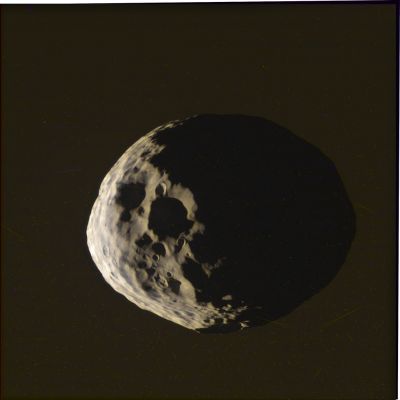
Janus (RAW Natural Colors; credits for the additional process. and color.: Elisabetta Bonora and Marco Faccin - Lunexit Team)
Janus - apparently, and according to our Readers, one of the most interesting Celestial Bodies that we have shown and talked about on our APOD in the past - is one of the so-called "Inner Natural Satellites" of the Giant Gas-Planet Saturn; it is also called and known, sometimes, as Saturn X, and it occupies (better yet: shares) the same orbit as the Saturnian Inner Minor moon Epimetheus. This (now we know NOT infrequent) circumstance, however caused, in the past, some confusion to many astronomers which, at the time of Janus' discovery - and according to their different observations - assumed that there should have been only one Celestial Body in the orbit where Janus was spotted. 
For a long time, in fact, the Astronomical Community struggled to figure out what was going on, until they realized that what they were trying to solve, was (let us use this expression) an "impossible equation": in other words, they were trying to reconcile (so-called "reductio ad unum")  different observations of different and distinct Objects, on the wrong assumption that what they all were looking at, was just a single Celestial Body.
The discovery of Janus is attributed to its first observer, such as the French Astronomer Audouin Dollfus, who spotted Janus on December 15, 1966. The newly discovered Object was given the temporary designation of "S/1966 S 2". Previously, though, another Astronomer (Jean Texereau) had also photographed the very same Celestial Body (to be exact, on October 29, 1966), but without realizing the discovery! On December 18 of the same year, then, Richard Walker made a similar observation which is now credited as the discovery of Epimetheus.

Twelve years later, in October 1978, Stephen M. Larson and John W. Fountain finally realized that the 1966 observations would have been better explained by assuming that they were relative NOT to one, BUT to two distinct Objects (as we said, Janus and Epimetheus), sharing very similar (or perhaps the same, as we know now) orbits. Finally, in the AD 1980, the NASA - Voyager 1 Spacecraft confirmed that this "controversial moon" was, in fact, a couple of co-orbital Celestial Bodies. 
Afterwards, Janus was observed on other occasions and given different provisional designations. It was observed, for instance, by the NASA - Pioneer 11 Probe when it passed near Saturn on September 1st, 1979. Janus was also observed by Dan Pascu on February 19, 1980 (and then provisionally designed as "S/1980 S 1") and then by John W. Fountain (once again), Stephen M. Larson (again), Harold J. Reitsema and Bradford A. Smith on the 23rd (and, this time, the observed object was, always provisionally, recorded as "S/1980 S 2"). 
All these Scientists, in a way and in the end, should therefore share, to various degrees, the title of Discoverer of Janus, but this "fair dispute", so far (and as far as we know), has not been solved. 

As far as the physical characteristics of Janus are concerned, we can say that this relatively small moon (whose dimensions are approx. 203 × 185 × 153 Km) is extensively cratered, and a few of these craters are more than 30 Km across. The Janian Surface, as we already wrote in the past, appears to be older than Prometheus' one, but younger than Pandora's. Furthermore, if you consideri its oval (or, if you prefer, its "non-spherical") shape, its (very) low Density and relatively high Albedo, it seems logic to conclude, for the time being, that Janus should just be a porous and icy "rubble pile" (such as the final result of a cloud of Cosmic Debris that have coalesced under the influence of gravity). 

The so-called Rubble Piles-type Celestial Bodies have a low density because there are, we believe, large cavities between the various "chunks" - such as fragments - of rocky material that made them up; Rubble Piles may also form when an Asteroid or a moon (which may originally be monolithic - such as "one single piece of rock") is smashed by an impact, and the shattered pieces left over by the impact, in time, fall back together, primarily due to self-gravitation (---> mutual attraction). In other words: a Celestial Body like Janus is formed, in our opinion, by a mass of different materials that cohered over time (we repeat: something like a "cloud" of Cosmic Debris - rocks, boulders, dust etc. - which, in time, due to a mutual gravitational attraction, got together until they became one - yet extremely fragile - Celestial Body). 
In the light of the above considerations and assumptions, we, as IPF, believe that Janus can reasonably be assimilated, for instance (and among others), to Asteroid 25143 Itokawa or 433 Eros.
Parole chiave: Saturnian Moons - Janus

Janus (RAW Natural Colors; credits for the additional process. and color.: Elisabetta Bonora and Marco Faccin - Lunexit Team)

Janus - apparently, and according to our Readers, one of the most interesting Celestial Bodies that we have shown and talked about on our APOD in the past - is one of the so-called "Inner Natural Satellites" of the Giant Gas-Planet Saturn; it is also called and known, sometimes, as Saturn X, and it occupies (better yet: shares) the same orbit as the Saturnian Inner Minor moon Epimetheus. This (now we know NOT infrequent) circumstance, however caused, in the past, some confusion to many astronomers which, at the time of Janus' discovery - and according to their different observations - assumed that there should have been only one Celestial Body in the orbit where Janus was spotted.
For a long time, in fact, the Astronomical Community struggled to figure out what was going on, until they realized that what they were trying to solve, was (let us use this expression) an "impossible equation": in other words, they were trying to reconcile (so-called "reductio ad unum") different observations of different and distinct Objects, on the wrong assumption that what they all were looking at, was just a single Celestial Body.
The discovery of Janus is attributed to its first observer, such as the French Astronomer Audouin Dollfus, who spotted Janus on December 15, 1966. The newly discovered Object was given the temporary designation of "S/1966 S 2". Previously, though, another Astronomer (Jean Texereau) had also photographed the very same Celestial Body (to be exact, on October 29, 1966), but without realizing the discovery! On December 18 of the same year, then, Richard Walker made a similar observation which is now credited as the discovery of Epimetheus.

Twelve years later, in October 1978, Stephen M. Larson and John W. Fountain finally realized that the 1966 observations would have been better explained by assuming that they were relative NOT to one, BUT to two distinct Objects (as we said, Janus and Epimetheus), sharing very similar (or perhaps the same, as we know now) orbits. Finally, in the AD 1980, the NASA - Voyager 1 Spacecraft confirmed that this "controversial moon" was, in fact, a couple of co-orbital Celestial Bodies.
Afterwards, Janus was observed on other occasions and given different provisional designations. It was observed, for instance, by the NASA - Pioneer 11 Probe when it passed near Saturn on September 1st, 1979. Janus was also observed by Dan Pascu on February 19, 1980 (and then provisionally designed as "S/1980 S 1") and then by John W. Fountain (once again), Stephen M. Larson (again), Harold J. Reitsema and Bradford A. Smith on the 23rd (and, this time, the observed object was, always provisionally, recorded as "S/1980 S 2").
All these Scientists, in a way and in the end, should therefore share, to various degrees, the title of Discoverer of Janus, but this "fair dispute", so far (and as far as we know), has not been solved.

As far as the physical characteristics of Janus are concerned, we can say that this relatively small moon (whose dimensions are approx. 203 × 185 × 153 Km) is extensively cratered, and a few of these craters are more than 30 Km across. The Janian Surface, as we already wrote in the past, appears to be older than Prometheus' one, but younger than Pandora's. Furthermore, if you consideri its oval (or, if you prefer, its "non-spherical") shape, its (very) low Density and relatively high Albedo, it seems logic to conclude, for the time being, that Janus should just be a porous and icy "rubble pile" (such as the final result of a cloud of Cosmic Debris that have coalesced under the influence of gravity).

The so-called Rubble Piles-type Celestial Bodies have a low density because there are, we believe, large cavities between the various "chunks" - such as fragments - of rocky material that made them up; Rubble Piles may also form when an Asteroid or a moon (which may originally be monolithic - such as "one single piece of rock") is smashed by an impact, and the shattered pieces left over by the impact, in time, fall back together, primarily due to self-gravitation (---> mutual attraction). In other words: a Celestial Body like Janus is formed, in our opinion, by a mass of different materials that cohered over time (we repeat: something like a "cloud" of Cosmic Debris - rocks, boulders, dust etc. - which, in time, due to a mutual gravitational attraction, got together until they became one - yet extremely fragile - Celestial Body).
In the light of the above considerations and assumptions, we, as IPF, believe that Janus can reasonably be assimilated, for instance (and among others), to Asteroid 25143 Itokawa or 433 Eros.

Rhea-PIA14605-PCF-LXTT-IPF.jpg Saturn_and_Friends-EB-MF-LXTT.jpg Janus-MF-EB-LXTT.jpg Enceladus-N00185224_to_N00185282-EB-MF-LXTT-IPF.gif Enceladus-N00185279-82_-_cl1cl2,bl1,red,ir1,ir3_filter-EB-MF-LXTT-IPF.jpg
Informazioni sul file
Nome del file:Janus-MF-EB-LXTT.jpg
Nome album:MareKromium / Saturn: the "Ringed Beauty" and His Moons
Valutazione (5 voti):55555(Mostra dettagli)
Parole chiave:Saturnian / Moons / - / Janus
Copyright:NASA/JPL/Space Science Institute and Elisabetta Bonora with Marco Faccin for the additional process. and color.
Dimensione del file:247 KiB
Data di inserimento:Apr 23, 2012
Dimensioni:1024 x 1022 pixels
Visualizzato:146 volte
URL:https://www.lunexit.it/gallery/displayimage.php?pid=30673
Preferiti:Aggiungi ai preferiti

Commento 1 a 6 di 6
Pagina: 1

Anakin   [Apr 24, 2012 at 08:35 AM]
mah!...

http : / / www . space . com /15395 - asteroid- mining- planetary- resources . html
paolocf1963   [Apr 24, 2012 at 09:42 AM]
Non riesco a connettermi, ma non appena ho letto "mining" (ossìa impiego di un oggetto a scopo di ricerca e sfruttamento minerario), ho avuto l'impressione che si tratti della solita bufalazza, che diventerà (semmai lo diventerà) realtà fra un millennio...
Anakin   [Apr 24, 2012 at 11:15 AM]
sì, vorrebbero creare delle sonde particolari capaci di inglobare gli asteroidi di piccole dimensioni vaganti nel sistema solare, ricchi di platino, per poi riportarli sulla terra e avere così grandi quantità di quel materiale...
paolocf1963   [Apr 24, 2012 at 11:27 AM]
...Si, va bene, ho capito. Ne riparliamo - visti i tempi che corrono e salvo, dunque, l'occorrere di "n" Miracoli - tra un mezzo millennio (minimo). Abbraccione Circolare! paolo
Gianluigi   [Apr 24, 2012 at 11:27 AM]
Tutto sto sbattimento per il platino, rispetto ad altre materie recuperabili, mi sembra tipico di una metodologia affetta da un altro elemento molto presente sulla Terra… lo stronzio.
Come stronzianite (altro nostro tipico elemento) mi sembrano queste notizie…
Boh… ora aspettiamo di tirar giù Caduceos e poi vediamo…
paolocf1963   [Apr 24, 2012 at 12:00 PM]
Ahahahahahahahahah!!! MITICO BIG "G"!!!!! Massì, tiriamo giù quel che capita, anche due o tre imprecazioni, e poi vediamo se, come temevano i Galli (parlo di Asterix ed Obelix, ovviamente), "Il Cielo ci cadrà sulla testa"!!!! Abbraccio Forte (e senza Stronzio)! paolo

Commento 1 a 6 di 6
Pagina: 1


Powered by Coppermine Photo Gallery