Inizio Registrati Login

Elenco album Ultimi arrivi Ultimi commenti Più viste Più votate Preferiti Cerca

Inizio > DEEP SKY > Deep Sky Objects
Ritorna alla pagina delle miniature FILE 33/1036 Torna all'inizio Guarda foto precedente Guarda foto successiva Salta alla fine
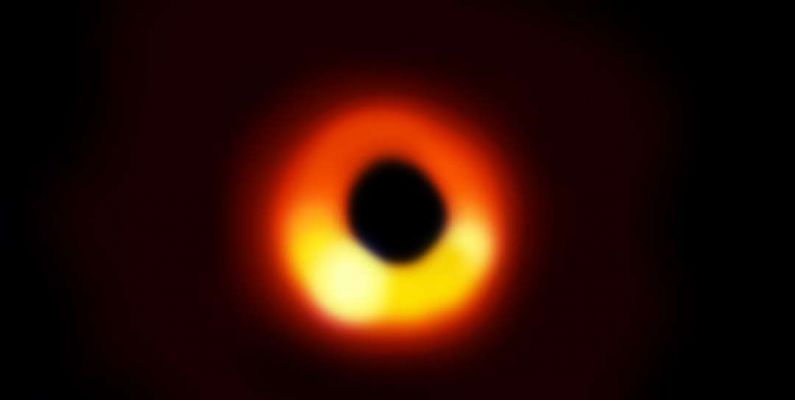
Black Hole in the "Heart" of M 87
The first image of a black hole, previously thought nigh impossible to capture, was named the top scientific breakthrough of 2019 by the journal "Science".

Black holes have gravitational pulls so powerful that, past thresholds known as their event horizons, nothing can escape, not even light. Supermassive black holes millions to billions of times the mass of our sun are thought to lurk in the hearts of virtually every large galaxy, influencing the fate of every star caught in their gravitational thrall.

Using Albert Einstein's theory of general relativity, German physicist Karl Schwarzschild was the first to lay the foundation of the science describing black holes. In the decades since then, scientists have detected numerous signs of black holes, such as the effects their gravity have on their surroundings and the ripples in the fabric of space and time known as gravitational waves emitted when they collide.
Parole chiave: Black Hole

Black Hole in the "Heart" of M 87

The first image of a black hole, previously thought nigh impossible to capture, was named the top scientific breakthrough of 2019 by the journal "Science".

Black holes have gravitational pulls so powerful that, past thresholds known as their event horizons, nothing can escape, not even light. Supermassive black holes millions to billions of times the mass of our sun are thought to lurk in the hearts of virtually every large galaxy, influencing the fate of every star caught in their gravitational thrall.

Using Albert Einstein's theory of general relativity, German physicist Karl Schwarzschild was the first to lay the foundation of the science describing black holes. In the decades since then, scientists have detected numerous signs of black holes, such as the effects their gravity have on their surroundings and the ripples in the fabric of space and time known as gravitational waves emitted when they collide.

IC-1396~4.jpg Black_Hole-M_87.jpg Black_Hole-BB13U1YE.jpg NGC-1333~2.jpg Gravitational_Lensing.gif
Informazioni sul file
Nome del file:Black_Hole-BB13U1YE.jpg
Nome album:MareKromium / Deep Sky Objects
Valutazione (5 voti):55555(Mostra dettagli)
Parole chiave:Black / Hole
Copyright:Event Horizon Telescope
Dimensione del file:15 KiB
Data di inserimento:Mag 20, 2020
Dimensioni:1080 x 543 pixels
Visualizzato:180 volte
URL:https://www.lunexit.it/gallery/displayimage.php?pid=31408
Preferiti:Aggiungi ai preferiti

Commento 1 a 4 di 4
Pagina: 1

Anakin   [Giu 24, 2020 at 09:20 AM]
Peccato non averne uno a "pochi passi"
MareKromium   [Giu 24, 2020 at 05:35 PM]
...Già, sarebbe fantastico... E non scherzo!
Anakin   [Giu 24, 2020 at 08:28 PM]
Ci credo. Basterebbe una distanza di 10/15 anni luce per stare quasi in prima fila a gustarci l'orizzonte degli eventi.
MareKromium   [Giu 26, 2020 at 04:22 PM]
Non oso immaginare lo Spettacolo!!!... ;-)

Commento 1 a 4 di 4
Pagina: 1


Powered by Coppermine Photo Gallery