|
|
Does Titan have a so-called "weather-pattern"?
|
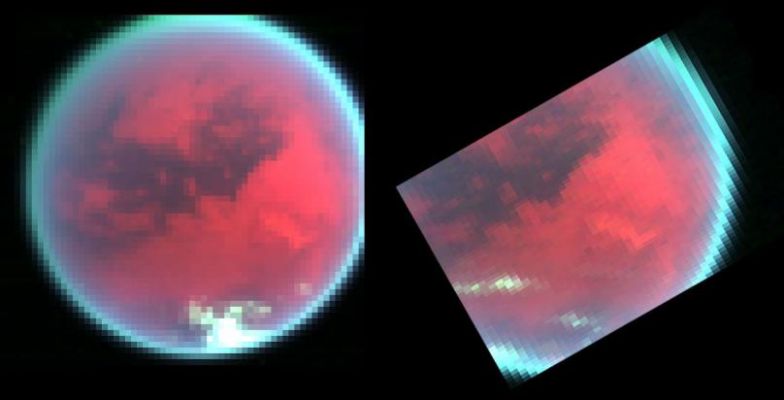
In the first image (left), obtained on the 1st Titan flyby, from a distance of 200.000 Km, Titan's skies are cloud-free, except for a patch of clouds observed over the South Pole near the bottom of the image. In contrast, the image on the right shows a recent view of this same area of Titan obtained 7 weeks later on the 2nd close Titan flyby, from a distance of 225.000 Km. This image clearly shows that several extensive patches of clouds have formed over temperate latitudes. The appearance of these clouds reveals the existence of weather. Tracking these features is currently underway by scientists, who hope to gain a better understanding of global circulation, regional weather patterns and localized meteorology in Titan's skies. The red color images the surface at a wavelength (2.01 micron) where the surface is relatively bright, making the surface appear reddish in these color images. The green color (2.83 micron) images the surface as well, but due to enhanced absorption of sunlight by the surface and lower atmosphere, the surface is relatively dark here compared to the red. The blue color (2.13 micron) is at a wavelength where sunlight cannot reach the surface at all due to strong absorption by the atmospheric gas methane. In contrast to the reddish surface, bright clouds at a relatively high altitude (here, about 30 kilometers (19 miles) above the ground) residing above most of the atmospheric absorption appear whitish in these representations, as they reflect sunlight effectively in all three near-infrared colors.
|
|