|
|
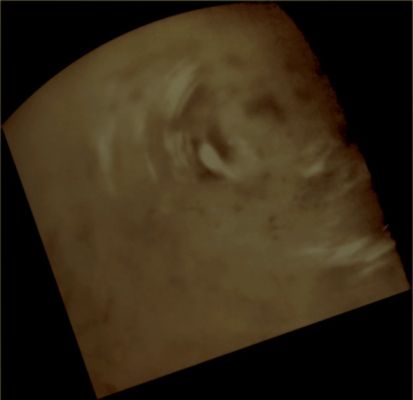
North Polar Clouds (Absolute Natural Colors; credits for the additional process. and color.: Dr Paolo C. Fienga - Lunexit Team)
|
Caption NASA:"Clouds move above Titan's large Methane Lakes and Seas near the Planet's North Pole. Methane Clouds in the Troposphere, such as the lowest part of the Atmosphere, appear white here and are moving East over several of Titan's large Northern Lakes. The darkest areas are Lakes and Seas of liquid Methane, identifiable because they have a low albedo, meaning they do not reflect much light (the difference in brightness and darkness on the Surface here indicates a difference in its composition).
The clouds seen near Lakes and Seas suggest that Titan may have "Lake-effect" Clouds created by weather systems over large bodies of liquid.
However, without earlier observations to show the Clouds did not originate West of the large Sea "Kraken Mare", scientists cannot determine conclusively if these clouds are really "Lake-effect" Clouds.
If full, Kraken Mare, at about 400.000 square Km (248.400 square miles), would be almost five times the size of North America's Lake Superior.
Even if these Clouds are not directly connected to the Lakes and Seas, scientists think that frequent detections of Clouds at High Northern Latitudes since 2007 are related to the abundant availability of Methane at the Surface in this Region.
This view is centered on Terrain at 49° North Latitude and 179° West Longitude. The North Pole is near the upper right. The Clouds are visible above Terrain at about 60 to 82° North Latitude and 220 to 260° West Longitude. Scientists calculate wind speeds from about 0,5 to about 10 meters per second (such as from about 1 to 22 miles per hour), based on tracking of individual cloud features in different images.
Other Cassini observations of Clouds in Titan's Southern Latitudes provide evidence of a Seasonal Shift of Titan's Weather Systems to low Latitudes from higher, South Polar Latitudes following the August 2009 Equinox in the Saturnian System.
This image was taken with the Cassini Spacecraft narrow-angle camera using a spectral filter sensitive to wavelengths of Near-InfraRed Light centered at 938 nanometers. The view was obtained at a range of distances from approx. 406.000 Km (such as 252.126 miles) to approx. 796.000 Km (such as 494.316 miles) from Titan.
Scale is about 2 Km (1,242 miles) per pixel".
|
|