Inizio Registrati Login

Elenco album Ultimi arrivi Ultimi commenti Più viste Più votate Preferiti Cerca

Inizio > SOLAR SYSTEM > Titan: The "Foggy" Moon
Ritorna alla pagina delle miniature FILE 168/426 Torna all'inizio Guarda foto precedente Guarda foto successiva Salta alla fine
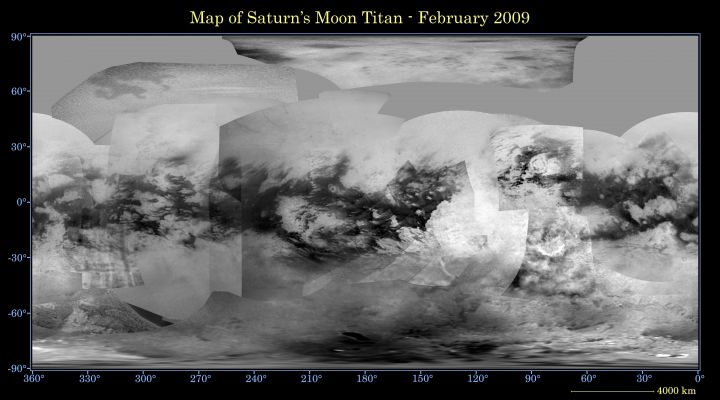
Titan's Global Digital Map (credits: NASA/JPL/Space Science Institute)
This Global Digital Map of Saturn's moon Titan was created using images taken by the Cassini Spacecraft's Imaging Science Subsystem. 
The images were taken using a filter centered at 938 nanometers, allowing researchers to examine variations in albedo (or inherent brightness) across the Surface of Titan. Because of the scattering of light by Titan's dense Atmosphere, no topographic shading is visible in these images.
The map is an equidistant projection and has a scale of 4 Km (about 2,5 miles) per pixel. Actual resolution varies greatly across the map, with the best coverage (close to the map scale) near the center and edges of the map and the worst coverage on the Leading Hemisphere (centered around 120° West Long.). 
Imaging coverage in the Northern Polar Region continues to improve as Titan approaches northern vernal equinox in August 2009 and the North Pole comes out of shadow. Large dark areas, strongly suspected to be liquid-hydrocarbon-filled lakes, have been documented at high at high latitudes (see PIA11146). 

The mean radius of Titan used for projection of this map is 2,575 kilometers (1,600 miles). Until a control network is created for Titan, the satellite is assumed to be spherical. 

Parole chiave: Maps

Titan's Global Digital Map (credits: NASA/JPL/Space Science Institute)

This Global Digital Map of Saturn's moon Titan was created using images taken by the Cassini Spacecraft's Imaging Science Subsystem.
The images were taken using a filter centered at 938 nanometers, allowing researchers to examine variations in albedo (or inherent brightness) across the Surface of Titan. Because of the scattering of light by Titan's dense Atmosphere, no topographic shading is visible in these images.
The map is an equidistant projection and has a scale of 4 Km (about 2,5 miles) per pixel. Actual resolution varies greatly across the map, with the best coverage (close to the map scale) near the center and edges of the map and the worst coverage on the Leading Hemisphere (centered around 120° West Long.).
Imaging coverage in the Northern Polar Region continues to improve as Titan approaches northern vernal equinox in August 2009 and the North Pole comes out of shadow. Large dark areas, strongly suspected to be liquid-hydrocarbon-filled lakes, have been documented at high at high latitudes (see PIA11146).

The mean radius of Titan used for projection of this map is 2,575 kilometers (1,600 miles). Until a control network is created for Titan, the satellite is assumed to be spherical.

Titan-N00081033.jpg Titan-N00051470.gif Titan-Map-PIA11149.jpg Titan-Map-Wind_Patterns-PIA11801.jpg Titan-Dunes-PIA11802.jpg
Informazioni sul file
Nome del file:Titan-Map-PIA11149.jpg
Nome album:MareKromium / Titan: The "Foggy" Moon
Valutazione (3 voti):55555(Mostra dettagli)
Parole chiave:Maps
Copyright:NASA/JPL/Space Science Institute
Dimensione del file:865 KiB
Data di inserimento:Feb 27, 2009
Dimensioni:4374 x 2430 pixels
Visualizzato:58 volte
URL:https://www.lunexit.it/gallery/displayimage.php?pid=23762
Preferiti:Aggiungi ai preferiti


Powered by Coppermine Photo Gallery